Budget 2026 · Scotland
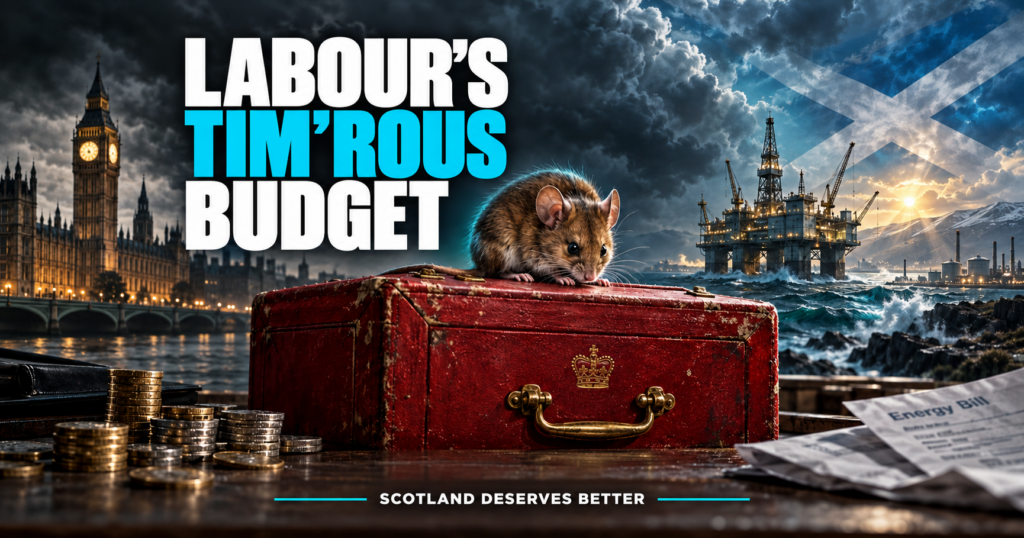
Labour’s sleekit, cowrin, tim’rous Budget
Britain is broke, and Labour’s Budget did nothing about it
Borrowing is up, growth is down and the hard choices have been kicked down the road. Here is what John Healey’s Budget means for your pay, your business and Scotland’s energy industry, and what Reform would do instead.
- Extra borrowing since March, over five years
- £65bn
- Economic growth forecast for 2027
- 1.0%
- Real household income per person in 2026
- −0.8%
- Debt interest a year by 2027-28
- £155bn
- Reform’s permanent cut to a typical energy bill
- £250
A timid Budget for a country that is broke
Reform UK needed one word for John Healey’s first Budget: timid. Nigel Farage put the problem as plainly as it can be put. “We are in a deep financial hole. Britain is broke.” Robert Jenrick, Reform’s Shadow Chancellor, called it a “do nothing” Budget and a “nothing burger”.
You do not have to take Reform’s word for it. The Treasury’s own tables make the case. Government borrowing this year is £17.7 billion higher than the Office for Budget Responsibility expected only seven months ago, and £65 billion higher across five years. Growth slows to 1.0% next year. Real household income per person falls this year. Business investment stalls and then shrinks. By 2027-28 the country will be spending £155 billion a year just on the interest on its debts, more than it spends on education and far more than it spends on defence.
Faced with all that, the Chancellor gave us what Burns might have called a wee, sleekit, cowrin, tim’rous Budget. Sleekit, because the real tax rise is hidden in a frozen allowance and the small print. Cowrin, because the bigger bills, on pensions, on welfare and on public spending, were pushed years down the road. What was left was a £100 payment to some households in England, a few more months of the fuel duty cut and a VAT cut on electricity that runs out next July. Paul Johnson, the former head of the Institute for Fiscal Studies, summed it up: “The real story of this Budget is the can being kicked down the road.”
For Scotland the picture is sharper still. Scots already pay more income tax than anyone else in the UK once they earn more than about £33,500. This Budget leaves the tax-free allowance frozen, keeps the windfall tax on the North Sea, and hands HMRC a wider power to take money from your bank account. Here is what it means for you, and what Reform would do differently.
What it means for working people in Scotland
The tax rise you never voted for
The Treasury’s headline is that the Budget “rejects broad-based tax rises”. Income tax, National Insurance and VAT rates are all unchanged. What it does not dwell on is that the tax-free Personal Allowance stays frozen at £12,570, where earlier Budgets fixed it until 2030-31.
A frozen allowance is a quiet tax rise. When your pay goes up to keep pace with prices, the thresholds stay put. More of every pound is taxed, and more people are pulled into higher bands. You are no better off in real terms, yet you hand more to the Treasury.
In Scotland it bites harder, because Holyrood’s 42% higher rate starts at £43,663, more than £6,500 below the point where the higher rate begins in England. Picture a nurse, an engineer or a police sergeant on £43,000 who gets a 3% pay rise. Of the £1,290 rise, the first £662 is taxed at 21% plus 8% National Insurance. The other £628 is taxed at 42% plus 8%. They keep about £784, or 61p in every pound. On the same salary in England, they would keep £929.
Income tax plus employee National Insurance, 2026-27 rates. Full bar is the whole £1,290 rise.
What the Budget gave you, and for how long
There is some help in the Budget, but it is small and most of it is temporary. The National Living Wage rises 3.9% to £13.21 an hour from April 2027, worth £910 a year before tax to someone working full time. After income tax and National Insurance, a Scottish worker keeps about £655 of that.
On energy, VAT on household electricity stays at zero until 1 July 2027. The Treasury reckons that takes around £50 off the annual price cap next April, and then it is gone. The £100 Household Energy Payment goes to homes in council tax bands A to D, but only in England. Scotland gets a share of the money through the Barnett formula, and it will be for the Scottish Government to decide whether Scottish households see anything like it.
Fuel duty stays 5p lower until 1 July 2027. In the Highlands, the islands and the Borders, where a car is not a choice, that matters. But it is another cliff edge, eight months away.
Tariffs come off more than 100 imported foods. The Treasury’s own figures put the saving from all its food tariff cuts at £245 million to £595 million a year. Spread across 29 million households, even the top of that range is about £20 a year. That is roughly 6p a day.
Pensioners whose income is no more than the full new State Pension will not have to pay income tax on it from April 2027. But from April 2030 the Triple Lock is being adjusted so the pension can no longer pull ahead of earnings over time. The Treasury expects that to save £15 billion a year by the late 2030s.
Savers pay more. Income tax on savings interest rises by another two points to 24%, 44% and 49% from April 2027, right across the UK. The Treasury says a basic rate taxpayer can hold more than £25,000 outside an ISA before paying tax on the interest, but that assumes a 4% rate and the £1,000 Personal Savings Allowance. It is not a fixed threshold. If interest rates rise, the tax bites sooner. The same rise on rental income applies only in England, Wales and Northern Ireland. Scottish landlords pay Scottish rates on their rent, and those are set at Holyrood.
Add it up and the forecast is grim. Inflation peaks at 3.8% early next year. Unemployment rises to 5.1%. Real household income per person falls 0.8% this year and barely moves in 2027. As Reform’s response points out, the OBR does not expect real earnings to grow at all next year. This is a Budget that asks working households to tread water.
What a Scottish pay packet looks like
Holyrood has given Scotland six income tax bands. On low pay the starter rate saves a Scottish worker a few pounds. By the middle of the scale that advantage has gone, and by £50,000 a Scot is paying almost £1,500 a year more than someone doing the same job in Carlisle.
| Salary | Scotland | Rest of the UK | A Scot pays |
|---|---|---|---|
| £25,000 | £21,559 | £21,520 | £40 less |
| £35,000 | £28,705 | £28,720 | £15 more |
| £50,000 | £38,024 | £39,520 | £1,496 more |
Scottish bands: starter 19% to £16,537, basic 20% to £29,526, intermediate 21% to £43,662, higher 42% above that. Employee National Insurance is the same in both.
Reform’s alternative: keep more of what you earn
Reform’s plan works through both parliaments, and it is worth being clear about which does what.
At Westminster, Reform’s Economic Rescue Plan lifts the Personal Allowance from £12,570 to £15,000. Reform says that gives most taxpayers a £486 tax cut and takes 2.9 million people out of income tax altogether. The allowance is set in London and covers every Scottish taxpayer. For a Scot the exact gain depends on the bands Holyrood sets above it: if they stayed where they are, the extra £2,430 tax-free would come out of the 19% band, worth about £462 a year. Reform’s longer aim is a £20,000 allowance, as the public finances allow.
The Hard Work Bonus would mean no income tax on overtime beyond a 40 hour week for anyone earning under £75,000, from the plan’s second tax year. Reform’s example is a warehouse worker doing six hours of overtime a week, who would keep about £700 a year more. On energy, Reform would take £250 a year off a typical bill for good, by scrapping carbon taxes on power, moving green levies off bills and onto the Treasury, and taking VAT off household gas and electricity. The 5p fuel duty cut would become permanent instead of ending next summer.
At Holyrood, Reform UK Scotland’s manifesto would scrap Scotland’s six bands and replace them with the same three used in the rest of the UK, each set 1p lower, with the aim of reaching 3p lower within five years.
Westminster: £15,000 allowanceHolyrood: three bands, 1p lower
Our arithmetic on Reform’s published pledges, against 2026-27 Scottish rates. The Westminster gain is £462 at each salary if Holyrood’s thresholds stay as they are. The Holyrood gain is £85, £239 and £1,870. Reform has not published a combined Scottish figure.
Decided at Westminster
- The tax-free Personal Allowance
- National Insurance and VAT
- Tax on savings and dividends
- Energy bill levies and VAT on energy
- Fuel duty and the State Pension
Decided at Holyrood
- Scottish income tax rates and bands
- Tax on rental income for Scottish landlords
- Business rates and Land and Buildings Transaction Tax
- Whether Scots get an equivalent of the £100 payment
- Scottish disability and carer benefits
| Measure | Labour’s Budget | Reform’s plan | Who delivers |
|---|---|---|---|
| Tax-free allowance | Frozen at £12,570 | £15,000, aiming for £20,000 | Westminster |
| Scottish income tax | Not addressed | Three bands, 1p below the rest of the UK, then 3p | Holyrood |
| Overtime | Taxed as normal | No income tax above 40 hours for those under £75,000 | Westminster |
| Energy bills | About £50 off until July 2027; £100 one-off in England | £250 a year off, permanently | Westminster |
| Fuel duty | 5p cut until 1 July 2027 | 5p cut made permanent | Westminster |
| Pensions | Triple Lock adjusted from April 2030 | Triple Lock kept this Parliament and next | Westminster |
Sources: Budget 2026 paragraphs 1.29, 3.4, 3.5 and 3.13; Reform UK, Economic Rescue Plan, pages 13 to 16 and 32; Reform UK Scotland, Manifesto for Scotland 2026, pages 5 to 6.
What it means for small and medium businesses
Small firms create most of the new jobs in this country. There are 5.7 million of them across the UK, employing 16.9 million people. This Budget offers them very little that lasts and several things that cost.
The Treasury’s own forecast has business investment flat this year and falling next year. Labour’s rise in employer National Insurance to 15%, with the threshold cut to £5,000, stays exactly where it is. In its place come targeted grants: the £3,000 Youth Jobs Grant announced in the spring, and a £2,000 payment for small firms that take on young apprentices in England. Grants help at the margin. They do not change what it costs to hire the next person.
Less reward for building a business
Business Asset Disposal Relief is the lower rate of capital gains tax an owner pays when they sell or hand on a firm. From April 2027 its lifetime limit is halved, from £1 million to £500,000. The Treasury says three quarters of claimants will still get relief on their whole gain. For founders whose gains go over £500,000, more of the reward for years of risk will now face the full rate of capital gains tax.
Capital allowances get a reshuffle. Relief in the first year on new investment rises from 40% to 50%, but the main writing-down allowance falls from 14% to 12%. It is sold as an incentive to invest. Taken together, it raises more than £1 billion a year from business by 2029-30. Family farms and family firms get no relief from the inheritance tax caps Labour brought in. Reform estimates about 1,100 families a year face a bigger bill, averaging £273,000 each.
Pay sooner, pay by direct debit, and HMRC can help itself
The changes that will hit the self-employed hardest were tucked away at the back of the Budget. From April 2029, anyone who makes self-assessment payments on account will have to pay more of their bill during the year it is earned, rather than in January and July. Every business that pays VAT or PAYE will have to hand HMRC a direct debit, which it will use to collect anything left unpaid. VAT invoices will have to be issued in a set electronic format.
HMRC can already take larger tax debts straight from bank accounts, under existing rules. From July 2029 the Budget goes further, with a new power to take smaller debts in regular instalments from people and companies it judges can afford to pay but “repeatedly fail to do so”. The safeguards have not been written yet. They will come later, in a Code of Practice. On top of that the government will spend another £70 million on private debt collectors and hire 670 more compliance officers.
About £6 billion in all. Source: Budget 2026, Table 6.3.
Making Tax Digital carries on. People who join in April 2027 will not get penalty points for missing their first four quarterly updates, and the rollout to some groups has been put off “until further notice”. The quarterly reporting itself stays.
Taken one at a time, each of these looks small. Put them together and the direction is plain. A self-employed joiner in Fife or a café owner in Perth will be asked to report every quarter, pay earlier, pay by direct debit, and accept that HMRC can reach into their account if it decides they owe. Cash and power move from the business to the taxman.
Devolved
In Scotland, Holyrood sets your business rates
The Budget’s extra 20% off rates for pubs and music venues, wider relief for 70,000 more shops and hospitality firms, and the freeze for everyone else all apply in England only. Scotland gets its Barnett share instead. From every Budget decision combined, the Scottish Government receives £600 million extra over the whole Spending Review period. That is not £600 million a year, and none of it is set aside for business rates. Whether a pub in Paisley sees a penny depends on choices made in Edinburgh.
Reform’s alternative: make it cheaper to hire and easier to grow
Reform would cut employer National Insurance from 15% back to 13.8% for British workers, paid for by a new levy on employers who hire migrant labour, from the plan’s second tax year. For a firm with ten staff on £25,000 each, that takes the bill from about £30,000 to about £27,600 a year.
A saving of £2,400 a year, before any Employment Allowance. Threshold stays at £5,000. The lower rate applies to British workers.
The VAT threshold would rise from £90,000 to £150,000 and then rise with inflation. Reform counts 320,000 sole traders and small firms across the UK who would gain straight away, including 44,000 who hold their turnover below £90,000 today rather than add a fifth to every price. For a joiner in Inverness or a café in Peebles, that is room to grow.
Quarterly Making Tax Digital reporting would become voluntary. Labour’s Employment Rights Act would be repealed. Full relief from inheritance tax for family farms and family firms would be restored at once. Pubs would get 10% VAT and a 10% cut in duty on beer sold over the bar. Small firms that take on 16 to 18 year old apprentices would get 30% of the apprentice’s wage back as a tax credit, about £4,742 a year.
At Holyrood, Reform UK Scotland would reverse the April 2026 business rates revaluation, phase out Land and Buildings Transaction Tax, and over ten years replace both with a single annual property tax paid to local councils.
| Measure | Labour’s Budget | Reform’s plan | Who delivers |
|---|---|---|---|
| Employer National Insurance | 15%, threshold £5,000 | 13.8% for British workers | Westminster |
| VAT threshold | £90,000 | £150,000, rising with inflation | Westminster |
| Making Tax Digital | Quarterly updates continue | Quarterly reporting made voluntary | Westminster |
| HMRC bank-account power | Starts July 2029 | “Reform will fight this at every turn” | Westminster |
| Farm and family firm inheritance tax | Caps kept | Full relief restored | Westminster |
| Hiring young people | £3,000 grant; £2,000 apprentice payment in England | 30% of an apprentice’s wage back | Westminster |
| Business rates | Reliefs in England; Barnett share for Scotland | Reverse the April 2026 revaluation | Holyrood |
Sources: Budget 2026 paragraphs 2.53, 2.54, 5.22, 6.147 to 6.152 and Table 6.3; Reform UK, Economic Rescue Plan, pages 15 to 17 and 28 to 29; Reform UK, Contract with Small Business; Reform UK Scotland, Manifesto for Scotland 2026, pages 6 to 7.
What it means for Scotland’s energy
The North Sea, kept on a slow decline
The north-east needed one thing from this Budget: a reason to invest. It got a promise of stability instead. The Treasury now says oil and gas “will remain a part of our energy mix for decades to come”. Yet the Energy Profits Levy, the windfall tax on North Sea producers, stays until April 2030, and a permanent Oil and Gas Revenue Levy is already being written into law to take over the day it ends. There is still no new exploration licensing. Rosebank does not get a mention. The government points to its approval of the Jackdaw gas field as proof of good faith.
Labour
Reform
Energy Profits Levy abolished, licensing restarted, Rosebank approved
Timeline runs from today to 2032. Sources: Budget 2026 paragraph 4.35; Reform 64 point plan, points 1 to 5.
Meanwhile £2 billion goes into a new Energy Wealth Fund, linked to future North Sea revenues and spent on renewable and low-carbon projects. Put simply, the money the North Sea earns is set aside for the industries meant to replace it.
There is a sting in the carbon capture line too. The Budget backs clusters at Teesside, Merseyside and North Wales, and keeps grant funding for the Viking project in England. Scotland’s Acorn project is only told the government is “actively looking” at loans or equity.
What Scotland did get is modest: an £800 million National Wealth Fund guarantee for four grid upgrades in the north of Scotland, £12 million for the offshore wind project at Montrose Port, and £5.7 million already put into the EnergyWorks hub in Aberdeen. Great British Energy gives up £200 million and keeps £8.3 billion. For a region whose best-paid jobs depend on decisions made years in advance, a windfall tax with its successor already drafted is not stability.
Your bills: short-term help, and a catch
The VAT cut on electricity ends on 1 July 2027. The £100 payment is for England. Gas standing charges, about £108 a year on a typical bill, are to be scrapped by the end of 2027, but the cost will be moved onto the price of each unit you use. As Farage pointed out, “while low-usage households will pay less, the rest will end up paying more.” In a Scottish winter, few homes are low users. Rural homes heated by oil do get a small help, with tariffs on kerosene suspended until December 2028.
Labour: about £50 from the VAT cut, plus the one-off £100 for council tax bands A to D in England only. Reform: £250 a year off a typical bill for three years.
Reform’s alternative: produce our own energy
The first five points of Reform’s 64 point plan are about the North Sea: approve Rosebank, restart oil and gas licensing, legalise onshore exploration, abolish the Energy Profits Levy, and make maximum economic extraction the regulator’s objective again. Reform’s Economic Rescue Plan says bad policy has throttled the industry, “taking our energy security and thousands of highly-paid Scottish jobs with it”.
“If we are going to use oil and gas anyway, we should produce it ourselves.”
Reform UK, Economic Rescue Plan
Licensing at sea and the windfall tax are decided at Westminster, so this needs a Reform government there. Onshore licensing in Scotland is a Holyrood power, so lifting the block on land would need a Scottish decision as well.
Beyond oil and gas, Reform would abolish the Emissions Trading Scheme, halt the new carbon border tax, cancel the latest round of renewable subsidy contracts, carry out the Fingleton review of nuclear regulation in full, and approve proven French and South Korean reactor designs automatically. Point 30 of the plan, lifting launch limits at SaxaVord Spaceport in Shetland, is a Scottish jobs measure in its own right.
At Holyrood, Reform UK Scotland would scrap the SNP’s Net Zero targets, end the ban on new nuclear power, prepare to bring North Sea gas back into favour, draw up a Scottish Energy Workforce Plan, and require an Energy Price Impact Statement on every decision that touches bills.
Reform is honest about the sums. Its own costing shows that scrapping the windfall tax costs £1.17 billion in the first year, with extra North Sea revenue building to £670 million a year by 2031-32 as investment comes back. The case is about jobs, investment and keeping the lights on with our own gas.
| Measure | Labour’s Budget | Reform’s plan | Who delivers |
|---|---|---|---|
| Windfall tax | Kept to 2030, then a permanent levy | Abolished | Westminster |
| New licences and Rosebank | None; Rosebank not mentioned | Licensing restarted; Rosebank approved | Westminster |
| Onshore exploration | Not addressed | Legalised | Holyrood, for Scotland |
| Household bills | VAT cut to July 2027; £100 in England | £250 a year off, permanently | Westminster |
| Carbon taxes on power | Carbon Price Support ends April 2028 | Emissions Trading Scheme and Carbon Price Support scrapped | Westminster |
| Nuclear in Scotland | Not a Budget matter | Ban on new nuclear ended; SNP Net Zero targets scrapped | Holyrood |
Sources: Budget 2026 paragraphs 3.4 to 3.9, 4.25, 4.33 to 4.37, 4.145 and 4.152; Reform 64 point plan, points 1 to 10 and 30; Reform UK, Economic Rescue Plan, pages 14 to 15, 19 and 23 to 24; Reform UK Scotland, Manifesto for Scotland 2026, page 9.
What it means for the UK as a whole
The numbers the Chancellor did not lead with
Borrowing this year is forecast at £133.2 billion. In March it was meant to be £115.5 billion. In every year of the forecast the gap is there, and over five years it adds up to £65 billion of extra borrowing. Most of it goes on interest: £15.4 billion more this year alone.
March forecastOctober Budget
2026-27
2027-28
2028-29
2029-30
2030-31
Source: Budget 2026, Table 1.3 (OBR).
By 2027-28 the interest bill on the national debt will be £155 billion a year. That is more than the whole education budget, and well over half as much again as the country spends on defence. Reform’s response puts this year’s figure at £109 billion, rising to £160 billion by 2031.
Source: Budget 2026, Annex C, Chart C.2.
Debt sits at 95.5% of the size of the whole economy this year. It climbs to 97.3% and is still 95.6% at the end of the forecast. The margin the Chancellor keeps against the main borrowing rule has fallen from £23.6 billion in March to £14.5 billion, and higher interest costs alone ate £12 billion of it.
Growth down, living standards flat
Growth slows from 1.2% this year to 1.0% next year, and never gets above 1.8% across the whole forecast. Reform notes that in March the OBR expected 1.6% for 2027. Real household income per person, the best single measure of whether people are getting better off, falls this year and barely moves next year.
Source: Budget 2026, Table 1.1 (OBR).
Real household disposable income per person, after inflation. Source: Budget 2026, Table 1.1 (OBR).
Relief now, the bill later
The Budget’s own scorecard shows how it is built. This year the tax measures give away £1.6 billion. By 2028-29 they take in £2.9 billion. By 2031-32 they take in £7.0 billion a year. Add in spending, and the whole package swings from a £7.6 billion giveaway this year to a £7.4 billion squeeze by the end of the forecast. The sweeteners come first. The bill comes later.
The savings meant to make the sums add up are thin. Labour is pencilling in cuts of 2.6% a year to most public services from 2028-29. Paul Johnson’s verdict: “Pull the other one. It’s got bells on.” Welfare reform is promised in a White Paper next year. The change to the Triple Lock saves nothing until 2030. As Jenrick put it: “This Prime Minister, this Chancellor, have not been able to offer a single saving in their 100 days in office.”
Reform’s alternative: cut spending to cut taxes
Reform’s Economic Rescue Plan is built the other way round. Cut spending first, then cut taxes, and borrow less. Its costed table finds savings of £39.9 billion in the first year, rising to £67.5 billion in 2029-30 and £87.5 billion by 2031-32. Most of it comes from welfare, Net Zero subsidies, foreign aid and the size of the civil service. That is the “£40bn in the first financial year” rising to “£80bn over five years” Farage described.
On Reform’s own figures, those savings pay for every tax cut in the Economic Rescue Plan and still bring borrowing down, by £16.5 billion in 2029-30 and £28.1 billion the year after. The Holyrood pledges and the apprentice wage credit are not part of that table. Reform puts the headline at £1,300 of tax relief for households.
| Measure | Labour’s Budget | Reform’s plan |
|---|---|---|
| Approach | Short-term relief now, tax rises and restraint later | Spending cuts now pay for permanent tax cuts |
| Savings | Small efficiency and capital savings now; the real squeeze waits until 2028-29 and the Triple Lock change in 2030 | £39.9bn in year one, rising to £87.5bn |
| Welfare | A White Paper in 2027 | Over £36bn saved in 2029-30 |
| Foreign aid | Committed to returning to 0.7% of national income when finances allow, but not this Parliament | Capped at £1bn, enough for Ukraine and emergency relief, saving £5.8bn to £7.4bn a year |
| Borrowing | Up £65bn over five years since March | Down £16.5bn in 2029-30 |
| Pensions | Triple Lock adjusted from 2030 | Triple Lock kept this Parliament and next |
Reform costed its plan against the OBR’s March forecast, adjusted for higher interest rates; the Budget uses the new October forecast, so the two sets of totals cannot simply be subtracted from each other. Sources: Budget 2026 Tables 1.1 to 1.3 and 6.1, Chart 1.6; Reform UK, Economic Rescue Plan, pages 4, 20, 31 and 32.
Reform’s response
Reform’s response was quick and it was united. Nigel Farage tore into a Budget he called timid. “We are in a deep financial hole. Britain is broke,” he said. “Only a radical plan can begin to do anything about it. That’s why we’ve set out spending cuts of £40bn in the first financial year of a Reform government, rising to £80bn over five years.”
He did not pretend it would be painless. “Not everyone’s going to like it. It’s going to be tough. There’ll be protests. There’ll be upset. But Government spending has to be cut.”
On bills, he drew the line against the Chancellor’s £100. “By taking strong action, we can cut energy bills. Not just by £100 in the short-term, for certain council tax bands. But by £250, on average, permanently, in the first 100 days of being in power.”
“The British economy is broken. Only Reform have the guts to do the one thing that is needed and cut welfare spending.”
Nigel Farage
Robert Jenrick was just as blunt. “This was a ‘do nothing’ Budget. It was a nothing burger. It was a Budget that could, and should, have responded to a crisis in our country.” Then: “Britain is broke. And British people feel broke. And this was the best that the Chancellor could deliver?”
“Living standards will be down. Growth will be down. Borrowing will be up. And prices are set to rise even higher in the months and the years to come,” he said. “This isn’t even the managed decline we’ve seen in recent years. The country is going backwards.” And on Labour’s promise of savings some time later, one question: “Where are the cuts coming from!?”
Writing afterwards, Farage called the Budget “a patchwork of gimmicks, giveaways and minor tweaks”, and “one hour’s worth of one-off sticking plasters”. Of the £100 payment, he wrote: “that’ll barely touch the sides when prices rise in January.”
“Financial authoritarianism, plain and simple”
Nothing drew a sharper reaction than the plan to let HMRC take smaller debts straight from bank accounts. “HMRC can now seize money from your bank account without even having a meeting,” Farage said. “As someone who’s been de-banked, this sets a dark precedent. Reform will fight this at every turn.” In his column he went further: “It turns the presumption of innocence on its head.”
A Reform spokesman added: “This is a draconian and dystopian power grab by the Government. Once they have the power to take money from accounts, they will inevitably expand the use cases.” By the Treasury’s own figures the power raises just £320 million a year by 2031-32. That is a small sum for so large a shift in who holds the power over your money.
Why it matters for Scotland
Scots are told there is no money, and then asked to pay more. The SNP has given Scotland six income tax bands and the highest rates in the UK. Labour has frozen the allowance, kept the windfall tax on the North Sea, raised the cost of every job and now wants a direct line into your bank account. This Budget was the moment to change course, and it did nothing. Burns knew that the best laid schemes o’ mice an’ men gang aft agley. Labour’s are not even well laid. They rest on spending cuts of 2.6% a year from 2028-29 that few believe will happen, and on tax rises that arrive after the temporary help has run out. When those plans go agley, it is Scottish families who will pay.
Reform has a costed plan that cuts spending so it can cut taxes and borrowing at the same time: a bigger tax-free allowance, £250 off energy bills for good, cheaper fuel, a reopened North Sea and the jobs that come with it. At Holyrood, Reform UK Scotland would cut Scotland’s income tax below the rest of the UK and end the ban on new nuclear power. Both point the same way.
“Britain is Broke. Britain needs Reform.”