3 Key Policies
To Tackle Lawlessness
In Scotland
Communities across Scotland deserve to feel safe in their homes and on their streets. Reform UK Scotland is setting out a clear plan to back the police, restore order and put public safety first.
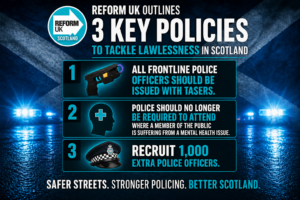
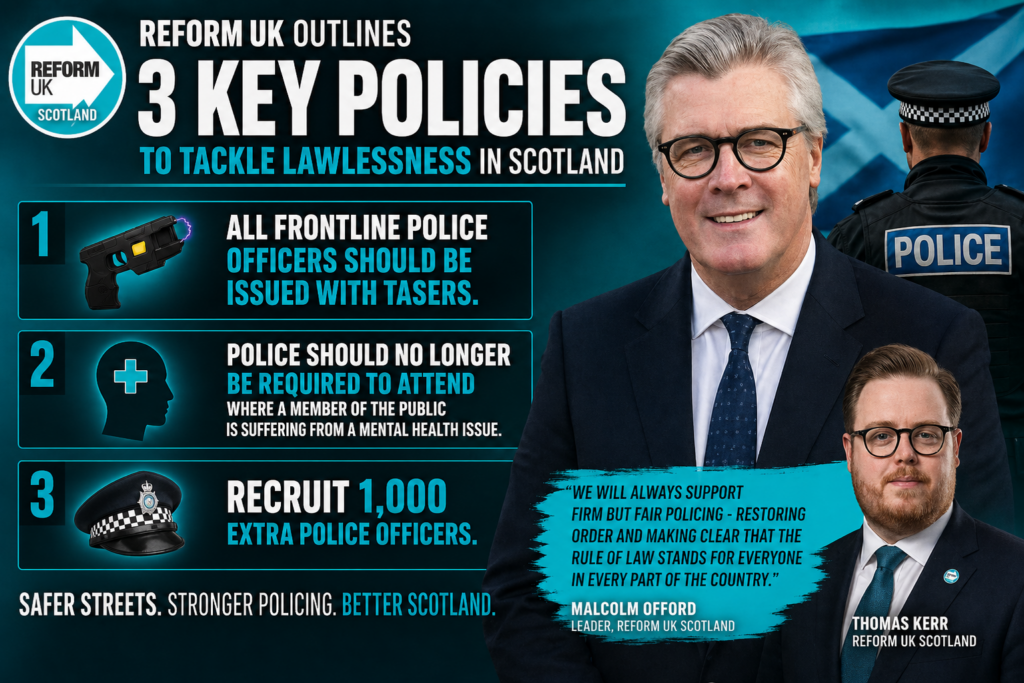
Today Reform UK Scotland is outlining three key policies to help tackle lawlessness in Scotland. These measures are designed to strengthen frontline policing, free up officers to fight crime, and rebuild the police numbers needed to keep communities safe.
Scotland needs a government willing to stand behind the rule of law. Under the SNP, public confidence has been undermined while pressure on policing has grown. Reform believes safer streets start with stronger policing, clearer priorities and the political will to act.
1. Issue all frontline police officers with Tasers
Reform believes every frontline police officer in Scotland should be issued with a Taser. At present, only around 2,000 officers in Scotland are able to use the devices. That leaves too many officers facing dangerous situations without the protection and tools they need.
Equipping all frontline officers with Tasers would help protect both the public and the police. It only takes four days to train an officer to use a Taser, making this a practical and deliverable policy rather than an empty slogan.
There were 7,159 assaults on police officers and staff in Scotland in 2024 to 2025. That equates to around 20 assaults every day, or almost one every hour. Assaults rose by 6.3% on the previous year and remain above the five year average.
Scotland’s police need greater protection. Reform will give them the backing they deserve.
Reform UK’s Scottish leader, Malcolm Offord, says:
“Communities across Scotland deserve to feel safe in their homes and on their streets. That means ensuring Police Scotland have the powers, resources and backing they need to act decisively against crime.”
2. Stop tying up police officers with mental health callouts
Police should no longer be required to attend where a member of the public is suffering from a mental health issue unless there is a genuine criminal justice or immediate public safety reason to do so.
Around 20,000 calls per month to Police Scotland relate to mental health or vulnerability. These figures are repeatedly cited by the Scottish Police Federation, HMICS and parliamentary committees as the single biggest inhibitor to frontline policing capacity.
Fewer than 20% of police calls result in a recorded crime, which means the majority of demand is preventative, welfare based, or crisis response rather than criminal enforcement.
This is not a police matter. It is tying up officers who should be out fighting crime, protecting victims and restoring order on Scotland’s streets.
3. Recruit 1,000 extra police officers
Reform will recruit 1,000 extra police officers to strengthen numbers and rebuild visible policing across Scotland.
Recent figures show that Police Scotland has about 16,416 full time equivalent police officers. Before Police Scotland was formed in 2013, there were around 17,500 full time equivalent officers.
Safer streets start with stronger numbers.
If Scotland is serious about tackling lawlessness, it cannot keep expecting fewer officers to do more with less. Reform will reverse that decline.
Reform UK’s Thomas Kerr states:
“Under the SNP we have seen our city become lawless with a rapid rise in rapes and sexual assaults, while mass illegal migration is pushing Glasgow towards breaking point and anarchy. That is why Reform is announcing our plan to give the police the tools they need to tackle crime and put victims first.”