Economy & Tax
Working Scots Pay Too Much Tax
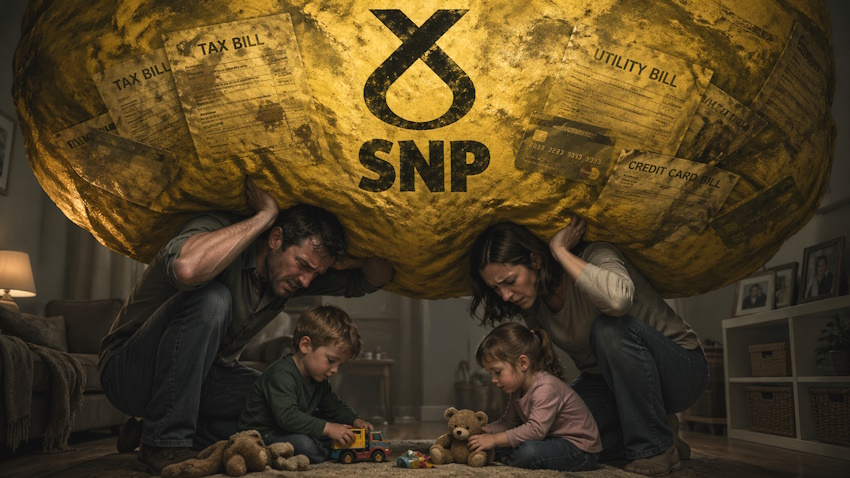
Scotland is not high-tax by destiny. It is high-tax by choice, and those poor choices are now destroying work, family and growth.
The high price of living
Scotland does not have a slightly different income-tax system. It has a different political theory of work. In 2026-27 the UK-wide Personal Allowance still covers the first £12,570. After that, Scotland applies six rates: 19, 20, 21, 42, 45 and 48 per cent. England, Wales and Northern Ireland use three: 20, 40 and 45. The starter rate and wider lower bands mean someone on £20,000 pays about £40 less in Scotland. At the Scottish Government’s illustrative median taxpayer income of £31,136, the advantage is about £24. The crossover comes at roughly £33,500. Above that point, the direction changes, and it changes quickly.
| Annual income | Difference | |
|---|---|---|
| £20,000 | £40 less | |
| £31,136 | £24 less | |
| £45,000 | £396 more | |
| £50,000 | £1,496 more | |
| £80,000 | £2,300 more | |
| £130,000 | £5,331 more |
Scottish Government illustrative examples for a standard taxpayer, 2026-27. Income tax only, before pensions and other reliefs. Around 55% of Scottish taxpayers are estimated to earn below the crossover. Use Reform’s Scottish income tax calculator to see the figure for your own pay.
These are not oligarchs. A salary of £45,000 or £50,000 can belong to an experienced nurse, a police sergeant, a teacher, an engineer, a software contractor or the manager of a small firm. They are alarm-clock Britain: the people who get up, keep the lights on, and are then told that asking them for more is compassion. If Holyrood wants that money, it owes them an account of what it bought, and the name of the person responsible when the results fail.
Reform UK Scotland starts from a simpler proposition: working people are not a revenue opportunity. They are the country.
What is left at the end of the month
Tax taken before payday is only the first cut. The rest is taken when the household tries to live on what remains. Meet four working Scottish households: Callum Reid, renting a one-bed in Shawlands and saving for a deposit he cannot yet reach; Fraser and Eilidh McTavish, two young children and a three-bed let in Gilmerton; Alasdair and Kirsty Paterson, three teenagers in a bought house in Troon; and Douglas and Margaret Campbell, empty-nesters in Bridge of Allan, still paying a mortgage while he runs a small firm. Annual pay sits at the top of each card. The ledgers are monthly, because that is how the bills arrive.
Callum, 28, is a site operative with a south-side contractor. He rents a modest one-bed tenement because a deposit is still out of reach, and he runs a used hatchback on PCP to get to the job.
- Income tax and employee NI
- −£551
- One-bed rent
- −£875
- Council tax and water
- −£125
- Energy
- −£95
- Food shop and work lunches
- −£325
- Car PCP
- −£240
- Car insurance
- −£100
- Fuel, road tax and servicing
- −£237
- Phone, broadband and basics
- −£45
- Left to choose
- £413
About £413 a month remains for a deposit, clothes and everything else.
Fraser, 32, earns the Scottish full-time median at a food plant. Eilidh, 30, works 22 hours on a supermarket checkout. Harris is two; Maisie is ten months. They rent a three-bed house and share a used family car on PCP.
- Income tax and employee NI
- −£724
- Universal Credit
- +£1,645
- Scottish Child Payment
- +£244
- Child Benefit and Best Start Foods
- +£268
- Three-bed rent
- −£1,650
- Council tax and water
- −£190
- Energy
- −£180
- Food shop
- −£700
- Childcare
- −£1,100
- Car PCP
- −£280
- Car insurance
- −£70
- Fuel, road tax and servicing
- −£230
- Nappies and basics
- −£120
- Left to choose
- £1,585
About £1,585 a month remains, after a tapered top-up. Rent sits about £279 above the housing element.
Alasdair, 47, is a solicitor in Ayr. Kirsty, 45, manages a printing works in Prestwick. Finn, 16, Isla, 14, and Brodie, 13, still live at home. They bought a four-bed in Troon and run two used cars on PCP.
- Income tax and employee NI
- −£1,812
- Child Benefit
- +£273
- Mortgage
- −£1,450
- Council tax and water
- −£252
- Energy
- −£200
- Food shop
- −£850
- Two car PCPs
- −£530
- Car insurance
- −£105
- Fuel, road tax and servicing
- −£430
- School, phones and basics
- −£330
- Left to choose
- £2,279
About £2,279 a month remains. The state takes £1,812 a month from two average professional salaries before the mortgage.
Douglas, 58, is a self-employed owner of a small trades business with £110,000 of annual trading profit. Margaret, 56, left paid work when the children were small. The children have moved out. They still have a mortgage and own their car outright. No pension contribution is deducted here, so the £100,000 allowance trap is shown in full.
- Income tax and Class 4 NI
- −£3,412
- Mortgage
- −£900
- Council tax and water
- −£280
- Energy
- −£180
- Food shop
- −£430
- Car insurance
- −£50
- Fuel, road tax and servicing
- −£230
- Phone, broadband and basics
- −£60
- Left to choose
- £3,625
About £3,625 a month remains for pension saving and everything else. In the allowance trap the next pound can cost 67.5 pence in Scottish income tax, or 69.5 pence including Class 4 NI.
Illustrative households, not a claim about every family. 2026-27 Scottish income-tax bands and UK National Insurance. Food is the 2026 shop (about £119 a week for a typical household, £161 with two children). Cars: PCP on typical used values, insurance by age, RAC-style servicing and repair provision, plus fuel. Universal Credit uses April 2026 rates, the official Lothian three-bed LHA of £316.44 a week (about £1,371 a month), and 85 per cent of childcare. Pension contributions are excluded.
A site worker on £36,075 keeps about £413 a month. A two-earner family still needs Universal Credit. Two professionals pay the taxman £1,812 a month before the mortgage.
That remainder still has to cover clothing, repairs, dentists, school costs, a holiday if they are lucky, an emergency if they are not, and any attempt to save. VAT, fuel duty and insurance premium tax are already sitting inside the spending lines; they are the second tax, paid at the till rather than on the payslip. The McTavishes are not shown without the benefits they would actually receive. They still rent, they still hit the 55 per cent Universal Credit taper, and their Gilmerton rent sits about £279 a month above what the housing element will cover. These are illustrations. The point does not depend on rounding. A large gross salary can bear almost no resemblance to a family’s freedom.
People have a right to build a family, then a community, then a country.
A state that prices working parents out of children has broken that order. Scotland registered 45,067 births in 2025, the lowest since records began in 1855, with a total fertility rate of 1.23. Tax did not cause that alone. Housing, insecurity, childcare and delayed family formation all matter. A government that keeps adding to the burden on working-age households cannot then feign surprise when the next generation arrives smaller.
Why do we pay so much tax?
The socialists would have you believe this is the price of civilisation: pay up, or the poor go without. That is not an argument. It is a sermon. Its purpose is to stop you asking where the money went, and whether the people who took it can even say.
Virtue is cheap when somebody else is paying. There are four reasons why, every year, you spend weeks if not months working for the taxman rather than for yourself or your family.
Waste, and nobody to sack
This is one of the biggest reasons you are landed not only with eye-watering direct tax but with a swarm of taxes on the bill, the pump and the till. The people who spend your money waste it with impunity, because every one of them knows they will almost never be made to answer for it.
Contracts go to the politically convenient bidder. Projects are botched. Hundreds of millions disappear. It is a rare day when anyone responsible is fired, let alone investigated. Quangos and arm’s-length boards have hauled the chain of accountability still further from the minister on television. Couple that with decision-by-committee, and you cannot pin a name on the person who signed the cheque.
In the ten years to April 2024, the Scottish Government ended the employment of 17 staff through its performance process, and that figure includes people who failed probation. Failed projects in the same era include the Ferguson Marine ferries, the CAP Futures farm-payments system, the NHS 24 Future Programme, the BiFab intervention, and more besides. Each overrun is money taken from you to pay for their mistakes. That is before you even look at the same disease in Whitehall.
Cowardice
We have seen the quality of too many politicians: few genuine convictions, and a talent for reversing them as soon as the wind changes. Many of them live for the next post and the next election. They will do almost anything to avoid a fight over a difficult subject. So services that cannot be afforded are not cut, because a cut makes a bad headline, and projects that should happen are postponed indefinitely. It is easier to spend your tax than to tell the public the truth.
Social-media pile-ons now spread like a contagion. Politicians answer them by announcing whatever they think will soothe the online mob, with cost, evidence and fitness for purpose optional. That is not leadership. It is expensive appeasement, billed to people who were at work while the row was happening.
Ideology instead of reality
Governments have been captured by people who believe they have the moral authority to impose their picture of the world over the world itself, without consulting you, the public who pay for it. Untold billions have been thrown away on pursuits that made an ideologue feel virtuous: Net Zero treated as theology rather than engineering, mass immigration without the homes or the wages to match, a nuclear ban in a country that still needs the lights on, and spending sprees undertaken not because they were needed but because they photographed well.
A government that cannot tell virtue from value will always need another tax rise. Reality does not send an invoice. You do.
Institutional incompetence
The SNP and other legacy parties have slowly filled their ranks with candidates and staff who went straight from school or university into a party youth role, then climbed the rungs of the party ladder. They have had no real-world experience to temper their ideological zeal. They have never run a business, employed people, or faced a wage bill or VAT bill at the end of the month. They have never skipped their own pay to keep a firm afloat, or worked hundred-hour weeks to make payroll. Fundamentally, they do not, and cannot, understand the real-life pressures their inane and poorly contrived policies create. They treat businesses and the people who own them as a cash cow to be milked whenever it suits.
Over time these parties have been populated through internal nepotism rather than by seeking competent, experienced people. It shows.
How did we get here? The four-front storm
The squeeze is not one policy. It is a storm with four fronts, all of them chosen.
Housing and population
Scotland’s average two-bedroom private rent reached £921 a month in the year to September 2025, 66.3 per cent above 2010. Planning failure, construction costs and the SNP’s private-rented regulations, which have driven landlords out and supply down, all matter. Politicians who discuss housing demand while refusing to name mass migration are insulting the public’s intelligence.
In the year to mid-2025, Scotland recorded 45,400 births and 61,600 deaths: a natural decrease of 16,200. The population still rose because total net migration was 17,900. National Records of Scotland has described migration as the main driver of growth for two decades. That is not an opinion about migrants as people. It is arithmetic. Every additional household needs a home; every extra worker lives within travelling distance of a job; every child needs a school place. The Migration Advisory Committee’s 2026 evidence review found that immigration tends to raise house prices and rents where planning makes supply slow to respond. A one-percentage-point increase in the migrant share was associated, across credible studies, with a 0 to 3 per cent rise in house prices, with a median of 0.65 per cent in countries most like the UK. Migration is not the only cause of the housing crisis. At the scale of the last few years it is a material one. A government cannot admit that supply is scarce, increase demand by hundreds of thousands, and then pretend the two subjects are unrelated.
Illegal and irregular entry, legal low-skill inflows and higher-skill visas are not the same thing. All of them add housing demand. The first two hit bargaining power in lower-paid work hardest. The third can still restrain wages and training if employers can import a substitute instead of growing one here.
Labour and wages
Scotland’s nominal full-time median weekly earnings rose 4.6 per cent in 2025 and 0.4 per cent after inflation. The Scottish Fiscal Commission says productivity has been broadly flat since 2016-17. Real disposable income per person has only recovered to its 2021-22 level. Economic inactivity among 16 to 64-year-olds was estimated at 22.0 per cent in April to June 2026, against 20.9 per cent for the UK.
Mass migration changes bargaining power as well as headcount. The official evidence does not show that every migrant lowers every wage. It does show a distributional effect that Westminster prefers to bury. The Migration Advisory Committee found some negative wage impact in jobs requiring less training, while longer-training occupations could benefit. A small average is not small to the cleaner, warehouse worker, kitchen porter or labourer whose pay rise disappears because the employer can draw from a much larger pool. Offshoring, permitted for years as if it were weather, has done similar work at the other end of the chain: fewer jobs here, and a political class that talks about “upskilling” while the work leaves. A wage that has already been held down still faces the same tax take.
Energy, regulation and the bill passed to the customer
Using the revised typical-consumption measure introduced in July, Ofgem put the typical direct-debit dual-fuel bill at £1,663 for July to September 2026, 13 per cent above the equivalent April to June figure. Wholesale gas markets matter, but they are not the whole story. Britain has spent a generation closing the plant that kept the lights on when the wind did not blow, then wondering why the remaining system is dear, brittle and increasingly dependent on imports. Longannet, Scotland’s last major coal-fired station, closed in 2016. Hunterston B, one of the two nuclear stations that had quietly underwritten Scottish supply, ceased generation in 2022. Torness still runs, yet SNP policy has been a presumption against new nuclear on Scottish soil, so there is no replacement in the pipeline here while England builds. Capacity that is closed is not “transitioned”. It is gone, and the gap is filled by interconnectors, by gas we increasingly buy in, and by levies loaded onto the bill.
The same political weather has been blowing through oil, gas and refining. The SNP-Green Bute House agreement of 2021 locked Holyrood into an alliance whose price was hostility to the North Sea and a Net Zero timetable treated as theology rather than engineering. Licensing, planning and the constant threat of earlier decline have told operators to take their capital elsewhere. Scotland’s only oil refinery at Grangemouth stopped processing crude in April 2025, with the loss of hundreds of skilled jobs, and the site is being turned into an import terminal for fuel refined abroad. John Swinney called the closure premature; the policies his party and its Green partners spent years championing made domestic hydrocarbons a moral embarrassment rather than a strategic asset. Reform UK Scotland’s manifesto is explicit: energy prices have been running at several times those of competitors, and de-industrialisation is not a mystery when you price power as a virtue signal. A business does not absorb those costs out of patriotism. It puts them in the price, cuts the wage bill, or closes.
Fiscal drag and a state that never has to economise
The Personal Allowance is still £12,570. The Office for Budget Responsibility says freezing personal tax thresholds until 2030-31 will drive much of the forecast rise in income-tax receipts. Wages rise in cash, often merely keeping pace with prices, and fixed lines pull more income into tax or into higher bands. Government raises more without the honesty of a rate rise. In Scotland the squeeze is tighter still, because the higher-rate line already starts at £43,662.
- The UK Personal Allowance has been frozen at £12,570 since 2021-22, so inflation itself becomes a tax rise.
- Scotland’s higher-rate threshold sits at £43,662. A pay rise that would once have stayed in the intermediate band is taxed at 42 per cent.
- National Insurance still takes 8 per cent on that same slice until £50,270, so the combined take on the next pound can reach half.
- The freeze is scheduled to run to 2030-31. Every year of wage growth, even a cost-of-living rise, drags more ordinary pay into the net.
Median full-time weekly pay in Scotland, annualised, rose from about £32,344 in 2021 (£622 a week) to £40,238 in 2025 (£773.80 a week). The Personal Allowance did not move. ASHE flags a series break in 2021 and methodology changes from 2023, so this is an illustrative wage-linked comparison, not a full tax computation or a claim of exact like-for-like earnings growth.
| If the allowance had risen with that wage | Frozen at £12,570 | |
|---|---|---|
| Pay in 2025 | £40,238 | £40,238 |
| Tax-free allowance | £15,638 | £12,570 |
| Income pulled into tax | £24,600 | £27,668 |
| Extra taxed each year because of the freeze | n/a | £3,068 |
Uprated allowance is £12,570 increased by the 24.4 per cent rise between the two annualised weekly-pay figures. At Scottish starter and basic rates that extra slice is worth roughly £600 a year, every year, before National Insurance. Leave the freeze in place to 2030-31, as the OBR expects, and a worker who never received a “tax rise” will have been dragged deeper into the system for a decade. Cross £43,662 and the next pounds are taxed at 42 per cent: that is how a cost-of-living pay award becomes a promotion into Holyrood’s higher rate.
Combine fiscal drag with Scotland’s extra bands, housing, energy and weak productivity, and you have the perfect storm: the money is taken, the services do not improve in proportion, and anyone who notices is invited to feel ashamed.
Taxation is a contract
Working Scots expect to fund healthcare, schools, policing, roads and protection for people who genuinely cannot support themselves. That is not in dispute. What is in dispute is the blank cheque. Taxation is legitimate when it finances necessary common goods under democratic law. It is not legitimate as a habit: take more, explain less, and treat the family as residual.
The moral argument too often runs in only one direction. Citizens are told what they owe the state. The state’s obligations of restraint, competence and a name on the failure receive less poetry. A government that keeps raising the burden while insulating itself from the consequences is not practising compassion. It is practising extraction.
Government should have to justify taking money from citizens.
Citizens should not have to justify keeping what they earn.
Money left with a family is not money lost to society. It pays for children, a deposit, a pension, a local tradesman, a meal on the high street, a small company or a charity. Civil society exists beyond government. “Progressive taxation” is a flattering name for a blunt proposition: the more successfully you work, train or take a risk, the larger the percentage of the next pound the state claims.
Reform rejects the idea that government acquires a stronger moral title to earnings merely because somebody did well.
A proportionate system already makes the higher earner pay more in cash. Taxable income of £80,000 charged at 20 per cent produces four times the tax of £20,000. If A earns twice what B earns, A should pay twice the tax, not three times because politicians invented extra bands. A generous tax-free threshold can protect the low-paid without turning ambition into an offence. Escalating the percentage is not required for contribution. It is a political choice to punish success. Reform does not propose a single flat rate tomorrow. It does propose fewer bands, lower rates than the SNP, and at Westminster a starting point of £20,000 so that work pays before the first extra penny of rate is even discussed.
Government has no money of its own
Every pound the state spends comes from tax, from borrowing that future taxpayers must service, or from monetary consequences that reduce what a wage will buy. Borrowing for productive infrastructure can be justified. Borrowing to avoid reform, fund day-to-day overspending or rescue weakly governed projects cannot.
UK public finances. Debt is reserved; the interest still crowds out everything a working household was told the tax was for.
| £2.98tn | Public-sector net debt at the end of July 2026, 94.1% of GDP. Source: ONS. |
|---|---|
| £110bn | Forecast debt-interest spending in 2025-26, rising to £137 billion by 2030-31. Source: OBR, March 2026. |
| Twice | Interest as a share of GDP compared with the decade before the pandemic. Money used to service the past cannot pay a nurse or cut a tax bill. |
Where your hard-earned tax was wasted
The accountability black hole
Scotland currently has 134 devolved public bodies. Around them sit councils, integration authorities, commissioners, consultants and contractors. The useful word is quango: a body carrying out public functions at public expense, sitting at arm’s length from the minister who will be on television when it goes well and mysteriously unavailable when it does not.
The official defence is expertise and independence, and sometimes that is real. The political attraction is less noble. Too many of these bodies are expensive, overlapping and lightly accountable. They duplicate work the civil service or a local council is already paid to do, they cost fortunes to staff and house, and they give ministers a convenient deniability: the board was operationally independent; nobody, apparently, was in charge.
Those spending your money are too often insulated from the consequences of spending it badly.
A household that overspends hits a wall. A firm that disappoints customers loses them. A public monopoly can argue that failure is proof it needs a larger budget. The frontline is not the target. Nurses, teachers, police officers and carers routinely carry decisions made above them. The target is the machine that multiplies process and then uses the dedication of those staff as a human shield.
The pathology is old, which is why it has names. C. Northcote Parkinson observed that administrative work expands to fill the time and staff available. Laurence Peter and Raymond Hull described hierarchies promoting people until they reach a role they cannot perform. Public-choice theory, associated with James Buchanan and with William Niskanen’s account of the budget-maximising bureau, treats politicians and officials as people with interests like everyone else: larger empires, more staff, less blame. They do not maximise the taxpayer’s interest by default. These are not insults aimed at every public employee. They are warnings about institutions with no customer who can walk away. Unless government is regularly cut, it will not cut itself. Reform UK Scotland’s answer is a department of government efficiency, the shutting of quangos, and the return of power to ministers who can be sacked.
Fraud, corruption and deliberate misconduct are criminal matters. Incompetence is not, and should not be mislabelled as a crime. It should not be consequence-free either. Named ownership, published milestones, dismissal for serious repeated failure, and an existence test for every arm’s-length body: what power does it exercise, why must it be independent, what did it deliver, what did it cost, and which minister answers for it?
Education Scotland is the manifesto example of a quango Reform would abolish, returning Scottish education to a government answerable to Holyrood rather than sheltered by another board. The ferry programme is the warning written in steel and delay. The lesson is not that Scotland should abandon island communities. It is that risk, contract and ministerial decision must be recorded before the trouble begins, not reconstructed afterwards by Audit Scotland.
When work stops paying
Welfare exists for a reason. It should protect severe disability, serious illness and genuine temporary need, and restore independence wherever work is possible. It fails when extra work feels pointless. Universal Credit is withdrawn at 55 pence for every extra pound of net earnings above any work allowance. Take a Scottish claimant above that allowance, paying the 21 per cent intermediate rate plus 8 per cent employee NI. From an extra £100 of gross pay, £29 goes in those deductions. Universal Credit then falls by £39.05. The household keeps £31.95: a marginal deduction of about 68 per cent. Add childcare and travel and the visible reward can be smaller still.
Reform distinguishes people who cannot work from people who can work but face a system that shrugs. The first group should be protected without being used as a human shield for the second. The SNP’s social security expansion, and the habit of announcing extra payments in the shadow of elections, should be judged as budget facts and incentive politics, not as a secret plot to import a clientele. Parties that expand the client state are rewarded by the client state. That is enough of an indictment. Work is part of the Scottish DNA. The best welfare is a good job. Alarm-clock Britain is not a slogan to Reform. It is the people economic policy is supposed to serve.
Class warfare: tax the “rich”
When growth is weak, housing is scarce, energy is dear and the state has wasted money, it is useful for government to point at someone else, and the chosen target is almost always people who have done well by legal work, trade, property or enterprise. They are relabelled “the rich”, treated as a class apart, and blamed for hoarding, so that attention slides off ministerial choices such as migration, Net Zero, fiscal drag, quangos and welfare incentives, and onto private success. Envy does the rest. The demand that follows is not better government but more tax on whoever can be made to look guilty.
None of this is accidental wording. It is a toolkit. Relabel a nurse, a contractor, a shop owner or a landlord with one flat as “the wealthy”, and ordinary working people can be taxed as if they were oligarchs; split the country into “they” who extract and “we” who suffer; keep talking until the argument has left economics altogether and become a sermon about how much money a person ought to be allowed to keep, rather than whether the tax raises revenue, grows jobs or keeps families afloat. Then refuse to define “fair share”, so the charge can never be paid in full. The slogans exist to stop the public asking whether the government can run an economy, and to start them asking whether their neighbour has too much.
You do not have to guess at the language. In the 2024-25 Budget statement the then Deputy First Minister said that “those with the broadest shoulders are asked to contribute a little more” and that they “should pay a higher tax rate”, adding that “asking those with more to pay more is the right choice.” Scotland’s tax strategy still boasts of “asking those with the broadest shoulders to contribute more,” and John Swinney has told Parliament he is proud that those same shoulders “should bear the greatest responsibility for funding public services.” That is not analysis. It is a permission structure: once the phrase is in circulation, any extra band can be sold as virtue.
HMRC projections for 2026-27, among income-tax payers. UK-wide. A proportionate system would still collect the bulk of the cash from higher earners, because they earn more. Extra rates are the punishment premium.
Top 1% share of taxpayer income12.8%
Top 1% share of income tax26.6%
The top half of taxpayers are projected to pay about 90% of income tax. “Fair share” that can never be numbered is not a policy. It is a mood.
There is a fork here, and it is not complicated. Either people may earn, save and build under known rules, or the state claims a moral veto over how much they may keep. Where reward is crushed, effort thins. That is not a lecture from a history textbook. It is why owners in Scotland are already asking what the point is of the extra hour, the extra hire, the extra product.
Scotland: the high-tax laboratory
The SNP calls its model a progressive social settlement. The Scottish Government estimates that 62 per cent of households are better off or unaffected after income tax and greater social-security support are combined. That is the defence. It is not the last word. Redistribution cannot be judged only by adding a benefit and subtracting a tax in a single year. It must include behaviour, administration, growth and whether the tax base survives.
Government Expenditure and Revenue Scotland is the unfashionable document. On its excluding-North-Sea basis for 2024-25, GERS recorded £87.3 billion of revenue against £117.6 billion of spending: a £30.3 billion deficit covered within the United Kingdom’s public finances. On that same Scottish GDP basis, spending was 55.4 per cent of GDP, against 44.4 per cent for the UK. There has been no austerity of the sort the SNP describes. There has been a failure to grow the economy in line with the spending. You cannot redistribute what you do not produce.
Scottish income tax raised £18.635 billion in 2024-25, up 9.0 per cent, while revenues in England and Northern Ireland grew 10.2 per cent. The provisional reconciliation is a negative £728 million in the 2027-28 Scottish Budget, the largest since income tax was devolved. Higher rates alone did not necessarily cause that shortfall; forecast error and the block-grant mechanism matter. What cannot be wished away is the warning the Scottish Fiscal Commission already writes into its forecasts: a relatively small number of high earners contribute a large and volatile share of receipts, and people change behaviour. HMRC’s own history records income being brought forward or deferred when additional rates move. That is not a cartoon Laffer curve. It is the reason a tax strategy is not an economic strategy.
Owners and firms are in the same laboratory. Land and Buildings Transaction Tax is higher than stamp duty south of the border and fines people for moving to the job or the house that would make their life work. Business rates punish expansion with a revaluation lottery; Reform would reverse the April 2026 revaluation. Extra council-tax bands, sold as a mansion tax, land on ordinary terraces and pensioners. Energy is a tax on every factory and cold store. The manifesto’s line is the right one: those with the broadest shoulders are now shrugging them, and asking what the point is of working longer, hiring, or launching anything new.
There is another way ..The Reform way
Britain once had no income tax. Pitt introduced it in 1799 to pay for war against Napoleonic France. It was not invented to fund a welfare state, a health service, or a peacetime administrative machine. It was repealed after the war. Peel brought it back in 1842. The peacetime state later grew around it. Using income tax to pay for ever-expanding public services is a later political choice, not the original bargain. Reform will not abolish income tax tomorrow. A high, permanent income-tax state is still a choice. A country that aspires to take as much as possible has forgotten why people work.
Lower taxes on business are not a gift to “the rich”. A firm has no magic money tree. Tax, rates, energy levies and compliance come out of prices, wages, investment or survival. High and unpredictable burdens mean less cash to buy kit, take on an apprentice, open a second site or ride out a bad quarter. That means fewer vacancies, weaker pay and a thinner tax base. You cannot squeeze a shrinking private sector forever and call it fairness. In Scotland the owner and the worker are often the same household: a plumber, a haulier, a contractor, a shop. Punishing business is punishing the people who write the wages. A firm that overspends goes under. A quango bills the taxpayer. If you want growth, the private sector has to be allowed to keep more of what it earns.
Reform UK Scotland has published the Holyrood tools. The manifesto costs immediate tax alignment at £1.2 billion and each further 1p at £850 million: about £2 billion up front, around 3 per cent of the Holyrood budget, found from the £1 billion on ideological Net Zero projects and the bloated £6.5 billion across 132 unaccountable quangos. Not every quango pound is spare cash. That is where the fat is, and that is where Reform would find the saving without stripping the front line.
Scrap the six bands. Match the rest of the UK’s three, 1p below each, then 3p below within five years.
Over time, roll LBTT and rates into a fairer, more predictable annual property tax whose yield goes to local authorities. Fast-track industry on existing industrial sites. Restore the local connection in housing, and repeal the private-rented rules that have shrunk supply and raised rents. The up-front tax cut is an investment in that growth, not a hole to be filled by punishing firms. Tax cuts do not automatically raise revenue next April. Scotland’s problem is too little growth. That is the arithmetic that matters.
Holyrood cannot set UK corporation tax, National Insurance or the national debt. Westminster can.
Reform’s Westminster offer
- £20,000
- Income-tax starting point
- £70,000
- Higher-rate threshold
- 15%
- Corporation-tax target
- 0%
- VAT on household energy bills
The same Contract would scrap Net Zero levies, freeze non-essential immigration and raise employer National Insurance on foreign labour, with published exemptions for essential health and care.
What this means for the four households
The families in What is left pay today’s Scottish rates. The figures below apply Reform’s published income-tax plans to those same salaries, using 2026-27 thresholds and keeping employee National Insurance and Class 4 contributions at current rates. The large number is the combined offer by year 5.
Callum ReidShawlands, Glasgow
Gross £36,075. Current income tax £4,727 and employee NI £1,880. Take-home about £29,468.
+£1,994 a yearAbout £166 more each month by year 5
Holyrood year 1: +£261. With the £20,000 starting point: +£1,673. His deposit pot finally moves.
The McTavish familyGilmerton, Edinburgh
Combined gross £56,062. Current income tax and NI about £8,693. Eilidh’s part-time wage sits inside today’s 19% starter band.
+£2,779 a yearAbout £232 more each month before Universal Credit
Holyrood year 1: +£344. With the £20,000 starting point: +£2,374, which takes Eilidh out of income tax. The 55% taper would claw back about £1,528, leaving roughly £1,251 in the house.
The Paterson familyTroon, South Ayrshire
Combined gross £95,581. Current income tax and NI about £21,743. Both pay Holyrood’s 42% higher rate.
+£6,659 a yearAbout £555 more each month by year 5
Holyrood year 1: +£2,724. With the £20,000 starting point: +£5,548. On the slice above £43,662, year 1 cuts the combined income-tax and NI take from 50p to 27p in the pound.
Douglas and Margaret CampbellBridge of Allan
Trading profit £110,000. Current income tax £37,482, including the Personal Allowance taper, and Class 4 NI £3,457. No pension relief is assumed.
+£12,332 a yearAbout £1,028 more each month by year 5
Holyrood year 1: +£5,074. With the £20,000 starting point: +£7,972. The year-five figure also applies the published £70,000 higher-rate threshold.
Callum keeps the smallest cash gain because he is not yet in the 42% band. The Patersons keep the largest PAYE gain because both of them are. The Campbells show why the frozen higher-rate line and the £100,000 allowance trap matter: £110,000 of sole-trader profit is not a mansion, yet it is where Scotland’s extra rates bite hardest. The McTavishes gain on the payslip and then meet the taper. That is not an argument against cutting their tax. It is an argument against a system that takes with one hand and gives back, at 55 pence in the pound, with the other.
Illustrative calculation, rounded to the nearest pound. Excludes pension contributions, student loans and other reliefs. The year-one illustration uses the rest-of-UK taxable basic-rate limit and sets each rate 1p lower; the year-five illustration assumes 3p lower. For the Campbell example, the £20,000 Personal Allowance is assumed to retain the current £1-for-£2 taper above £100,000, while the £70,000 higher-rate threshold corresponds to a £50,000 taxable basic-rate limit before allowance withdrawal. Those two thresholds are reserved to Westminster and their published policy does not specify these interactions. National Insurance is left unchanged. These are policy illustrations, not guaranteed personal forecasts.
A government that cuts tax without controlling spending simply posts the bill to borrowing. Reform must therefore cut waste in the open: named owners, published milestones, quangos that have to justify their existence. Care for people who cannot work. Do not carry, as a mark of civilisation, the dead weight of those who will not, whether they are milking a benefits system or hiding inside a bureaucracy that never has to meet a customer.
Reform’s proposed sequence is to create spending headroom first, return it through lower and simpler taxes, then let households and firms put more money to productive use.
-
First 100 days
Find the waste
Audit Scotland’s quangos, publish costs and milestones, name accountable owners and stop the £1 billion of ideological Net Zero spending identified by the manifesto.
-
Year 1
Return the first dividend
Replace six income-tax bands with three set 1p below the rest of the UK, reverse the April 2026 business-rates revaluation and fund the roughly £2 billion up-front cost from savings.
-
Years 2-3
Lower the cost of growth
Close duplicating bodies, phase out LBTT, move toward predictable local property funding and reduce the energy and regulatory costs that hold back hiring and investment.
-
By year 5
Deepen the tax settlement
Move Scottish income-tax rates to 3p below the rest of the UK and preserve the principle that people should keep at least 50p of every extra pound they earn.
How the economic benefit is intended to build
These are the policy’s potential transmission channels, not guaranteed forecasts.
- Household spending power
- More disposable income can support saving, housing, family costs and demand for local businesses.
- Business investment
- Lower tax, rates and energy costs can leave more cash for equipment, apprentices, vacancies and expansion.
- A broader tax base
- More jobs and output can strengthen revenues without raising rates; manifesto costing links each extra 1% of growth to about £8 billion in tax over ten years.
The intended cycle: waste savings fund tax relief; tax relief supports investment and work; stronger growth creates room for further reform.
Illustrative sequence based on Reform UK Scotland’s published 2026 manifesto commitments. Timing and fiscal effects would depend on implementation, economic conditions and decisions reserved to Westminster.
Family. Community. Country.
Return to Callum, the McTavishes, the Patersons and the Campbells. None of them became a villain at £43,662. They still have rent or a mortgage, children or a deposit they cannot reach, and a life they are trying to build. They did not take the extra shift for a minister. They took it for the people they are responsible for.
That is the order Reform has put in print. People work first to support a family. Then they support a community. A country is what those families and communities add up to. It is not a department that owns them.
- Family
- Reform UK calls family the foundation of society, and strong families the bedrock of a thriving country. People work to feed children, keep a roof, look after parents and have a life that is more than a payslip. Britain’s future, the Contract says, depends on our young people. A tax system that prices that out has failed.
- Community
- The Scottish manifesto says people should be able to create prosperity for their families and communities. Work funds the shop, the tradesman, the club, the neighbour who needs a hand. Reform’s New Deal is to revitalise those communities and put local people first, not treat the high street as leftover after the state has taken its cut.
- Country
- Reform’s Contract is plain: the government must work for the British people, not against them. A country is the sum of families and communities that can stand. It does not come first. It is what they build when they are left with enough to do so.
The present settlement has that backwards. The household exists to feed the state, and anyone who notices is told they are selfish. Reform’s published answer is the opposite. We work for our families and communities. The state should support that end: lower tax, homes, work that pays, energy that does not price a childhood out of reach. The state serves the family and the community. They do not exist to serve it.
A smaller tax burden is not selfishness. Money left with a family is money for children, a home, savings, a business, a local charity and a retirement. Family first, community next, country after that. That order is not a retreat from solidarity. It is how a country is actually built.
Government should have to justify taking it. Citizens should not have to justify keeping it. That is the Reform bargain, and it is available the moment Scotland chooses it.