

Holyrood
Never-Neverendum Land: John Swinney Fiddles While Scotland Burns
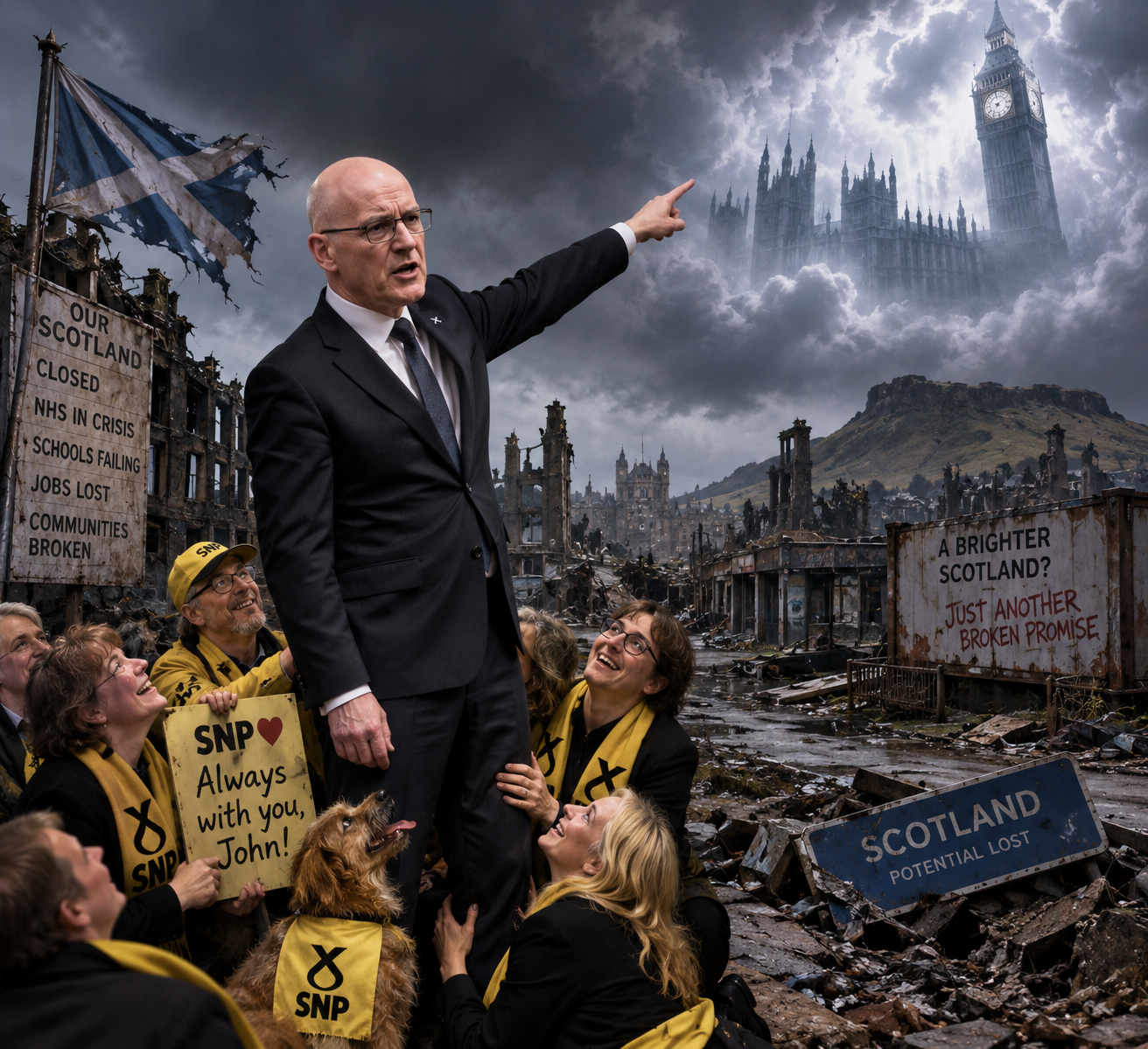
Scotland has an NHS crisis, a housing crisis, rising crime, weak economic growth, failing infrastructure and some of the highest drug-death rates in Europe. John Swinney’s answer? Another independence referendum he does not currently have the legal power to hold.
The bill with no power
After almost two decades of SNP government, you might reasonably expect Scotland’s First Minister to be consumed by the state of the country he actually governs. Instead, John Swinney is once again consumed by the constitution.
On 28 August his government published yet another draft Independence Referendum Bill — with one rather important catch. Even the Scottish Government admits the Bill can only be introduced “once the necessary powers are secured.” Those powers do not presently exist. The UK Supreme Court ruled in 2022 that legislation for a Scottish independence referendum relates to matters reserved to Westminster, and the temporary Section 30 powers that allowed the 2014 vote are no longer in force.
“Once the necessary powers are secured.”
None of that stopped the reflex. Within days of Prime Minister Andy Burnham suggesting a referendum could be considered if public opinion clearly demanded one, Swinney was immediately demanding talks on a new legal mechanism. For the SNP leadership, this is Never-Neverendum Land: always another demand, another declaration, another constitutional grievance, and another promise that independence is just around the corner. Meanwhile, Scotland burns.
Bread and circuses for the SNP faithful
There is a political purpose to all this. Independence has become the great SNP distraction machine. Whenever the record of government becomes uncomfortable, Westminster can be wheeled back onto the stage. Whenever public services fail, constitutional grievance can replace uncomfortable questions about ministerial competence. It is the modern political equivalent of bread and circuses: give the nationalist faithful another referendum campaign to dream about, and perhaps they will spend less time asking what nearly two decades of SNP government have actually delivered.
The problem for John Swinney is that the numbers cannot be wished away.
The SNP record, in official figures
- 588,825
- People on NHS waiting lists at the end of July 2026
- 10,480
- Children in temporary accommodation, September 2025
- 323,531
- Crimes recorded in the year to June 2026, up 7%
- 1,017
- Drug-misuse deaths in 2024
- £330m
- Spent on Glen Sannox and Glen Rosa since nationalisation
- 2035
- Current A9 dualling target — ten years after the 2025 promise
An NHS with almost 589,000 people waiting
At the end of July 2026, Public Health Scotland estimated that 588,825 people were on at least one new outpatient, inpatient or day-case waiting list. There were more than 507,000 ongoing outpatient waits and more than 157,000 inpatient and day-case waits, and tens of thousands had already waited more than a year. This is happening after the SNP has controlled Scotland’s health service since 2007. Instead of another constitutional roadshow, Scotland needs ministers obsessed with getting patients treated.
A housing emergency measured in children
The latest official homelessness figures showed 18,092 households in temporary accommodation at 30 September 2025 — up almost 9 per cent in a year. Among them were 10,480 children, and families in that position were spending an average of 237 days there. Those children cannot live in a constitutional white paper. They need homes.
Crime moving in the wrong direction
The year to June 2026 saw 323,531 crimes recorded in Scotland, 7 per cent more than the previous year. Non-sexual crimes of violence were up 7 per cent, sexual crime up 9 per cent, and crimes of dishonesty up 10 per cent. At the same time Scotland had 16,402 full-time-equivalent police officers at the end of June, slightly fewer than a year earlier. That should command the First Minister’s attention.
Scotland’s continuing drug-death tragedy
The latest fully published annual figures show 1,017 drug misuse deaths in 2024. That was, thankfully, down from the previous year — but Scotland’s age-standardised drug-poisoning mortality rate remained dramatically worse than elsewhere in Britain. The comparable 2023 rate was 2.8 times those of England and Northern Ireland, and 1.9 times the Welsh rate. The 2025 statistics have not even been published yet: National Records of Scotland has scheduled them for 23 September 2026. This is a national disgrace. It needs relentless focus, not another round of constitutional theatre.
The ferry fiasco
Then there are the ferries. The original 2015 contract was £48.5 million for each vessel — £97 million for the pair — and they were supposed to be delivered in 2018. By June this year the Scottish Government confirmed that since nationalisation alone it had provided £154 million for Glen Sannox and £176 million for Glen Rosa: £330 million between them, on top of the costs incurred before nationalisation. Glen Rosa is now expected in the fourth quarter of 2026.
If the SNP could build ferries as efficiently as it builds grievances against Westminster, Scotland would have the finest fleet in Europe.
The A9: 2025 becomes 2035
The SNP Government committed to completing the A9 dualling programme between Perth and Inverness by 2025. That promise has disappeared over the horizon. The current commitment is completion by 2035 — ten more years. Communities in the Highlands did not need another referendum bill. They needed the road they were promised.
Education: another warning light
The latest PISA results contain some welcome news — Scotland remains above the OECD average in several areas, and that should be acknowledged. They also show the longer-term problem. Scottish reading performance in 2025 remained significantly below the levels recorded in 2000, 2003, 2012 and 2018, and Scotland performed significantly below England in reading. Mathematics was statistically similar to the OECD average. After nineteen years of SNP control of education policy, “not as bad as some countries” is hardly a record to boast about.
Higher taxes and sluggish productivity
Scotland now has six income-tax bands, with rates of 42 per cent from £43,663, 45 per cent from £75,001 and 48 per cent above £125,140. Between £43,663 and the equivalent UK higher-rate threshold, the Scottish rate is 42 per cent while the rest of the UK pays 20 per cent. And what has this high-tax experiment bought? The independent Scottish Fiscal Commission warned in June that productivity growth has been broadly flat since 2016-17, and expects that subdued picture to continue. Scotland cannot tax itself into prosperity.
Enter the nationalist alliance
Now Swinney has found some travelling companions. On 14 September the leaders of the SNP, Plaid Cymru and Sinn Féin gathered in Cardiff and signed a memorandum declaring that “Westminster’s time is coming to an end”, and calling on the UK Government to “prepare for, plan and facilitate constitutional change”.
“Westminster’s time is coming to an end.”
It is worth being precise about what happened. This was not an agreement between the governments of Scotland, Wales and Northern Ireland. The participants acted as political party leaders, and that makes it more revealing, not less. Three nationalist parties of the political left have formed an overt alliance to push constitutional upheaval across the United Kingdom.
And what remarkable timing. Wales has around 547,500 individual patients estimated to be on NHS treatment waiting lists, while its latest PISA results put it significantly below the OECD average in both science and mathematics. Northern Ireland’s health crisis is even starker. At the end of June, 504,537 patients were waiting for a first consultant-led outpatient appointment, with a median wait of 59.1 weeks. More than half had been waiting over a year. Yet the nationalist answer in Cardiff was constitutional revolution.
Scotland, Wales and Northern Ireland have very different constitutional arrangements, political histories and legal routes to change. Northern Ireland, in particular, has arrangements governed by the Belfast/Good Friday Agreement that cannot simply be copied and pasted onto Scotland. Politically, though, the strategy is obvious. When government becomes difficult, change the subject from how you govern to who governs. When hospitals struggle, blame the constitution. When infrastructure fails, blame Westminster. When economic growth disappoints, blame Westminster. When promises made by devolved governments are broken, demand more powers. It is a wonderfully convenient model, because responsibility can always be somewhere else.
Scotland needs Reform, not another referendum circus
Scotland does not suffer from a shortage of political structures. It suffers from a shortage of competent government. After nearly two decades in office, the SNP can no longer plausibly present itself as an insurgency fighting somebody else’s system. It is the Scottish establishment. It controls the Scottish Government, enormous spending responsibilities, Scottish income-tax rates, the NHS, education, justice, policing, housing, ferries and large parts of Scotland’s transport network. Eventually government has to be judged by results.
Reform UK’s alternative should be unapologetically different: focus government relentlessly on the basics — a functioning NHS, safe streets, affordable housing, lower and simpler taxation, economic growth, reliable infrastructure, affordable energy, and public services that deliver value for the people paying for them. Those priorities are consistent with the emphasis on lower taxes, law and order, NHS reform, housing, energy and government efficiency set out in Reform UK’s Our Contract with You.
Scotland does not need another decade arguing about another referendum. It needs politicians who get up in the morning thinking about the patient waiting for an operation, the family stuck in temporary accommodation, the shopkeeper facing crime, the commuter paying higher taxes, the islander waiting for a ferry, and the Highland family still waiting for the A9 they were promised.
John Swinney wants Scotland looking towards another referendum. Reform should insist that Scotland looks instead at the SNP’s record. After nearly twenty years, the excuses have run out.
While John Swinney plays Never-Neverendum politics, the real Scotland is waiting to be governed.

That is the choice. While John Swinney offers another constitutional circus, Malcolm Offord’s keynote conference speech outlined a brighter, more positive vision for Scotland: a country judged by results, not by another referendum campaign. The SNP wants Scotland looking backwards at a vote it cannot currently hold. Reform should keep pointing Scotland forwards.
Reform UK Scotland
Scotland needs reform — and Reform UK needs you
Join, volunteer, stand, or back your local branch.