
BP North Sea Exit Warning Shows Scotland’s Energy Industry Is Being Driven Away
Malcolm Offord says reports that BP is considering leaving the UK North Sea are “an absolute hammer blow for Scotland” and a direct consequence of bad policy.
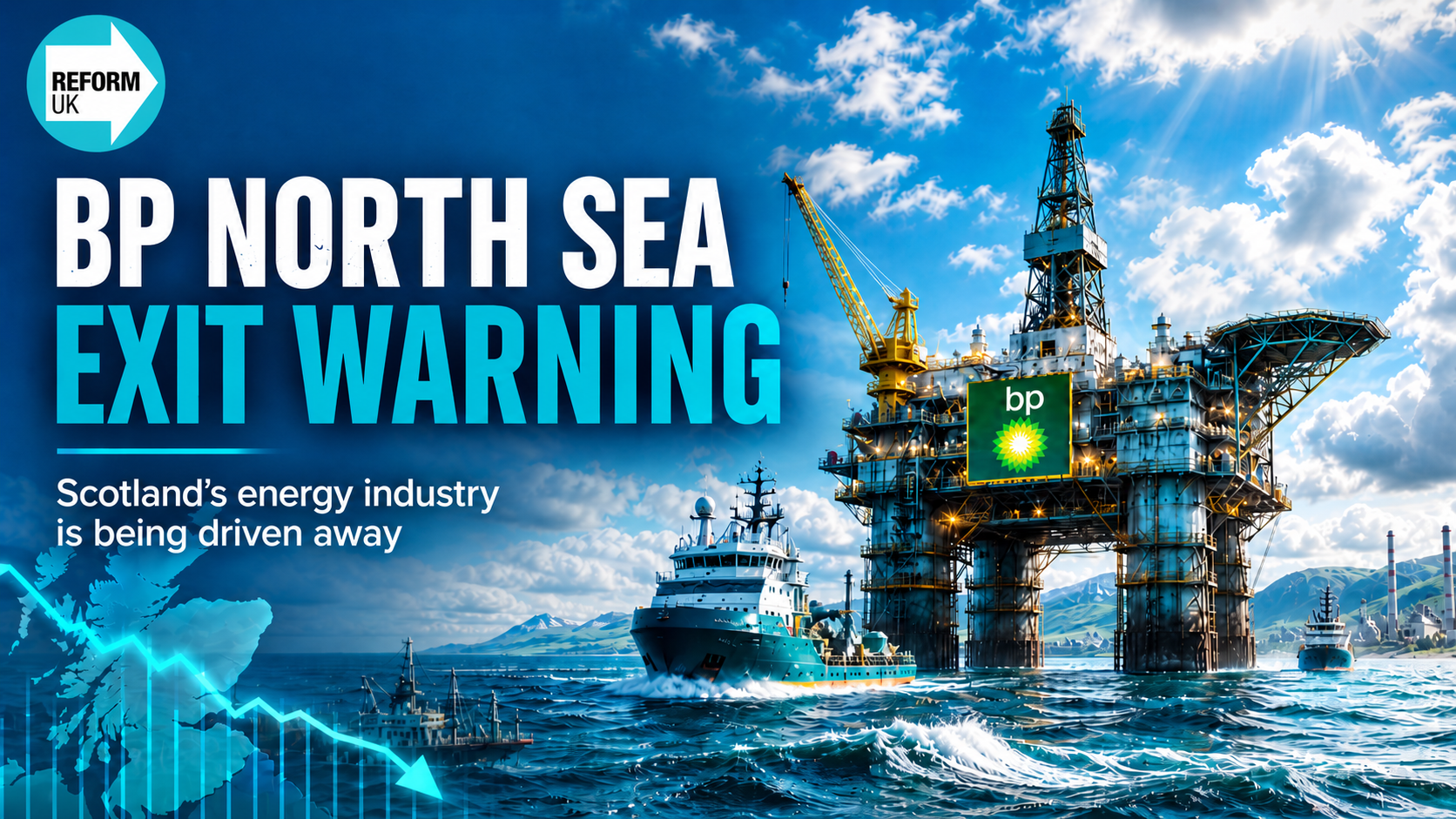
Reuters has reported that BP is weighing a sale of some or all of its UK North Sea operations, citing a Bloomberg News report. According to the report, a full sale could be valued at around £2 billion, although the plans are not final and may not materialise.
The development has raised fresh concern over the future of one of Scotland’s most important industrial sectors, with major oil and gas companies increasingly reassessing their position in the North Sea.
“That BP is even considering walking away from the North Sea is an absolute hammer blow for Scotland and it’s entirely down to bad policy.”
Malcolm Offord, Reform UK leader in Scotland

Reacting to the report, Reform UK leader in Scotland Malcolm Offord said successive governments at Westminster and Holyrood had damaged the North Sea through higher taxes, political hostility and net zero targets which have made investment harder.
“The groupthink of successive Westminster and Holyrood government with their taxes and net zero dogma have effectively killed a crucial Scottish industry, costing jobs and driving investment overseas.”
“We’ll end up importing more energy while our own resources are left in the ground.”
Scotland’s Oil And Gas Sector Has Been Managed Into Decline
Scotland was once at the heart of Britain’s energy strength. The North Sea supported tens of thousands of skilled jobs, paid billions in taxes, anchored world class engineering expertise and gave the country a strategic advantage in energy security.
That advantage is now being squandered. The UK Parliament’s Scottish Affairs Committee has reported that oil and gas production in 2024 was at record twenty first century lows, around 75% below the 1999 peak. It also highlighted ONS estimates of 61,225 direct oil and gas jobs, around a 30% fall compared with 2015.
North Sea Production
UK oil and gas production, indexed against the 1999 peak.
Source: UK Parliament Scottish Affairs Committee, 2025.
Direct Oil And Gas Jobs
ONS estimate cited by Parliament, indexed against 2015.
Latest estimate: 61,225 direct jobs, around 30% lower than 2015.
The SNP cannot hide behind Westminster. Offshore licensing is reserved, but political leadership, industrial strategy, planning policy, rhetoric, investor confidence and Scotland’s wider energy direction are all areas where the Scottish Government has influence. Instead of championing an industry that still supports communities across Aberdeen, the North East, Fife, Falkirk and beyond, the SNP spent years sending a message of managed decline.
The Scottish Government’s own energy strategy set out a direction of no support for unconventional oil and gas, no support for onshore conventional oil and gas, and consulted on a presumption against new offshore exploration. That political signal matters. Companies do not invest billions in places where government appears to view them as a problem to be phased out rather than a national asset to be backed.
Grangemouth Shows The Cost Of Industrial Weakness
The closure of Grangemouth refinery is the clearest warning yet. Scotland’s only oil refinery is being shut down and converted into a fuels import terminal. Reuters reported that 400 jobs would go, with staff numbers falling from 475 to around 75 over the following two years.
Grangemouth Refinery Workforce
The site is moving from refinery operations to an import terminal.
That is an estimated workforce reduction of around 84%.
Source: Reuters reporting on Petroineos Grangemouth closure announcement.
This is not a serious industrial transition. It is a retreat from production to import dependency. Scotland is moving from refining fuel here, supporting skilled jobs here and retaining capacity here, to importing more of what it still needs from overseas.
The SNP’s response to Grangemouth has been too little, too late. The Scottish Government talks about a “just transition”, but workers and communities need real jobs, real investment and real industrial capacity, not slogans and promises of future projects that may never replace what has been lost.
The Pattern Is Clear
- North Sea production is far below its peak.
- Direct oil and gas jobs have fallen sharply since 2015.
- Scotland’s only oil refinery is closing and becoming an import terminal.
- Political hostility and net zero dogma have damaged investor confidence.
- Scotland is being pushed towards importing more energy while leaving its own resources undeveloped.
Scotland Needs Jobs, Investment And Energy Security
The North Sea has supported skilled Scottish jobs, local supply chains, engineering businesses and communities for decades. Reform UK Scotland believes the country should be backing domestic energy production, not forcing investment abroad while relying on imported energy from overseas.
Mr Offord said the current approach amounts to economic self-harm, damaging the very industries that Scotland should be using to strengthen its economy and protect national energy security.
“It’s economic self-sabotage. Reform UK would scrap the windfall tax, back North Sea jobs and put Scotland’s energy future first.”
Reform UK Scotland’s Position
Back North Sea investment
Reform UK Scotland’s manifesto commits to supporting North Sea oil and gas, restoring energy security and protecting skilled Scottish energy jobs.
Back North Sea workers
Protect the engineers, offshore workers, supply firms and communities built around the sector.
Put Scotland’s energy first
Use our own resources responsibly instead of increasing dependence on imported energy.
Reform UK Scotland says the choice is clear: Scotland can either continue down a path of higher taxes, shrinking investment and managed decline, or it can back its workers, its energy sector and its economic future.
Sources
Reuters: BP weighs potential exit from UK North Sea, Bloomberg News reports, 1 May 2026.
UK Parliament Scottish Affairs Committee: The future of Scotland’s oil and gas industry, 2025.
House of Commons Library: Transitional support for North Sea oil and gas workers, 2025.
Reuters: Scotland’s Grangemouth oil refinery closure reporting, 2024.

Save Our Oil & Gas Industry
Vote Reform on May 7th
Find Your Reform Candidate