Clacton Speaks: Nigel Farage Returns to Parliament with a Renewed Mandate
The people of Clacton have delivered their verdict — and it is an emphatic one.
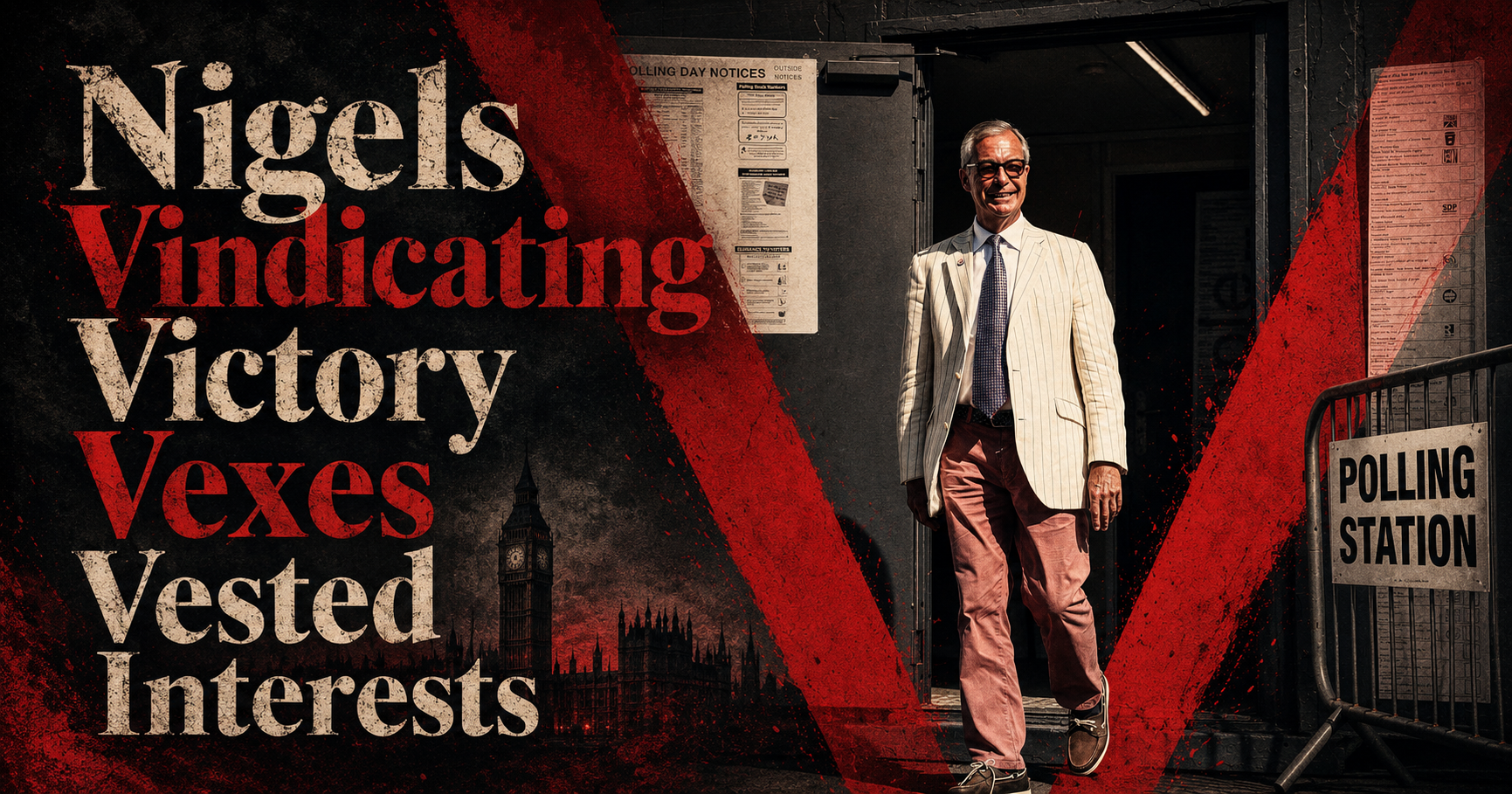
Nigel Farage has been returned to the House of Commons as Reform UK MP for Clacton after winning 22,239 votes — 63.34% of all votes cast — in the by-election held on 13 August 2026. His majority over second-placed Count Binface was 12,784 votes, with turnout at 44.37%. Tendring District Council confirmed that a record 34 candidates contested the seat.
Most importantly, Nigel Farage did not simply retain his seat. His support increased.
At the 2024 General Election, Farage won Clacton with 21,225 votes and 46.2% of the vote. This time he secured 22,239 votes despite the substantially lower turnout. That means his raw vote increased by 1,014 votes, while his vote share jumped by more than 17 percentage points, from 46.2% to 63.34%. His majority also rose from 8,405 in 2024 to 12,784 in 2026.
That is not the result of an electorate deserting Nigel Farage. It is the opposite.
Nigel Farage responds following his emphatic victory in the Clacton by-election.
A Verdict Delivered After Months of Accusations
The significance of this result goes far beyond the numbers.
Nigel Farage has spent months on the receiving end of intense scrutiny from political opponents and large sections of the media over his finances, donors and personal security arrangements.
That scrutiny intensified as Reform UK’s electoral strength increasingly threatened the established parties. It is entirely legitimate for politicians to face questions about their financial affairs, but Reform supporters have also watched an increasingly hostile political and media environment in which almost every aspect of Farage’s personal finances has been dissected publicly.
Central to that controversy has been the £5 million personal gift from businessman Christopher Harborne, received before Farage became an MP in 2024.
Farage has argued that the £5 million was an unconditional personal gift, given in circumstances where Christopher Harborne was deeply concerned about his safety and wanted to ensure that he could remain properly protected. Those concerns now have an even more sobering context. Ann Widdecombe, a prominent Reform UK member and close friend of Farage, was murdered at her Devon home in July 2026 in what counter-terrorism police have described as a targeted attack. A man has been charged with her murder, and the investigation remains ongoing.
Police investigating Widdecombe’s killing have also reopened an investigation into a 2025 incident at Nigel Farage’s home, reported as an alleged attempted arson or firebomb attack, and are examining whether there may be a connection between the two cases. Counter Terrorism Policing has acknowledged that a previously overlooked line of inquiry is now being pursued, while Farage has said he believes the incidents are directly linked. That possible connection has not yet been established by the courts or police, but it underlines why Farage’s security requirements cannot reasonably be treated as those of an ordinary political figure. He faces exceptional risks requiring professional protection, including round-the-clock security, and such protection is extremely expensive.
Against that background, the suggestion that financial help towards keeping Farage safe should automatically be viewed with suspicion deserves proper perspective.
The Parliamentary Commissioner for Standards is currently investigating an allegation concerning failure to register an interest, and that process should be allowed to run its course.
Crucially, the existence of an investigation is not itself a finding that Farage has broken parliamentary rules.
What is beyond dispute is that the threats surrounding senior Reform figures are no longer hypothetical: one of the party’s most prominent figures has been murdered, while police are simultaneously revisiting an alleged attack on Farage’s own home.
Farage is one of Britain’s most recognisable and polarising politicians. He has faced repeated threats and physical attacks during his political career, and Reform subsequently committed to providing 24-hour protection for its MPs amid growing concerns about political violence. Reports have also documented Farage’s previous concerns about the withdrawal or inadequacy of taxpayer-funded protection.
Whatever one’s politics, protecting elected representatives from violence should not be controversial.
Serious Questions About Leaked Confidential Financial Information
There is another aspect of this affair which deserves considerably more attention than it has received.
Farage and Reform deputy leader Richard Tice have launched legal action against the National Crime Agency, alleging that confidential banking information contained in Suspicious Activity Reports was improperly leaked to the media.
The allegation concerns private financial information relating to transactions which subsequently became the subject of extensive press reporting, including information connected with the Harborne gift. The NCA has said its Professional Standards Unit is investigating complaints made about the alleged disclosure.
That distinction matters.
The Parliamentary Commissioner for Standards is examining whether Farage complied with parliamentary registration rules. That investigation should be allowed to reach its conclusion independently.
But the question of whether confidential financial information held within the law-enforcement system was improperly leaked is a separate and extremely serious matter. The allegation has not yet been proven, but if confidential banking intelligence relating to a prominent political figure was improperly disclosed, the public would be entitled to demand answers about how, why and by whom.
Accountability must work both ways.
Farage Put the Question Back to the People
Faced with this barrage of allegations and investigations, Nigel Farage chose an extraordinary course.
He resigned his parliamentary seat and went back to the electorate.
His argument was straightforward: if his constituents believed that the allegations surrounding him had destroyed their confidence in their MP, they had the opportunity to remove him. If they still trusted him to represent them, they could send him back to Westminster.
They have done exactly that.
Farage received more votes than he did in 2024, despite turnout falling from 58.7% to 44.37%. His percentage share increased from 46.2% to 63.34%.
This election does not determine the outcome of the Parliamentary Commissioner’s investigation, nor should it.
But politically, the electorate has delivered an unmistakable verdict: Clacton still wants Nigel Farage as its MP.
Where Were the Establishment Parties?
Perhaps the most revealing feature of this election was not who stood, but who did not.
Labour, the Conservatives, Liberal Democrats and Greens all declined to field candidates against Farage. Major parties described the election as a stunt, a farce or a vanity exercise rather than putting those arguments directly before the electorate and allowing Clacton voters to decide between them.
Instead, a satirical candidate dressed as an intergalactic rubbish bin became Farage’s principal opponent.
Count Binface openly styled himself as a “unity candidate”, and in the absence of candidates from the established parties became the focal point for much of the anti-Farage vote. Polling showed particularly strong support for him among Labour, Liberal Democrat and Green voters. There were also reports of individual activists and supporters from established parties campaigning for him, although this should not be confused with formal endorsements by each party’s national organisation.
Political satire has a legitimate place in British democracy. Joke candidates have been part of elections for generations.
But there is something deeply revealing about major political parties refusing to put their own candidates before the electorate while much of the political and media establishment treated a novelty candidate as the principal vehicle for defeating the leader of Reform UK.
If Labour, the Conservatives, Liberal Democrats or Greens believed Nigel Farage was unfit to represent Clacton, they had the opportunity to say so on the ballot paper.
They chose not to.
Democracy requires more than criticising your opponents from television studios and newspaper columns. It requires being prepared to put your arguments before voters and accepting their answer.
Back to Westminster With a Stronger Mandate
Nigel Farage now returns to the House of Commons not weakened by this contest but with a significantly larger share of his constituency behind him.
The Parliamentary Commissioner for Standards has resumed the investigation into the registration issue following Farage’s re-election. Farage must now engage fully with that process and answer the questions put to him.
But he returns able to make one powerful point that none of his critics can erase:
The voters knew about the accusations. They knew about the £5 million gift. They knew about the investigation. They knew why the by-election had been called. And they still returned him with 63.34% of the vote.
That gives Nigel Farage a renewed political mandate and an opportunity to confront the allegations directly, defend his position and return his attention to the issues that propelled Reform UK forward in the first place.
Scotland Should Pay Attention
There is a lesson here for Scotland as well.
Politics fails when politicians convince themselves that they know better than the people they represent.
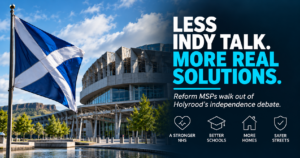
The SNP continues to devote enormous political energy to constitutional separation. Its programme following the 2026 Holyrood election included an early attempt to seek the powers required for another independence referendum, alongside further constitutional campaigning.
Reform Scotland believes Scotland needs a government focused instead on the everyday priorities confronting ordinary families: the NHS, housing, education, crime, taxation, economic growth and functioning public services.
Immigration provides another increasingly obvious example of the gap between Scotland’s political establishment and public opinion.
Immigration policy itself remains reserved to Westminster. The SNP therefore does not control the UK immigration system. But the SNP and Scottish Government have consistently argued that Scotland should have greater powers to attract migrants, established Scotland’s Migration Service and advocated immigration as part of its economic and demographic strategy. In its proposals for independence, the Scottish Government explicitly proposes a range of visa routes intended to encourage people to live, work and study in Scotland.
Yet an Ipsos poll published in April 2026 found that 55% of Scots believed immigration into Scotland was either “much too high” or “a bit too high”. Just 11% thought immigration was too low.
That deserves to be heard.
Scotland absolutely needs skills, investment and people who contribute to our economy. But there is a fundamental difference between controlled immigration serving the national interest and politicians continually assuming that ever greater migration is the answer regardless of pressures on housing, infrastructure and public services.
Reform Scotland’s message is straightforward: government should listen to the public rather than lecture it.
Clacton Has Spoken
Nigel Farage asked his constituents a remarkably simple question:
Do you still want me to represent you?
Clacton’s answer was overwhelming.
A vote share more than 17 percentage points higher than in 2024.
A larger majority.
And more individual votes than he received when first elected.
The investigations and arguments will continue. Nigel Farage will undoubtedly remain one of the most scrutinised politicians in Britain.
But today one fact stands above the noise.
The people of Clacton were given the final word — and they chose Nigel Farage.
Reform Scotland congratulates Nigel on his emphatic return to Parliament.
Now it is time to get back to work.