
Reform Surges as Labour Membership Falls: Scotland’s Unionist Politics Is Changing
Reform UK’s rapid growth in Scotland is changing the political landscape. With a growing membership, 17 MSPs and a regional vote that surpassed Labour at the 2026 Scottish Parliament election, Reform is establishing itself as a major force in Scottish Unionist politics.
At a Glance
The political landscape in Scotland is changing — and it is changing quickly.
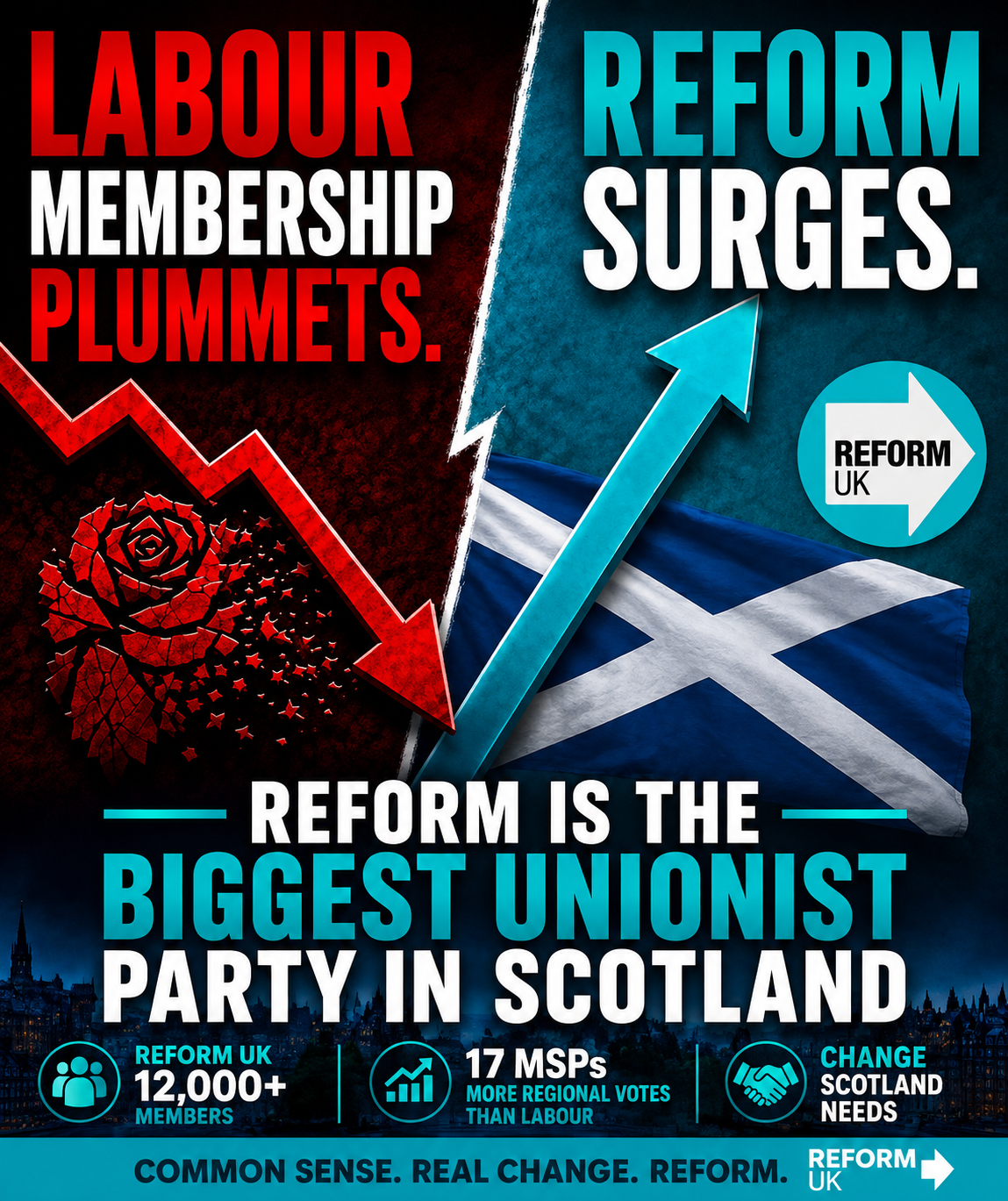
New membership figures underline a remarkable shift in the balance of Scotland’s pro-Union politics. Reform UK Scotland says it now has well over 12,000 members north of the border, while Scottish Labour’s membership has reportedly fallen to around 11,000.
On that measure, Reform can now legitimately claim to be Scotland’s largest Unionist party by reported membership.
Reported Scottish Membership
Latest reported figures indicate that Reform UK Scotland now has more members than Scottish Labour.
Based on latest reported membership figures cited in the article.
That would have seemed almost unimaginable only a few years ago.
Reform entered the 2026 Scottish Parliament election without a single MSP elected at the previous Holyrood contest. It emerged with 17 MSPs, becoming joint second-largest party in the Scottish Parliament alongside Labour.
Scottish Parliament analysis described Reform as the biggest winner of the election, gaining 17 seats while Labour lost seats and the Conservatives suffered a dramatic collapse.
This is no longer a protest movement operating on the margins of Scottish politics. Reform UK has established a substantial membership base, a parliamentary presence and an organisation increasingly capable of campaigning across Scotland.
The Numbers Tell the Story
Regional Vote Share: 2021 vs 2026
Scottish Parliament regional vote share for Reform UK, Labour and the Conservatives.
Source: Scottish Parliament election briefings for 2021 and 2026 regional vote shares.
The Holyrood result provides particularly compelling evidence of the change.
On the regional vote, Reform UK secured 16.6% across Scotland, ahead of Labour on 16.0% and well ahead of the Conservatives on 11.8%.
Reform consequently won 17 regional MSPs — more regional seats than any other party.
Reform and Labour now have 17 MSPs each — but Reform also finished ahead of Labour on the nationwide regional vote.
Labour retained a higher constituency vote, so claims about Reform being the “biggest Unionist party” should be made accurately. Reform is ahead of Labour in reported membership and was ahead on the 2026 regional vote, while the two parties returned the same number of MSPs.
That distinction makes Reform’s achievement more striking, not less.
The party has gone from no elected representation at Holyrood in 2021 to standing alongside Labour with 17 MSPs apiece just one election later.
The old assumption that Scottish Unionism naturally belongs to Labour or the Conservatives can no longer be taken for granted.
A Different Kind of Unionism
For decades, Scottish voters who wanted Scotland to remain within the United Kingdom were largely asked to choose between Labour and the Conservatives.
Reform offers something different: support for the Union without support for the political status quo.
It is entirely possible to believe passionately in Scotland’s place within the United Kingdom while also believing that Westminster and Holyrood both need fundamental reform.
That is the political space Reform is increasingly occupying.
Reform UK has consistently argued for lower taxation, controlled immigration, stronger borders, tougher law and order, cheaper and more secure domestic energy, less government waste and the defence of British sovereignty.
Reform’s published policy programme describes Britain as a sovereign nation whose government should work for its citizens, while advocating lower taxes, energy independence, stronger borders and greater accountability in government.
For Scotland, that means rejecting the SNP’s endless constitutional obsession without pretending that everything about the current system works.
The choice should not be between SNP nationalism and establishment Unionism.
There is now another option: a reforming Unionism that believes Scotland and the rest of the United Kingdom can prosper together.
Labour Cannot Take Scotland for Granted
The fall in Labour membership matters because political parties ultimately depend upon people.
Members deliver leaflets, knock doors, stand as candidates, raise money, organise local campaigns and build the networks that sustain a party between elections.
A shrinking membership therefore tells us something deeper than a number on a spreadsheet.
Reform’s growth suggests that thousands of Scots who want political change are choosing not simply to vote Reform, but to become directly involved in the party.
That follows a Scottish Parliament election in which Reform’s support was already demonstrated at the ballot box. The party took 16.6% of the regional vote and finished with exactly the same number of MSPs as Labour.
Reform’s challenge now is different: turning rapidly expanding support into a permanent political organisation rooted in Scotland’s communities.
From Breakthrough to Grassroots Movement
That means the next stage matters enormously.
Reform needs strong local branches, capable candidates and members prepared to campaign in communities from the Borders to the Highlands and from Glasgow to Aberdeen.
The foundations are increasingly there.
In Scotland, Reform is represented at Holyrood by a parliamentary group of 17 MSPs. Membership growth now provides the grassroots manpower needed to build on that parliamentary breakthrough.
And that is why these latest figures should concern Reform’s opponents.
Political breakthroughs can sometimes disappear as quickly as they arrive. Building thousands of committed members creates something much harder to dismiss: an organisation.
Scotland Is Ready for Political Competition Again
For too long Scottish politics has revolved around the same arguments and the same parties.
The SNP has dominated government. Labour repeatedly promises renewal. The Conservatives once positioned themselves as the principal defenders of the Union but suffered a devastating result at the 2026 election.
Reform has disrupted that pattern.
We should be ambitious about what comes next.
Being the largest Unionist party by reported membership is an important milestone, but it should not be the destination.
The task now is to turn members into campaigners, campaigners into candidates, candidates into councillors and MSPs, and growing support into lasting political change.
Labour membership is falling.
Reform membership is growing.
Reform has already matched Labour’s representation at Holyrood and beaten it on the regional vote.
Scotland wants change.
Scotland Needs Reform.