
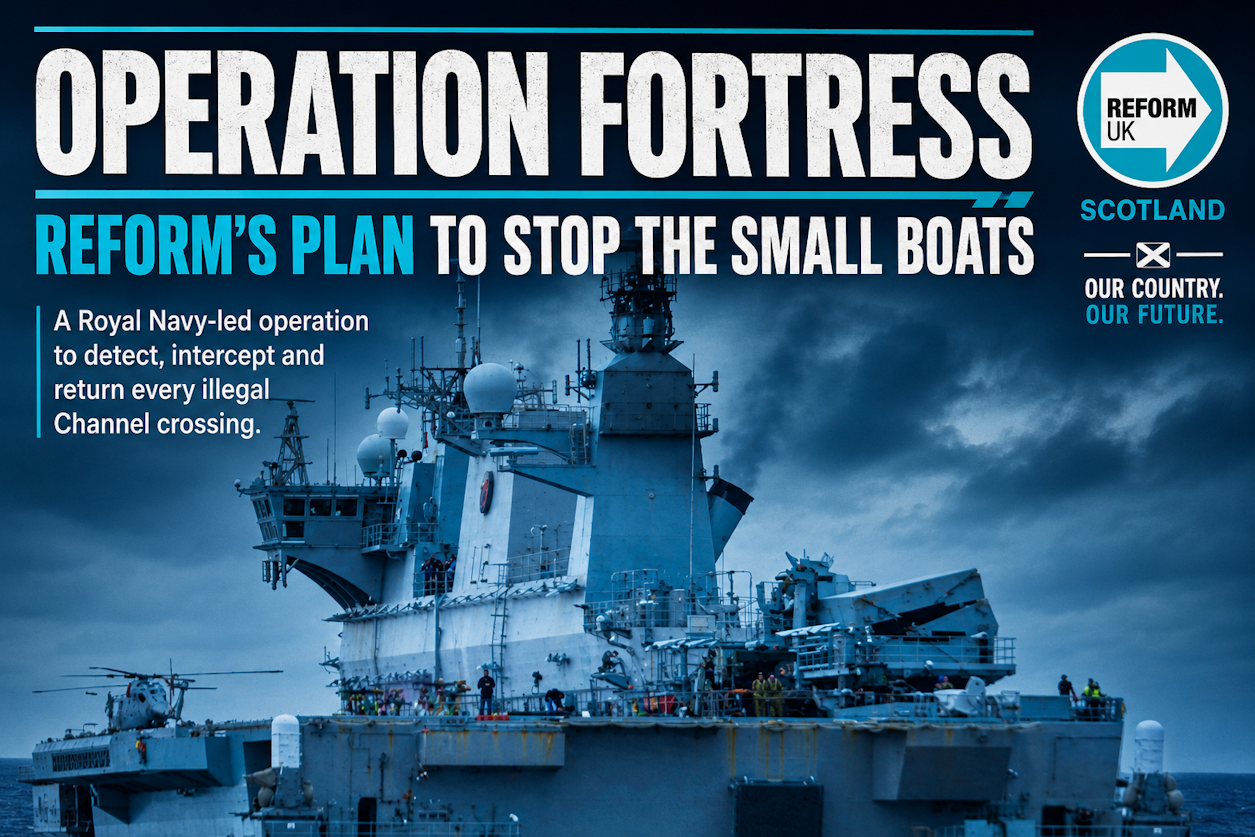
Operation Fortress: Reform’s Plan to Stop the Small Boats
A Royal Navy-led joint command, round-the-clock surveillance and the interception and return of every small boat attempting to enter Britain illegally are at the heart of Reform UK’s new Operation Fortress plan.
Reform UK has set out a detailed operational proposal for tackling illegal small-boat crossings of the English Channel. Rather than relying primarily on agreements with France or processing migrants after they reach Britain, Operation Fortress is designed around a different principle: intercept the boats at sea, rescue those on board and return them to the country from which they departed.
The plan brings together the Royal Navy, Royal Marines, Border Force, Coastguard, police, the National Crime Agency and intelligence services under a single command structure, replacing what the document describes as the fragmented system operating today.
The central idea is simple: make the Channel route pointless.
Under Operation Fortress, Reform says anyone attempting the journey would know in advance that reaching a small boat would no longer mean reaching Britain.
Why this needs to be done
The consequences of illegal Channel crossings do not stop when a small boat reaches the south coast of England. They eventually feed into the wider asylum, housing and public-service systems across the United Kingdom — including here in Scotland.
The Operation Fortress paper states that 95% of people arriving in Britain by small boat since 2018 have subsequently claimed asylum. While somebody whose asylum application is still being considered will normally be accommodated through the Home Office rather than a Scottish council, the position changes if they are granted refugee status or leave to remain.
At that point they can become eligible for mainstream benefits and homelessness assistance. Scotland’s homelessness system is considerably more generous than elsewhere in Britain, and significant numbers of people granted leave to remain elsewhere in the UK have subsequently travelled north and presented as homeless in Glasgow.
of small-boat arrivals since 2018 have claimed asylum, according to the Operation Fortress paper.
households granted status elsewhere in the UK were reported as having travelled to Glasgow from April 2024 and presented to homelessness services.
of Glasgow homelessness applications between April and September 2025 were from households with refugee or leave-to-remain status.
refugee or leave-to-remain households were in temporary accommodation in Glasgow by September 2025.
The Pressure Is Already Reaching Scotland
This is no longer an abstract argument about what happens hundreds of miles away in the English Channel. Glasgow is already experiencing substantial additional pressure on homelessness services and temporary accommodation from people who have passed through the UK asylum system.
Evidence submitted to Parliament reported that significant numbers — predominantly single males — were travelling to Glasgow from places including London, Manchester and Belfast after receiving leave to remain elsewhere in the United Kingdom.
Why Scotland?
Scotland provides stronger statutory homelessness rights than other parts of Britain. It abolished the traditional “priority need” test, meaning that entitlement is not restricted primarily to categories such as families with children or particularly vulnerable applicants.
In 2022 the Scottish Government also suspended local-connection referrals between Scottish councils. A homeless household in Scotland can therefore present to any of Scotland’s 32 local authorities without being sent to another Scottish council simply because it has no previous connection with that area.
Glasgow City Council has identified these differences between the Scottish and wider UK homelessness systems as one factor influencing the number of households travelling to the city after being granted leave to remain.
An Important Distinction
The 2022 local-connection change did not, by itself, create the right for newly recognised refugees elsewhere in Britain to move to Scotland. It specifically removed referrals between Scottish councils. The wider difference also reflects Scotland’s earlier abolition of the priority-need test and its broader homelessness entitlements. What is not disputed is that substantial numbers of people granted status elsewhere in Britain are now travelling to Glasgow and entering its homelessness system.
A Growing Cost for Scottish Communities
Scotland is already in the middle of a housing emergency. Every additional household requiring emergency accommodation adds to demand for hotel rooms, temporary flats, homelessness staff and ultimately permanent housing.
In Glasgow, refugee and leave-to-remain households have become a particularly significant part of that pressure. Scottish Parliament research reported more than 2,600 such households living in temporary accommodation in Glasgow by September 2025 — more than double the number two years earlier.
For Scotland, stopping the boats is therefore not simply an issue of border control in southern England. It is also about reducing downstream pressure on Scottish housing, homelessness services, council budgets and local communities.
What Is Happening Across the Channel?
Reform UK Chairman Lee Anderson recently travelled to the migrant camps around Calais and Dunkirk to see the situation first-hand. His visit gives a striking view of the camps from which people are waiting for an opportunity to attempt the journey across the English Channel.
Stop the Journey Before the Consequences Reach Scotland
For years governments have concentrated on managing what happens after people arrive: asylum accommodation, hotels, processing claims, homelessness support and eventual attempts at removal.
Operation Fortress starts from the opposite direction. Reform’s argument is that the most effective way to reduce all of those downstream consequences — including the growing pressure reaching Scottish councils — is to prevent illegal Channel crossings from succeeding in the first place.
How Would Operation Fortress Work?
The proposal describes a continuous four-stage operation controlled by a single Joint Task Force Commander.
Detect & Track
Drones, aircraft, intelligence and surveillance systems monitor launch areas and track vessels approaching Britain.
Interdict
Royal Navy patrol vessels, RHIBs and Border Force vessels are tasked to intercept boats entering UK waters.
Board & Secure
Border Force officers would make immigration arrests while naval personnel provide boarding, security and maritime support.
Transfer & Return
Those intercepted would be medically assessed, provided with food and water and transferred to suitable vessels for return.
One Command Instead of Multiple Agencies
One of the document’s strongest criticisms of the present system is that responsibility is divided between different organisations. Operation Fortress proposes bringing the relevant capabilities together as a single government-directed operation.
The Joint Operation Would Bring Together:
The initial headquarters would be established through Standing Joint Command UK, with the document envisaging a dedicated Joint Task Force Headquarters if required.
Seeing the Boats Before They Reach Britain
Operation Fortress also proposes an Integrated Surveillance Command. Its purpose would be to give British authorities their own real-time picture of attempted Channel crossings rather than depending upon information supplied by France or Belgium.
The proposal envisages combining drones and unmanned aircraft, Coastguard aircraft, helicopters, RAF reconnaissance capabilities, satellite information, infrared imagery and existing maritime surveillance into one operational picture.
The objective is not simply to detect boats once they are halfway across the Channel, but to identify launches early enough for naval assets to be positioned before they reach British waters.
What Would the Navy Use?
The paper sets out a proposed mix of existing military and Border Force vessels rather than relying on major warships.
River-class Patrol Vessels
Used to locate and intercept small boats, supported by intelligence and aerial surveillance.
Bay-class Landing Ship
Proposed as an offshore command and temporary holding platform with significantly greater capacity.
RHIBs
Fast rigid-hulled inflatable boats deployed from larger vessels for interception, boarding and transfer.
Border Force Cutters
Supporting patrol, interception and surveillance operations alongside naval vessels.
The Australian Model
A major influence on Operation Fortress is Australia’s Operation Sovereign Borders, introduced in 2013. The Reform paper argues that Australia demonstrated the deterrent effect produced when migrants know that travelling by boat will not result in settlement.
Operation Sovereign Borders introduced
Consecutive days without an illegal boat migrant landing, according to the paper
Boat arrivals after the Australian policy took effect, according to the document
There is an important difference. Australia sometimes turned boats around or transferred passengers into specially designed vessels to complete the journey back. Operation Fortress instead proposes removing passengers from unsafe boats and returning them under British escort.
What About Safety at Sea?
The paper describes Operation Fortress as both a border-security and humanitarian operation. People intercepted at sea would be medically assessed and provided with food, water and blankets before being transferred onto seaworthy vessels.
The proposal argues that establishing certainty that boats will be intercepted would remove the incentive to attempt the crossing and therefore reduce deaths in the Channel.
The Scale Described in the Paper
36,000 — approximately the number of small-boat arrivals cited for the year ending May 2026.
41,000 — arrivals cited for 2025.
900+ — crossings cited during the week beginning 22 July 2026.
14 deaths — the number the document says had occurred in the Channel during 2026 at the time of publication.
The Legal Argument
A substantial part of Operation Fortress is devoted to its legal case. Reform argues that France and Belgium constitute safe countries and that returning people intercepted after travelling from those countries would therefore be compatible with Britain’s international obligations.
The document examines the Refugee Convention, European Convention on Human Rights, UNCLOS and the Safety of Life at Sea Convention. It argues that maritime law requires the preservation of life at sea but does not automatically require rescued people to be landed in Britain.
Emergency legislation is nevertheless central to the plan. Initially, Border Force and other authorised officers would exercise immigration detention powers aboard naval vessels. Reform proposes subsequently giving military personnel the additional statutory powers required for the operation.
The Crucial Distinction
Operation Fortress is not presented as simply pushing overloaded dinghies back across the Channel. The proposal is to intercept them, take those aboard into custody, provide medical and humanitarian assistance, transfer them to suitable vessels and then escort them safely back.
Deterrence Is the Objective
Ultimately, the ships, drones and command structures are the means rather than the objective.
The central argument behind Operation Fortress is that the business model of the people-smuggling gangs depends upon customers believing that once they enter the Channel they have a realistic prospect of reaching Britain.
Detect every boat. Intercept every boat. Return every boat.
Operation Fortress is designed to replace the possibility of reaching Britain with the certainty of interception and return.
A Fundamentally Different Approach
Successive governments have concentrated heavily on agreements with France, policing beaches, processing arrivals and removing people after they have entered Britain.
Operation Fortress proposes changing the point at which Britain acts. Instead of dealing with the consequences after a boat completes the crossing, Reform wants British authorities to prevent that journey from succeeding in the first place.
Operation Fortress
Stopping the Small Boats
A naval-led joint operation designed around detection, interception, rescue and return.