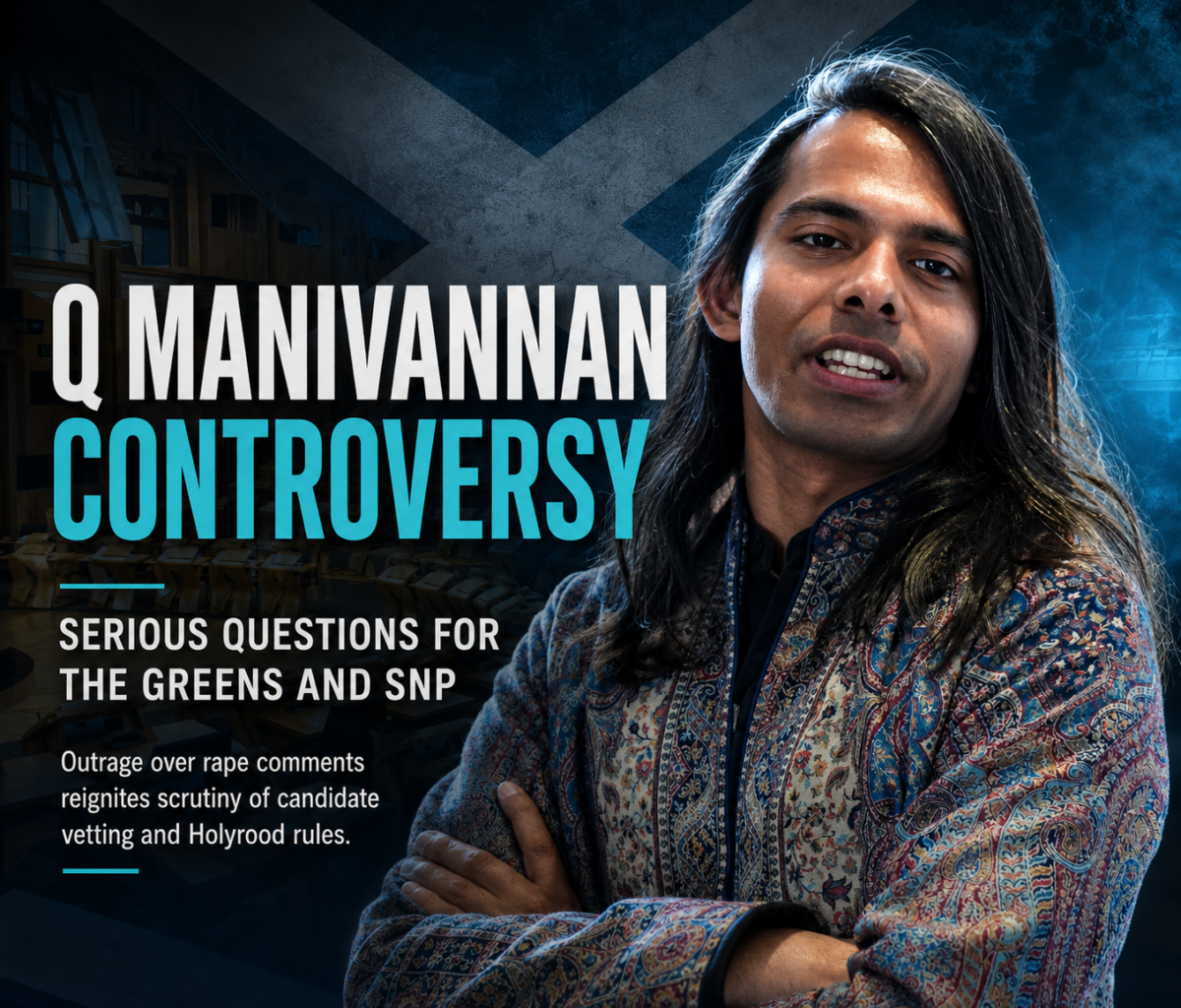
Q Manivannan Controversy Raises Serious Questions for the Scottish Greens and SNP
Comments made by Scottish Green MSP Q Manivannan about rape have rightly caused outrage and raise serious questions not only about the judgement of the MSP concerned, but about the political culture that placed them in the Scottish Parliament in the first place.
In a podcast recorded before their election to Holyrood, Manivannan spoke of a supposed “demonisation of rape”, described rape as being on a “spectrum” and discussed what he called different “modes” of consent.
Whatever wider philosophical argument Manivannan believed he was making, these are extraordinary words for an elected legislator to use when discussing one of the most serious crimes that can be committed against another person.
Rape is not an abstract academic exercise. It destroys lives. Victims can live with the physical and psychological consequences for decades.
That is why the reaction has extended far beyond party politics. The Scottish Rape Crisis Alliance rejected the suggestion that there should be any hierarchy of rape, while Reem Alsalem, the United Nations Special Rapporteur on violence against women and girls, also criticised the idea that rape should be described as existing on a spectrum.
Manivannan has subsequently apologised for the language used and said the remarks were intended to challenge stereotypes about perpetrators rather than diminish the seriousness of rape. He has also argued that extracts from the podcast were circulated without the full context. Those explanations should be reported, but they do not make the original language any less troubling.
An MSP should not require days of clarification to explain that rape is an appalling crime.
The Comments That Sparked the Controversy
The Scottish Greens Have Questions to Answer
There is also a question for the Scottish Green Party.
Manivannan did not arrive in Parliament by accident. He was placed on the Scottish Greens’ regional list for Edinburgh and Lothians East and subsequently elected as one of the party’s regional MSPs in May 2026.
Political parties are responsible for the people they put before the electorate.
Candidate selection should involve more than checking whether someone shares the ideology of the party leadership. It should involve serious scrutiny of judgement, previous public statements and whether a candidate possesses the temperament expected of somebody who could become a national legislator.
The podcast containing these remarks was publicly available before the election.
The Scottish Greens therefore need to explain whether they knew about these comments when Manivannan was selected and, if not, what level of vetting actually took place.
But There Is Another Question: How Was Someone on a Temporary Student Visa Able to Become an MSP?
The controversy also brings renewed attention to something Reform and many voters found remarkable immediately after the election.
When Q Manivannan was elected to Holyrood, he was an Indian national living in Scotland on a temporary student visa which was due to expire later in 2026.
Until recently, someone in that position could not have taken a seat in the Scottish Parliament.
That changed because of legislation brought forward by the SNP Scottish Government.
The Scottish Elections (Representation and Reform) Act 2025 extended candidacy rights for Holyrood and Scottish local government elections to foreign nationals with limited leave to remain.
The Scottish Government explicitly said the purpose was to allow resident foreign nationals with temporary immigration permission to stand for election. The new provisions came into force on 1 August 2025.
That meant that someone could come to Scotland on a temporary visa, stand for the Scottish Parliament and potentially be elected for a five-year parliamentary term even when their existing permission to remain in Britain would expire long before that term ended.
That is precisely the situation which arose with Manivannan.
Legal analysis following the election confirmed that the 2025 changes meant a person with any form of lawful leave to remain — including a student visa — could be returned as an MSP. There is no requirement for their existing immigration permission to cover the full parliamentary term.
The SNP Government Was Warned About the Obvious Problem
Even more remarkably, this possibility was not unforeseen.
During consideration of the legislation, the Scottish Government itself acknowledged that somebody elected under the new rules could have their leave to remain expire during their period in office.
Yet it pressed ahead.
The argument made by the SNP Government was essentially that voters should decide whether someone with temporary immigration status was suitable to represent them. Parliamentary business minister Jamie Hepburn argued during the legislation’s passage that it was ultimately for the electorate to make that judgement.
That answer ignores an obvious difficulty with Scotland’s regional-list system.
Voters do not choose individual candidates on a party’s regional list.
The political party chooses them and determines their order.
Manivannan was elected through the Edinburgh and Lothians East regional list. Voters cast a regional vote for the Scottish Greens; they did not individually select Q Manivannan to represent them.
That makes proper candidate scrutiny even more important.
Holyrood’s Rules Need Reconsidered
It should also be acknowledged that the SNP was not alone when the electoral legislation finally passed. The parties represented in the previous Scottish Parliament supported the legislation unanimously. Reform UK had no MSPs in Holyrood at that time.
But it was an SNP Government Bill, reflecting an SNP Government policy, and ministers actively defended the principle behind it.
Reform Scotland believes that principle should now be reconsidered.
There is an entirely reasonable distinction between somebody having permission to live, work or study in Scotland and somebody being eligible to become one of the 129 people responsible for making Scotland’s laws.
Membership of the Scottish Parliament is not simply another job.
MSPs legislate, scrutinise government, influence taxation and public spending and make decisions affecting more than five million people.
Requiring somebody seeking that responsibility to possess a secure and lasting right to remain in the country is hardly an unreasonable standard.
Scotland Deserves Better Judgement
The immediate issue remains Manivannan’s comments about rape.
Those comments deserve scrutiny on their own merits, and victims of sexual violence deserve considerably greater sensitivity from those holding public office.
But the controversy also exposes wider questions about political judgement.
The Scottish Greens must explain how someone who had publicly made these remarks passed their candidate-selection procedures.
And the SNP must defend an electoral system it deliberately changed so that somebody whose permission to remain in Britain might expire during their parliamentary term could nevertheless become an MSP.
Scotland’s Parliament should represent the people of Scotland with seriousness, responsibility and sound judgement.
On both candidate selection and electoral reform, voters are entitled to ask whether Holyrood’s political establishment has set the bar far too low.