Justice
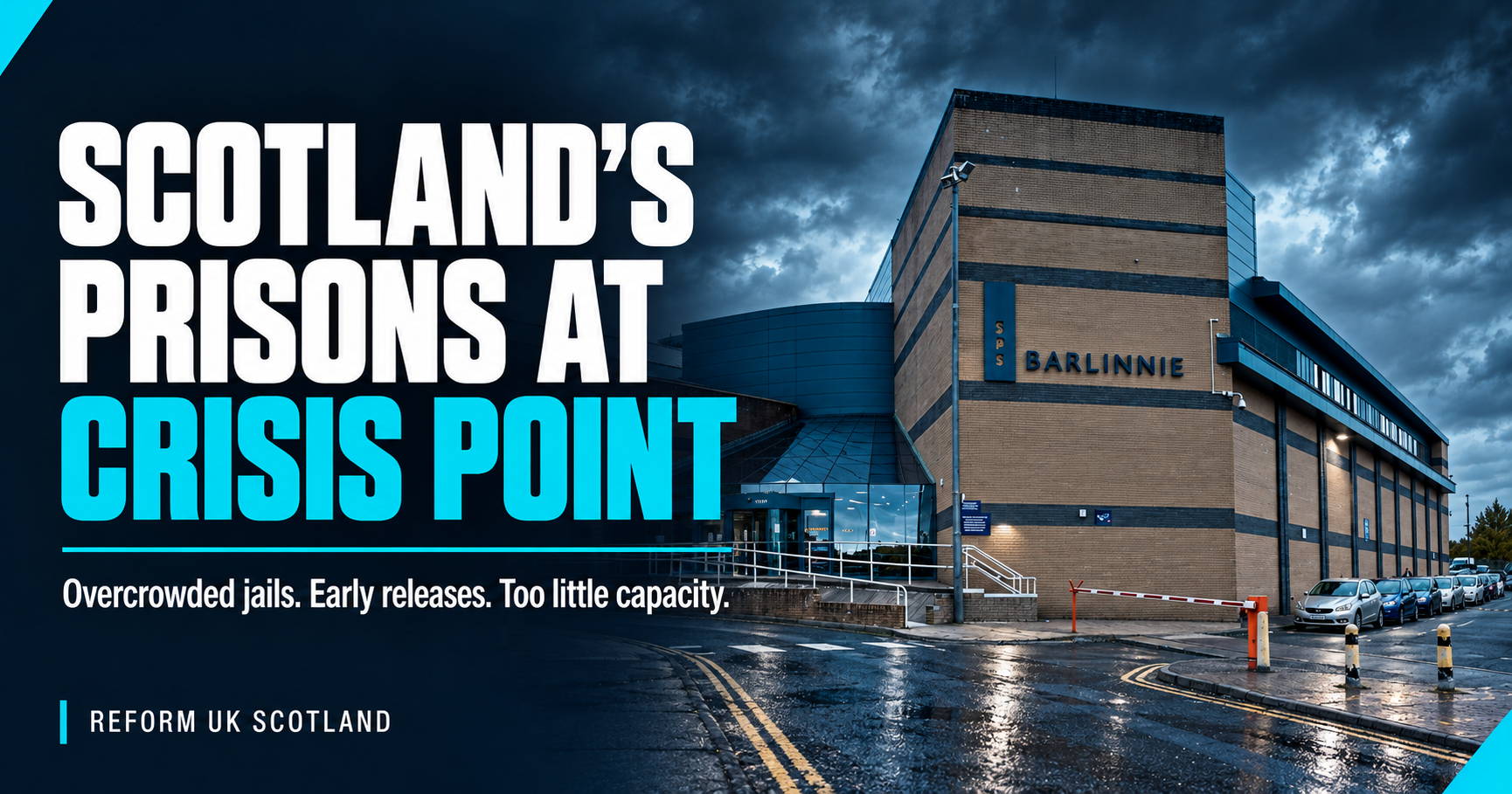
Scotland’s Prisons at Crisis Point
Overcrowded Jails, Early Releases and a Replacement for Barlinnie That Is Already Too Small
Thomas Kerr, MSP for Glasgow and Deputy Leader of Reform UK Scotland, has asked ministers where Barlinnie’s prisoners will go when the jail closes. His question follows a Freedom of Information response from the Scottish Prison Service showing that Barlinnie held 106 more people on 1 September than HMP Glasgow is being built to take. Across Scotland, 8,587 people were being held in an estate designed for 7,805 — a shortfall of 782 places.
Ministers call HMP Glasgow an expansion. Their go-ahead notice says the prison “will have a capacity of 1,344 — adding 357 more places to the overall prison estate” when it is completed in 2028. But that claim compares the new prison with Barlinnie’s design capacity of 987, not with the number of people now held there. One figure describes what the old building was designed for; the other records the overcrowding the replacement must actually relieve.
106 places short of the prison it replaces
Barlinnie’s design capacity is 987. The Scottish Prison Service business case for HMP Glasgow says the jail has been overcrowded for decades, “consistently housing far more people than its design capacity of 987, with numbers often exceeding 1,300.” The same document warns that replacing it with a prison of similar size “would simply shift the overcrowding elsewhere.”
By 1 September, Barlinnie’s population had reached 1,450. That is 147 per cent of its design capacity and 463 people above the baseline ministers use for their claim of 357 extra places. Even at HMP Glasgow’s maximum occupancy, 106 of those prisoners would have no place. The replacement therefore begins with a shortfall against the population it is meant to inherit.
Each bar is a share of 1,450. The 1,344 figure is the government’s maximum, not 1,344 ordinary single cells.
The business case also reveals what sits behind the headline capacity. HMP Glasgow will have 1,200 cells. Doubling 120 of them raises capacity to 1,320, while a specialist social and palliative care unit provides another 24 spaces. Only with both additions does the prison reach its “overall maximum designed occupancy” of 1,344. The figure ministers quote therefore already relies on shared cells and specialist accommodation.
Set against the 1,450 people held on 1 September, the single-occupancy prison is 250 places short. Using the doubled cells cuts the gap to 130. Counting every specialist place still leaves 106 prisoners without a bed.
| What is being counted | Places | Against 1,450 |
|---|---|---|
| Barlinnie design capacity | 987 | 463 over design |
| HMP Glasgow, single occupancy | 1,200 | 250 short |
| HMP Glasgow, doubled contingency cells | 1,320 | 130 short |
| HMP Glasgow, maximum | 1,344 | 106 short |
| Barlinnie, 1 September 2026 | 1,450 | 147% of design |
The FOI confirms that 12 of Scotland’s 17 prisons were operating above design capacity. Nor do the two flagship replacements catch up with the existing population. HMP Glasgow and HMP Highland are planned to provide 1,544 places between them; Barlinnie and Inverness held a combined 1,565 people on 1 September. On that snapshot, the new prisons together provide 21 fewer places than the establishments they replace were already using.
Where the “357 extra places” comes from
The 357 figure is not false; it answers a narrower question. It measures HMP Glasgow’s planned capacity against Barlinnie’s official design, while the 106-place shortfall measures the new prison against Barlinnie’s actual September population. Ministers have repeatedly promoted the first comparison without setting out the second.
The government sum
1,344 − 987 = 357
Maximum design of the new prison, minus design capacity of the old one.
The people in the building
1,344 − 1,450 = −106
The same maximum, set against the prisoners Barlinnie held on 1 September.
Capacity is not the only figure to have changed. The project was costed at £400 million in 2019; the approved total is now £998.4 million. That includes the land, VAT and a £683.8 million construction contract. The Prison Service business case, approved by ministers in January 2025, still gives a delivery date of 2028. Scotland is therefore paying almost two and a half times the original projection for a replacement that, on September’s numbers, cannot hold Barlinnie’s existing population.
Neil Gray answered a different question
Kerr’s first question, lodged on 6 October, asked where Barlinnie’s prisoners would be held after it closes. He set out the figures from the FOI response: 1,450 people in the existing jail and 1,344 places in its replacement. Justice Secretary Neil Gray replied on 14 October without disputing either number.
“As a replacement for HMP Barlinnie, HMP Glasgow, will deliver a modern, safe and secure accommodation that increases the overall design capacity by 357 spaces.”
“Detailed transition arrangements for the opening of HMP Glasgow are currently being developed by the SPS National Population Management Team, and consideration of prisoner allocation across the prison estate will form part of this planning.”
Gray’s answer repeats the increase in design capacity, but never says where the prisoners who do not fit will go. The FOI is no more reassuring. Asked for plans beyond Glasgow and Highland, the Prison Service said ministers had requested further options but that discussions and assessments were still under way. No decision had been taken on the number or location of new houseblocks, while possible modular accommodation at Castle Huntly remained at an exploratory stage with no commitment to buy it.
This is not planning for future growth; it is a search for somewhere to put prisoners who are already in custody. On 2 September, Gray told Parliament that Scotland held more than 8,500 prisoners against a design capacity of 7,800. The FOI confirms the exact position a day earlier: 8,587 people and 7,805 places. Replacing Barlinnie with a prison that is smaller than its current population cannot close that gap.
Kerr lodged a follow-up on the day Gray replied. S7W-04290 asks where the prisoners will be transferred, how much room exists elsewhere in the estate and whether the promised 357 places are merely a design-capacity increase or a genuine operational gain over Barlinnie. The answer is due on 11 November 2026.
“It will not even have the beds”
“Scotland’s jails have reached crisis point under the SNP with the government gambling on hundreds of early releases to fix an overcrowding crisis.”
“Now we learn the long-delayed, overbudget replacement for Barlinnie – HMP Glasgow – will not even have the beds to house the prison’s current population.”
“The public will look at HMP Glasgow as having the capacity for hundreds more prisoners without realising that as of September 1, the old prison is housing 147% of its official capacity.”
“Scotland is being suffocated by repeated failure and any hope invested in the scandal of early release evaporated once it was discovered a significant number end up back inside in a matter of days.”
“Hard-working Scots deserve better than this never-ending carousel of missed targets and broken promises.”
The Prison Service papers support the two central comparisons in Kerr’s statement. The projected cost has risen from £400 million in 2019 to £998.4 million, while 1,450 prisoners in a jail designed for 987 puts Barlinnie at 147 per cent of capacity.
When capacity fails, the public pays
The consequences reach beyond prison walls. Scotland has already used emergency early release to relieve pressure on the estate. Between November 2025 and April 2026, 614 prisoners were released ahead of schedule in seven tranches. Without enough permanent capacity, ministers will remain under pressure to reach for the same remedy again.
The Prison Service has published return data for the first 286 of those releases. Thirty-four people — 12 per cent — were back in custody before the date on which they would originally have been released. They had spent between two and 87 days in the community, with an average of 28. The Prison Service rightly cautions that a return to custody is not the same as a proven reoffending rate: the figures include convictions, remand for alleged offences and people later released. They do, however, show how quickly some of the pressure returned to the prison system.
Every release made to solve a shortage of cells carries a risk that should never have been created by a failure to plan. If more offenders are released early and some offend again, communities bear the consequences while victims are left wondering what the sentence meant. A justice system in which time served depends on available bed space gives the public every reason to feel that justice has not been done. Failing to provide enough capacity for the existing prison population is a dereliction of the SNP Government’s duty to protect the public.
749 non-UK nationals: an estimated £41.3 million a year
The Times reported on 16 August 2026 that 749 non-UK nationals were being held in Scottish prisons, almost 100 more than the 653 recorded by the Prison Service on 22 May 2025. Of the 749, 409 had been convicted and 340 were on remand. These are nationality figures, not birthplace figures, and the total includes people awaiting trial or sentence. It is not a count of 749 convicted prisoners who could simply be removed from the estate.
Estimated at the SPS average cost
- Per year
- £41.3m
- Per month
- £3.44m
- Per day
- £113,050
The Scottish Prison Service reports an average annual cost of £55,091 per prisoner place for 2025–26. That measure excludes capital charges, exceptional payments and the court custody and prisoner escort contract. Applying it to the 749 reported in August produces an estimated annual cost of £41,263,159. On the broader resource-accounting measure, which includes depreciation and impairment charges and averages £60,919 per place, the estimate rises to £45.6 million.
The 749 was a reported snapshot, not a live count for today. Prison populations move: a later SPS response recorded 731 foreign nationals on 10 September. Nor are the estimates an audited bill for those particular prisoners. They apply an estate-wide average, and any cash saving would depend on whether staffing, accommodation and other costs could actually be reduced. Even with those cautions, the calculation shows the scale of the burden carried by taxpayers in an estate already hundreds of places short.
Westminster · Reform UK national policy
Serve the sentence abroad, then deport
Reform UK’s Keeping Criminals Behind Bars policy says foreign national offenders given custodial sentences would serve the full remainder abroad, either in their home country or in prison places rented from another country. The paper names El Salvador and Kosovo as examples of countries offering prison capacity. Once the sentence is complete, the offender would return home and face a lifetime ban on re-entering the United Kingdom.
Foreign criminals given non-custodial sentences would be deported. Nationally, Reform says this programme would free 10,000 places in British prisons within months. That is a UK policy objective, not a claim that 10,000 places would be created in Scotland or that every non-UK national in the August snapshot qualifies.
The distinction matters: Reform’s policy is not early release. Custodial sentences would still be served, but abroad rather than at full cost in an overcrowded British prison. Scottish prisons and sentencing are devolved to Holyrood, while immigration and deportation are reserved to Westminster, so applying the national programme to prisoners in Scotland would require both governments to do their part.
Reform’s answer: build capacity, end early release
Holyrood · 2026 manifesto, page 12
Prisons, sentencing and early release in Scotland are controlled at Holyrood. Reform UK Scotland’s 2026 manifesto pledges to increase prison capacity, end early release and impose high prison sentences on repeat offenders. Courts cannot protect the public if the prison estate has no room to enforce their sentences.
Barlinnie needs replacing, and HMP Glasgow should provide safer, more modern conditions. But replacing the building without accommodating the people inside it is not enough. After years of delay and a cost approaching £1 billion, the SNP still has no settled answer for the overflow and no final plan for the extra houseblocks Scotland already needs. Kerr has asked where the remaining prisoners will go. Ministers are not due to answer until 11 November.
Reform UK Scotland
Scotland needs reform, and Reform UK needs you
Join, volunteer, stand, or back your local branch.