Brexit
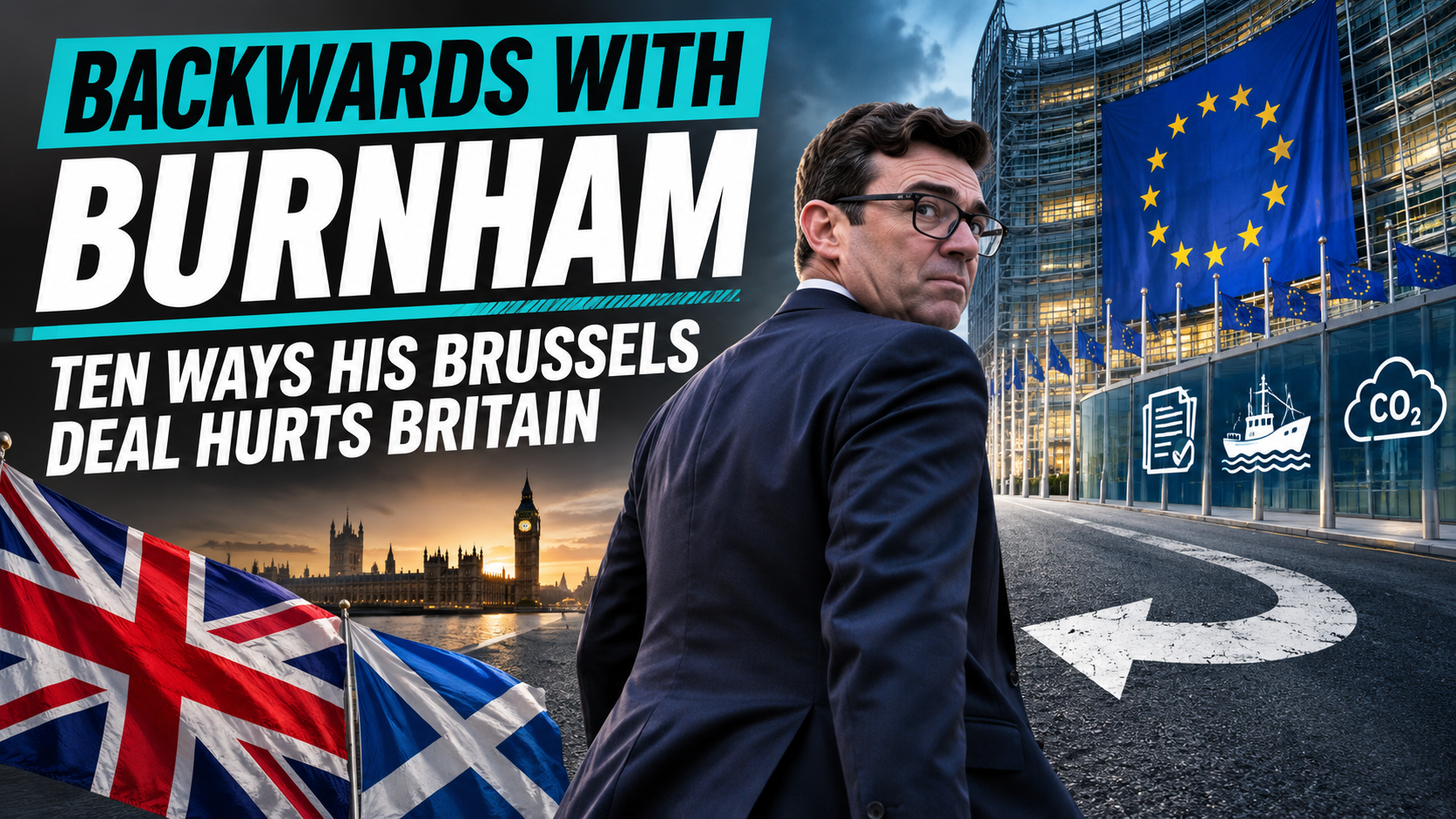
Backwards with Burnham: ten ways his Brussels deal hurts Britain
Andy Burnham went to Brussels on Friday and signed Britain up to EU food rules, EU carbon trading and a new route into the country for 100,000 young Europeans a year. Nigel Farage was there to answer him. These are the ten points that matter most, the facts behind them, and what they mean for Scotland.
Farage in Brussels
On Friday Andy Burnham arrived in Brussels for his first EU summit as Prime Minister, was greeted by a string quintet, and signed Britain up to the biggest step back towards the European Union since the country voted to leave. Nigel Farage made the same journey. He took the Eurostar, held his own press conference in the city, and gave his verdict on the day in three short sentences.
“Today was not a reset. It was a reversion back to pre-2016 referendum ideas. It was an overturn, more than a reset.”
The package has three parts. A food and drink agreement scraps most of the checks on animal and plant products moving between Britain and the EU from 1 March 2028, and in return Britain will follow EU rules in those areas. A second agreement links Britain’s carbon trading scheme to the EU’s from 2028. The third, a “youth experience scheme”, will let up to 100,000 Europeans aged 18 to 31 come to live, work and study in Britain every year, each for up to three years, starting no later than 2030. A row over university tuition fees has been parked for six months, and the next deal, which would take Britain back into the EU’s electricity market, is pencilled in for 2027.
Farage did not pretend there was nothing in it for anyone. He accepted that the food deal could make life easier for some exporters and for people taking their pets abroad. His point was about the balance: “whatever the minor red-tape tick, the downside for industry as a whole will be absolutely enormous.” Burnham says the Treasury believes the whole package could add up to £17 billion a year to the economy. Yet when the House of Lords European Affairs Committee examined the food deal, it found that the official assessments had left out the cost to businesses that never trade with the EU at all.
Burnham calls the deal “probably the limit” of what can be done in this Parliament, and has agreed an “informal brainstorming process” with Brussels on what comes next. Farage’s reading is simpler. The deal, he said, “was about the first steps, incrementally, to taking us back into membership of the European Union.”
- 100,000
- Young Europeans a year allowed into Britain under the youth scheme, each for up to three years
- 780+
- Pieces of EU farming law a year Britain could have to follow, on evidence given to the House of Lords
- 2038
- EU boats keep full access to British fishing waters until then, and the deal leaves that untouched
- £150
- Reform’s estimate of the extra on the average family gas bill from joining EU carbon trading
- 0.0%
- The Treasury’s own estimate of the youth scheme’s effect on GDP per head
Ten ways the deal hurts Britain
Reform has gone through the summit statement, the Government’s own figures and everything Farage said this week in Brussels, on LBC and in the Mail on Sunday. These are the ten points that do Britain the most damage, each with the facts behind it.
1A manifesto promise broken
Labour won the 2024 election on a manifesto that said, in black and white, “there will be no return to the single market, the customs union, or freedom of movement.” Burnham went further this summer, telling voters in the Makerfield by-election that he would not re-run the Brexit arguments. On the eve of the summit he even set himself three tests, the first of which was that any deal must keep to Labour’s manifesto. Farage says the deal failed that test on day one.
“The most significant thing that happened today is that the European Community has accepted the UK back into a large chunk of the single market. That is Burnham’s manifesto breach.”
Britain has not formally rejoined the single market. But in return for fewer checks, it will apply EU food and farming rules across the whole economy, not only to the firms that export. Farage also pointed out that a decision of this size has been taken by a Prime Minister with a personal mandate of “just 25,000 votes”, won in a seat that, as Reform has pointed out, voted overwhelmingly to Leave in 2016. “It is utterly shameful in every regard,” he said.
2Rules made in Brussels, obeyed in Britain
The price of fewer checks is what the negotiators call dynamic alignment. Britain will follow EU law in the areas the deals cover, including new rules written in future that no British minister or MP will have voted on. The UK will be allowed to sit in on some EU meetings as an observer, with a small upgrade for emergencies such as animal disease outbreaks, but it will not have a vote.
Farage put it in plain terms on LBC. Dynamic alignment, he said, means “the European Union makes a regulation or a directive, and the entirety of the British economy has to abide by it.” And if all 650 MPs voted against it, “it wouldn’t matter.” When Business Secretary Jonathan Reynolds told the same station that EU laws could not take effect in Britain without Parliament’s approval, Farage accused him of “lying” and called the deal “a massive sellout”. This is the heart of Reform’s objection. The point of Brexit was that the people who make your laws can be removed at the ballot box. Nobody in Britain can vote out the people who will write these rules.
The facts
The Guardian’s summary of the summit text: the UK “will be required to align with EU law in these areas, including new rules that it never had a say in writing.” Britain can attend relevant EU meetings as an observer without voting rights. Those details sit in a separate text, not in the main agreement.
3The European Court is back
Ending the reach of the European Court of Justice was one of the central promises of Brexit. Under the framework these deals are built on, disputes go to arbitration, but the European Court remains the authority on any question of EU law. Since the rules Britain will be following are EU law, that hands judges in Luxembourg the final word on what they mean. Farage told LBC that the deal subjects “everyone involved in the food industry to European rules and regulations overseen by the European Court”. Ten years after the referendum, that is a remarkable thing for a British government to sign.
The facts
The House of Lords Library, on the 2025 framework agreed by Sir Keir Starmer: the agreements would use arbitration to settle disputes, “but there would be a role for the European Court of Justice as the authority for questions of EU law.”
4A burden on firms that never export
The food deal helps the businesses that sell into Europe. Every other food business in Britain gets the rulebook without the benefit. Farage’s example was the local baker who does no business with Europe at all: “even he or she will have to abide by that rule.” The House of Lords European Affairs Committee heard evidence that farming legislation alone could generate “at least 780 pieces of in-scope EU law a year”, roughly two a day, and that firms trading entirely within Britain would have to comply. Its chairman, Lord Stirrup, warned: “This may sound like a technical issue, but the rules in question can affect everyday matters, from food standards and consumer prices to business costs and household budgets.”
Richard Tice made the same point on Sky News on Sunday. “A few exporting food businesses may benefit,” he said, but “the extra burdens of EU regulations that will be forced through dynamic alignment across all UK businesses is way more than that small net benefit.” Reform’s Contract with Small Business already records that about half of small firms name regulation as a barrier to growing. Burnham’s answer is to hand them a new rulebook they cannot vote out.
5Carbon taxes locked in
The second deal ties Britain’s Emissions Trading Scheme to the EU’s from 2028. Labour’s case is that this spares British steel and fertiliser from the EU’s new border carbon levy. Reform’s case is that it binds British homes and industry to Brussels’ carbon prices for good.
“We’re going to join the European carbon trading scheme. We estimate already that will put £150 on the gas bill of the average family home in Britain and continue the rapid deindustrialisation of a country that has got its energy strategy so totally wrong.”
Reform’s own plan goes the other way. The Economic Rescue Plan and the First 100 Days pledges abolish the UK Emissions Trading Scheme and Carbon Price Support, which together make up about £90 of the £250 a year Reform has costed off a typical household energy bill. They would also stop the Carbon Border Adjustment Mechanism, fertiliser tax included. Like the food deal, the carbon link comes with alignment to EU rules. A Britain tied into Brussels’ carbon market would find it far harder to scrap its own carbon taxes, and that is precisely why Labour’s deal and Reform’s plan cannot both stand.
6The Burnhamwave
The youth experience scheme lets up to 100,000 Europeans aged 18 to 31 into Britain every year, each for up to three years. Burnham sold it to young Britons as a chance to work and study abroad. Farage looked at the other side of the ledger. The scheme, he said, opens the door to “up to 300,000 people coming in over the course of the next three years to compete for jobs in the UK labour market.” He set that against the Milburn report which, he said, found that the immigration of young people was damaging the prospects of a million young Britons not in education, employment or training.
The Treasury’s own figures make his case for him. Its methodology note, published on the day of the summit, says the scheme would make the economy up to 0.2 per cent bigger five years after it starts, largely because there would be more people in it. The effect on GDP per head, the measure that tracks living standards, is 0.0 per cent.
“You read that right. More immigration, no net benefit to the economy… Eat your heart out Boriswave. Here comes the Burnhamwave.”
For Reform this is about trust as much as numbers. Voters were promised lower immigration after Brexit and got the Boriswave instead: 3.8 million long-term visas between January 2021 and June 2024, as Reform’s own costing of that wave records. Burnham insists his scheme is not free movement. Farage’s verdict in Brussels was that he had “opened the door to free movement, open-door immigration.”
7Strong-armed over student fees
The summit nearly came apart over university fees. The EU wants its students to pay the same as British students, capped at £9,790 a year in England, rather than international rates that can be four or five times higher. Britain resisted, so the question was parked for six months. The EU then issued a statement of its own, outside the joint text, saying it would not sign off any of the three deals without equal treatment on fees. The Prime Minister says the deal is done. Brussels says it is not done until it gets its way.
“Naive Andy Burnham has gone to Brussels and been hit by the stark reality I’ve warned about for decades. Flexibility is a fantasy. They’ve used this moment to strong-arm the British prime minister over tuition fee cuts for hundreds of thousands of EU students.”
Reform has warned that cutting EU students’ fees could leave universities with £1.5 billion of unpaid student loan debt. Its education spokesman, Suella Braverman, called it “disgraceful that Andy Burnham is willing to spend hundreds of millions cutting student fees for foreign students while allowing British youngsters to be ripped off with mountains of debt.”
In Scotland the question is sharper still. University funding is devolved, and before Brexit EU students at Scottish universities paid no tuition fees at all, just like Scottish students, with the Scottish Government meeting the cost. Neither government has said how the EU’s demand would apply north of the border. If “equal treatment” means a return to that arrangement, it is Scottish taxpayers who would pay, at a time when Scottish school leavers already compete for a capped number of funded places.
8The “Farage penalty”
Days before the summit, The Times reported that negotiators had agreed a clause in the food deal requiring whichever side walks away to pay compensation, covering the cost of putting the deal in place and of bringing back food checks across the Channel and the Irish Sea. Europe minister Hamish Falconer acknowledged that an exit clause could be included. It was quickly nicknamed the “Farage penalty”, because Farage has said he would take Britain out.
“If Andy Burnham were to do this, it would be wholly illegitimate. He cannot bind a future British government. I am putting the EU on notice. If I am Prime Minister after the next election, I will renege on this deal.”
Government sources say clauses like this are normal and would apply to both sides. The final wording, and how much a future government could be asked to pay, have not been published. Reform’s objection is one of principle. A deal that fines the British people for changing their government is not a partnership. It is a lock on the door.
9Fishing left on the table again
Last year’s reset under Sir Keir Starmer extended EU boats’ access to British waters until 2038, a deal The Telegraph reports will let the EU take £6 billion of fish. Burnham has not reopened it. A leaked draft of the summit statement “welcomes” full reciprocal access until 2038, with no plan to revisit it. That matters more in Scotland than anywhere else. Scotland lands 60 per cent of the UK’s catch, and Peterhead is one of the largest fishing ports in Europe.
The industry’s fear is that the food deal becomes a back door. Elspeth Macdonald, chief executive of the Scottish Fishermen’s Federation, said fishermen were “nervous” that dynamic alignment with EU rules could one day “trap the UK back” in the Common Fisheries Policy. She drew the line clearly: “there is a fundamental distinction between the arrangements governing how we sell our fish and those governing how we catch them.”
“Labour have extended the Tories’ terrible fishing agreement for another 12 years for nothing in return as part of their sellout ‘reset’ deal.”
10Paying for the privilege, with more to come
Britain will pay for these arrangements. The 2025 framework commits the UK to an “appropriate financial contribution” towards the EU’s costs under the food and carbon deals. The electricity deal due next year goes further: in return for access to the EU market, Britain will be expected to pay into the EU budget that supports poorer EU regions. Nobody has said how much.
And this is only the start. “Incremental steps only take us so far,” Burnham told the summit. He has said Britain lost more than it gained from Brexit, that the options for the future run all the way to rejoining the customs union, the single market or a fresh referendum on full membership, and that he hopes to see Britain rejoin in his lifetime. One senior ally told The Sunday Times: “He wants to rejoin. That’s the truth of it.”
“I can see he’s setting this up for a Brexit-style general election in May. This is not a fight that I’ve picked. But it’s a fight that he’s picked. I am ready for this fight.”
The Brexit they never delivered
On 23 June 2016, 17.4 million people voted to leave the European Union. It was the largest vote for anything in British history, on a turnout higher than any general election since 1992. Nobody who voted that day could have been in any doubt about what was supposed to happen next. The Government’s own leaflet, sent to every household in the country at the taxpayer’s expense, spelled it out.
“This is your decision. The Government will implement what you decide.”
The trouble was that the people charged with implementing it never wanted it. On the eve of the vote, 479 of the 650 MPs had declared for Remain and only 158 for Leave. Among them were 218 Labour MPs and 185 Conservatives. Parliament had handed the question to the people by 544 votes to 53, and the people gave an answer that three quarters of the Commons did not want. What followed was not delivery. It was damage limitation.
It went on for three and a half years. Theresa May’s withdrawal agreement was defeated by 230 votes, the heaviest defeat for any government in modern parliamentary history, and twice more after that. MPs passed laws to take leaving without a deal off the table, and with it the strongest card any British negotiator held. Sir Keir Starmer, then Labour’s Brexit spokesman, told his party conference that “nobody is ruling out Remain as an option”, and by 2019 Labour was promising a second referendum. It took a general election and an 80 seat majority to get Britain out at all.
Even then, the people running the country treated leaving as a box to tick rather than a chance to take. Reform’s Economic Rescue Plan records that more than ten years on, 4,221 pieces of EU law, 61 per cent of the total, are still in place unchanged. The Retained EU Law Act was supposed to sweep them away by the end of 2023. The sunset clause was scrapped, and of the 4,000 plus laws due to go, only 700 did. Fishing was traded away in the negotiations, and in Farage’s words, “the Conservatives betrayed those communities.” Immigration, the issue that drove so many to vote Leave, went up instead of down, with 3.8 million long-term visas issued in three and a half years. As Zia Yusuf puts it in Reform’s First 100 Days, the public’s wishes “were trampled on.”
Failure by design, then blamed on Brexit
Now the same establishment points at the result of its own half measures and calls it Brexit. Burnham says Britain has lost more than it gained. But you cannot judge a policy that was never carried out. A country that kept most of the EU rulebook, gave away its fishing, let immigration soar under its own steam and never cut the red tape it was finally free to cut has not tested Brexit. It has tested the people who refused to do it. Their failure is now being presented as the reason to go back, and the road back is being built on exactly the terms that the Government’s own Remain leaflet once warned against.
What they told you in 2016
The Government’s 2016 leaflet, written to persuade people to vote Remain, warned that no country had won significant access to the single market without having to “follow EU rules over which they have no real say”, “pay into the EU” and “accept EU citizens living and working in their country”. Ten years later, Burnham’s deal does a version of all three: dynamic alignment with EU rules, an “appropriate financial contribution”, and a scheme for 100,000 young Europeans a year.
A vote is a vote
Sixteen million people voted Remain in 2016, and most of them did what democrats do. They accepted the result. At the general election a year later, the Conservatives and Labour both stood on manifestos that promised to respect it. Labour’s said plainly that “Labour accepts the referendum result”. Between them those two parties won more than four in every five votes cast. In 2024 Labour promised again: no return to the single market, the customs union or freedom of movement. The voters kept their side of the bargain. Their representatives did not.
That is why this matters to everyone, not only to those who voted Leave. If a government can quietly set aside the largest democratic vote in the nation’s history because it dislikes the answer, then no vote is safe. A principle like that does not stay where it is put. Today it is a referendum the establishment never wanted. Tomorrow it could be an election result, a local decision, or a right that people of every political view take for granted. Anyone tempted to cheer the rule being broken this time, because they happen to like the outcome, should ask how they will feel when it is broken against them.
Scots understand this better than most. In 2014 Scotland voted by 55 per cent to 45 to stay in the United Kingdom, and unionists have spent the years since insisting that the result be respected. They are right, and Reform’s Scottish manifesto rejects another independence referendum as a distraction the public does not want. The same principle has to apply to 2016, when more than a million Scots voted to leave. Nobody can demand that the SNP honour one referendum while applauding Westminster for unpicking another.
Democracy rests on a simple bargain. The losers accept the result, and the winners get what they voted for. In 2016 the losers, by and large, kept their part of it. It was the establishment that would not.
What it means for Scotland
Scotland voted to Remain in 2016, and Reform does not pretend otherwise. But the parts of this deal that bite hardest bite here. Scotland’s fishing communities are still waiting for the waters Brexit promised them, and Burnham has left EU access untouched until 2038. Reform’s Scottish manifesto records that Scotland received less than 8 per cent of the £360 million Fishing and Coastal Growth Fund, the “consolation prize” for last year’s reset, despite accounting for 60 per cent of the catch.
Scottish seafood exporters will welcome less paperwork at the border, and Farage himself accepted that some exporters will gain. The question is the price. Making it easier to sell fish should never cost Scotland control over how that fish is caught, and it should not mean every Scottish farmer, butcher and baker following rules written in Brussels.
Energy tells the same story. Refining at Grangemouth has already gone, and Reform’s Scottish manifesto warns that Scotland is de-industrialising under energy costs seven times China’s and four times America’s. Tying Britain’s carbon prices to Brussels makes that harder to fix, not easier.
The SNP’s answer is to go further than Burnham and rejoin the EU outright. Full membership would mean the Common Fisheries Policy in full. John Swinney said last year that the UK had “surrendered” its fishing industry in Starmer’s reset. It is hard to see how handing the whole industry back to Brussels would be any better.
Westminster and Holyrood
None of this is decided at Holyrood. The deal was negotiated and signed by the UK Government, and only a UK Government can renegotiate or repeal it. Reform’s MSPs can press the Scottish Government on the parts it runs itself, starting with what “equal treatment” on fees would cost Scottish universities and taxpayers. Undoing the deal takes a Reform government at Westminster.
What Reform will do
Farage has been clear that a Reform government would not keep this deal. Writing in the Mail on Sunday, he told the Prime Minister directly.
“So Andy, take this as notice: one of the first priorities of a Reform UK Government will be to repeal this pernicious deal.”
Reform’s published policies already point the same way.
- Fishing. Renegotiate the EU reset deal and the Trade and Cooperation Agreement to recover quotas for UK fishermen, end automatic access to the UK’s Exclusive Economic Zone for foreign vessels, and ban foreign supertrawlers entirely.
- Energy. Abolish the UK Emissions Trading Scheme and Carbon Price Support, stop the Carbon Border Adjustment Mechanism including the fertiliser tax, and cut household energy bills by £250 a year.
- EU law. Review all the unchanged EU law still on Britain’s books, and repeal whatever remains after five years unless Parliament decides to keep it.
- The exit penalty. Farage has said he would “renege on this deal”, and Reform has said a Reform government “would immediately rip it up”.
On immigration, Farage restated in Brussels the position he has held for years: “regulating and controlling your borders and running immigration on an Australian-style points system is the way that sensible, normal countries run themselves.” And if Burnham wants to take Britain back into the EU, Farage told Euronews, he will have to ask the people first: “If Labour, if Burnham, fights the next election on a ticket of rejoining the EU, he’d have to have a referendum.”
Burnham says the British people “will be the boss” of what happens next. Farage’s reply was that the people have not been the boss since 23 June 2016, when they voted to leave and then watched successive governments fail to deliver what they voted for. On his way to Brussels he summed up the choice in six words.
Forwards with Farage, or backwards with Burnham.
Britain should make its own laws, control its own waters and set its own energy prices. Scotland needs Reform.