

Glasgow
Twenty months on, Glasgow’s ‘safe’ room still leaves needles at the supermarket
In February 2025, Thomas Kerr filmed discarded needles beside Morrisons in Calton, yards from the UK’s first drug consumption room. Ministers called it disinformation. The official record since then is 15,688 injecting episodes, 195 medical emergencies, a death on Hunter Street, and a Freedom of Information reply that cannot quantify lives saved.
The Thistle opened on Hunter Street on 13 January 2025 as the United Kingdom’s first sanctioned safer drug consumption facility: a three-year pilot, funded by the Scottish Government at up to £2.3 million a year, not a one-off bill. People bring drugs they have bought elsewhere, inject under supervision, and leave. The promise was fewer overdoses, less public injecting, and cleaner streets in Calton.
Six weeks later, Thomas Kerr — then Reform UK’s first Glasgow councillor, now the party’s Scottish deputy leader and MSP for Glasgow — walked the ground beside Morrisons on Gallowgate and filmed what families were stepping over. Used syringes. Spoons. Drug debris in a supermarket car park, a short walk from the flagship room. SNP ministers and local councillors branded the concerns false and “disinformation.”
The video is still the evidence. Twenty months of official figures have not made it look like an exaggeration.
What Kerr showed in February 2025
Kerr said he wanted Scotland’s drug-death record tackled. What he would not accept was a “safe” room that left unsafe kit on the ground next to a shop used by families.


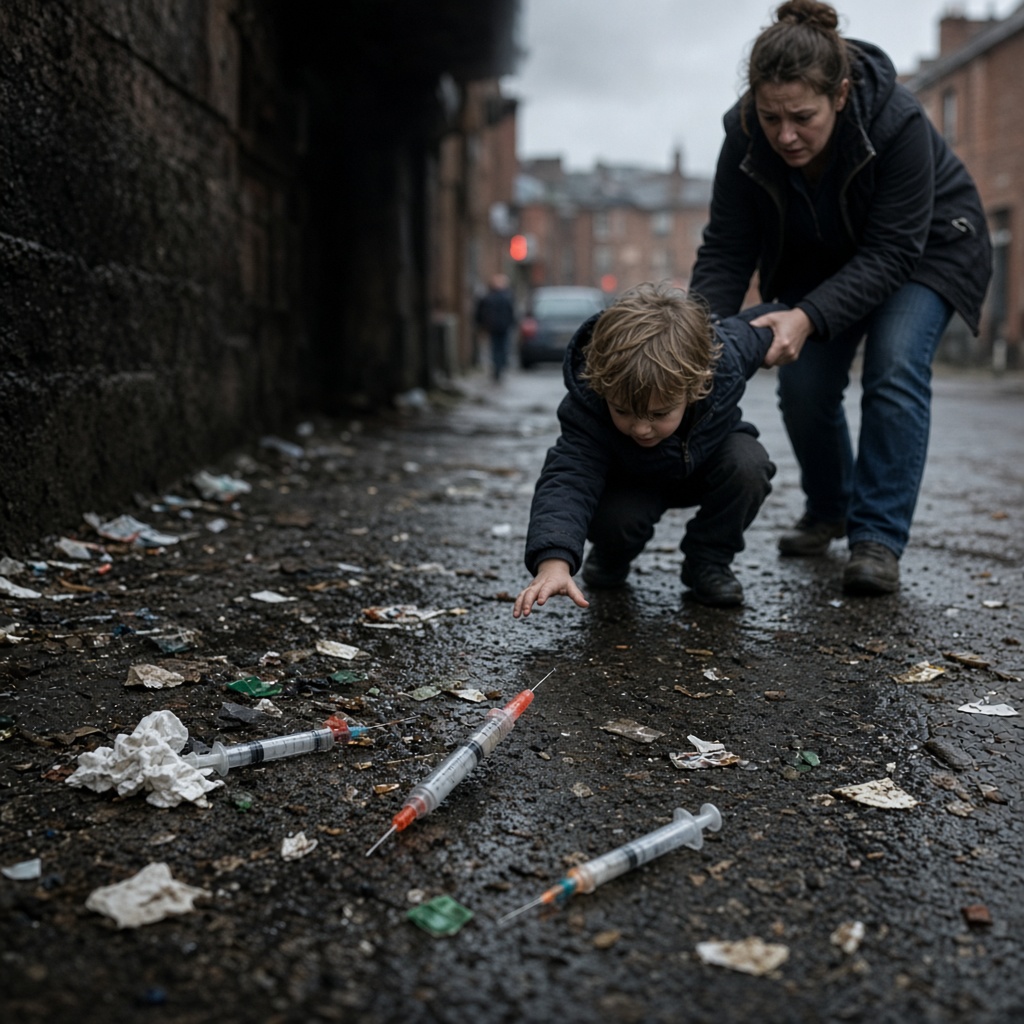
“If a child picks up one of these needles, then god help us.”
Residents were already saying the same thing in plainer language. One Glaswegian, speaking after Kerr’s footage circulated, put it like this:
“I have seen the drugs myself. It’s a total disgrace. Neil Gray is an idiot and a liar.”
The official record, to the end of August 2026
Glasgow City Health and Social Care Partnership publishes the Thistle’s own monthly figures. They are not Reform’s numbers. They are the service counting itself.
- 15,688
- Injecting episodes inside the room to the end of August 2026
- 22,533
- Registered visits — 336 in the first month, 1,362 in August 2026
- 195
- Medical emergencies on site, from observation to oxygen, naloxone or resuscitation
- 809
- Unique service users: 630 men, 179 women
| Measure | Jan 2025 | Peak month | Total |
|---|---|---|---|
| Visits | 336 | 1,582 (Feb 2026) | 22,533 |
| Injecting episodes | 268 | 1,136 (Feb 2026) | 15,688 |
| Medical emergencies | 0 | 21 (Feb 2026) | 195 |
Cocaine has been the majority substance declared in every month since opening. In January 2025 it was 84.1 per cent of declared use. In August 2026 it was still 61.3 per cent, with heroin at 23.5 per cent and heroin mixed with cocaine — a “snowball” — at 15 per cent. National Records of Scotland found cocaine implicated in 47 per cent of Scotland’s drug-misuse deaths in 2024, 479 people, the joint-highest cocaine figure in that series.
No death has been recorded inside the booths. That is the line ministers repeat. It is not the same as proving the room is cutting deaths in Glasgow, and it is not the same as making the streets around it safe.
The streets ministers said were a smear
Scottish Conservatives obtained council figures showing 175 reports of needles or drug paraphernalia within a mile of Hunter Street between opening and 20 May 2025. The Glasgow Times compared that with 187 reports in the five months before opening. The monthly average barely moved. In the two and a half years to mid-2025 the council logged 1,134 discarded-needle reports in the area.
By summer 2025, residents were still describing themselves as plagued by kit on the ground. Glasgow City Council then wrote to nearby postcodes to announce extra needle patrols and large-capacity sharps bins — including in the Morrisons Gallowgate car park, the same place Kerr had filmed. Locals told the Herald they felt vindicated. Some also said the bins themselves normalise needles on the street.
The partnership’s own first-year note later claimed a 79 per cent fall in needles found at Calton “hotspots” between May and November 2025. Read the next sentence on the same page. The new bins at Morrisons and Elcho Street accounted for 89 per cent and 92 per cent of the needles cleared at those sites over the same months. Most of what was “cleared” at the supermarket was going into a bin the council had put there because the problem had not gone away.
Discarded needles in Calton were a scandal before The Thistle opened. That is not a defence of the room. It is the test the SNP set for itself: a £2.3 million-a-year facility whose published aims include less public injecting and less drug litter. Twenty months later, families still shop beside a designated sharps point.
Deaths the room cannot claim, and one it cannot explain away
National Records of Scotland registered 1,017 drug-misuse deaths in 2024, down 13 per cent on 2023 and the lowest calendar year since 2017. Glasgow City recorded 185, down from 246. Those are confirmed figures for the year before The Thistle opened on 13 January 2025. They cannot be billed as the room’s result. Scotland still had one of the highest drug-death rates in the developed world, and Glasgow City still had the highest rate in the country.
Police Scotland’s suspected-death series is the latest official steer for 2025. It is scene-of-death management information, not the later NRS confirmation. In 2025 officers recorded 1,146 suspected drug deaths, 8 per cent more than in 2024. Greater Glasgow was the highest police division, with 243. Public Health Scotland, commenting on the 2024 NRS release, already noted that its RADAR surveillance had shown drug harms rising again during 2025.
On the morning of Sunday 8 March 2026 a man died outdoors on Hunter Street, outside the facility. Police taped the entrance. The force said the circumstances did not appear suspicious and that a report would go to the procurator fiscal. Glasgow City Council said it would not comment further. Ministers still say nobody has died inside.
Neil Gray, then Cabinet Secretary for Health, said the Thistle had had a “profound impact” in its first year and that it was “preventing deaths from overdoses.” A Scottish Government Freedom of Information reply later confirmed there is no completed internal analysis quantifying the facility’s effect on drug-related deaths, and that officials cannot precisely quantify lives saved. The claim rests on emergencies managed on site without a fatality in the booth. That is a narrower fact than the sentence the public was given.
The independent ENACT evaluation, led by Glasgow Caledonian University and the University of Glasgow and funded by the National Institute for Health and Care Research, is scheduled to run until 2029. Interim results are not due until mid-2027. The three-year pilot can be judged, expanded or copied long before that work reports. Gray told Westminster’s Scottish Affairs Committee that other areas, including interest from Edinburgh, would not have to wait for the Glasgow pilot to finish.
Accountability, not another slogan
Kerr asked Gray to come to Calton, see the debris and lead a clean-up. In written answers Gray later confirmed he had not held a specific meeting with Police Scotland about the Thistle’s impact, and had not held a specific meeting with Calton residents about it either. He said he would be happy to meet residents. He is now Cabinet Secretary for Justice. Angela Constance holds the health brief. Maree Todd is the minister for alcohol and drugs. The room is still there. The evaluation is still years away. The supermarket still has a sharps bin.
Health, policing, sentencing and prisons in Scotland are Holyrood’s business. Reform UK’s 2026 manifesto does not publish a line that says MSPs will close consumption rooms. It does publish a law-and-order offer: high sentences for repeat offenders, more prison capacity, and an end to the SNP’s early release policy. The UK website’s crime card is visible policing and mandatory minimums for serious and repeat offenders. Those are the published texts. They are not a licence to invent a drugs-treatment programme the index does not contain.
What the public can already see does not need a 2029 research paper. A supervised room can count injections and emergencies. It has not stopped Scotland recording more suspected drug deaths in 2025 than in 2024. It has not spared Calton a running argument about needles beside a supermarket. Kerr was right to put that on camera. Reform UK is still the opposition prepared to say so.
Get involved
Share the video. Ask the SNP why a flagship harm-reduction room still needs a sharps bin at Morrisons. If you want a Holyrood opposition that will not look away from what residents can see, join the campaign.
Reform UK Scotland
Scotland needs reform — and Reform UK needs you
Join, volunteer, stand, or back your local branch.