The First 100 Days: Reform Sets Out How It Would Govern Britain
Three days in Birmingham moved Reform UK beyond opposition politics and towards a much more demanding question: if voters hand Reform the keys to Downing Street, what happens next?
Reform UK’s 2026 national conference arrived with a deliberately practical theme: “The First 100 Days.”
That phrase mattered. Political parties are normally comfortable talking in four or five-year horizons. Difficult pledges can be pushed into the distance, watered down by consultation, or quietly abandoned once the election is over. Birmingham was built around a different proposition: identify the most urgent problems facing Britain, decide what can be done immediately, prepare the legislation before entering government and then judge ministers on whether they actually deliver.
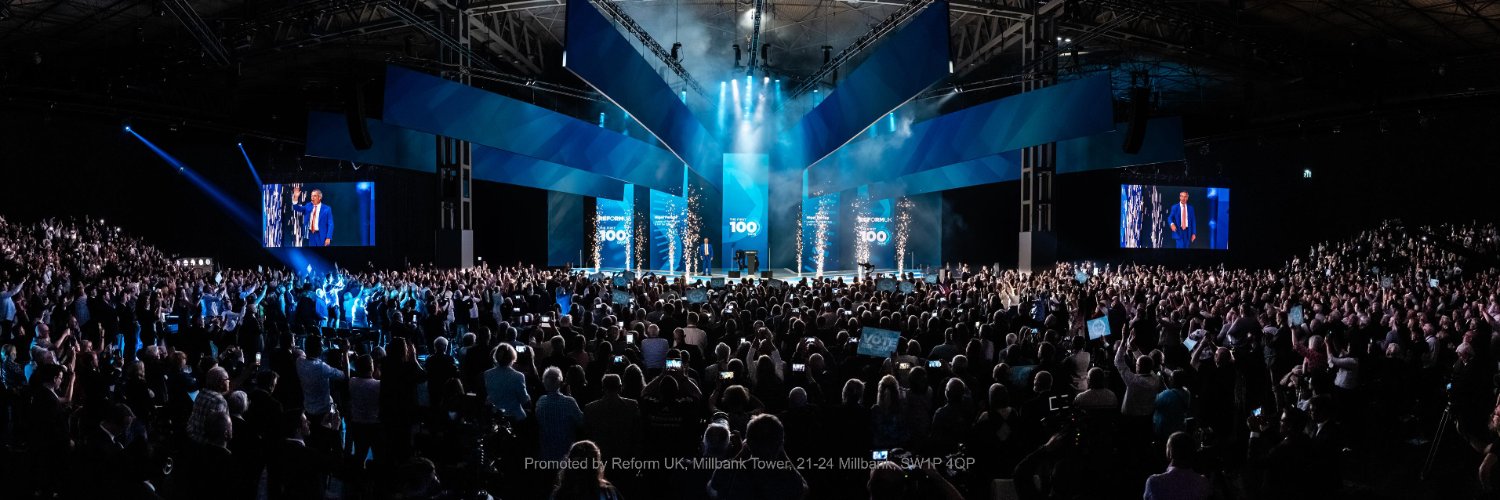
Despite the left-wing press and social-media pundits trying their usual tactics of posting pictures of empty halls (taken before people arrive), talking about a subdued atmosphere or Reform panic, the simple truth was that this conference had an energy, attendance and exuberance that no other UK party could even dream of putting on. This was an event where thousands of Reform members from every corner of our Isles came together with a common and manifest purpose. To take our country back.
Across Thursday’s first-ever Business Day, Friday’s main conference programme and Saturday’s final policy sessions, Reform’s senior figures attempted to turn that principle into specific commitments on spending, tax, energy, immigration, education, housing and government accountability.
For Scottish readers, the conference was also important because many of the problems being discussed at UK level have a distinctly Scottish dimension. Scotland sits on huge energy resources yet suffers high bills. Holyrood has constructed a more complex and higher-tax income-tax system than the rest of the UK. Scotland needs more doctors, nurses, engineers and skilled workers, yet governments have repeatedly treated overseas recruitment as a substitute for training more people at home.
What emerged from Birmingham was therefore not simply an English or Westminster programme. It was a framework that Reform Scotland can increasingly translate into devolved policy: lower taxes on work, cheaper energy, controlled immigration, stronger public services, fewer quangos and a state that is directly accountable to the people paying for it.
The NEC: A Conference Built at Scale
The first impression on entering the NEC was the sheer scale of the operation. This was not simply a stage at one end of a crowded room. The main auditorium sat alongside a vast exhibition hall laid out with the finish of a major trade show: strong branding, professional lighting, clear routes through the floor and enough separation for several parts of the conference to operate at once.
The floor plan ran to almost 190 numbered plots. Exhibitor spaces ranged from compact 3×2 metre stands to substantial 10×10 metre areas, while separate sound-reduced rooms provided space for roundtables and fringe discussions. Across the hall were dozens of distinct areas for businesses, charities, vendors, campaign organisations, hospitality and informal meetings.
The result was visually striking but also practical. A business could hold a serious conversation away from the auditorium, a fringe organiser could run a focused session, and delegates could browse the stands without losing the sense of being part of one large event. The layout gave the conference a confident, professional character before the first keynote speaker had even reached the stage.
Watch: The conference floor at the NEC
POV: You’re arriving at Reform UK Conference this morning. pic.twitter.com/zJGrnqgZfP
— Reform UK (@reformparty_uk) September 4, 2026
Business Day: From Protest Party to Government-in-Waiting
The conference began unusually. Rather than opening with a rally, Reform devoted Thursday to its first dedicated Business Day. The decision itself carried a message. Reform knows that attacking high taxes and weak growth is not enough; a party aspiring to government has to convince employers, investors and financial markets that it understands the public finances and can create a credible environment for business.
That is especially important when Britain is carrying a vast national debt and businesses are dealing with high energy costs, weak productivity, expensive borrowing and an increasingly heavy regulatory burden. Reform’s answer was to link fiscal discipline with growth: cut waste first, reduce the burden on productive activity, then use the space created to lower taxes.
The £100 Billion Challenge: Cut Spending Before Cutting Taxes
Robert Jenrick opened the economic case with one of the largest numbers heard during the conference: more than £100 billion of annual public-spending savings.
Reform’s published conference material broke the programme into several large areas: around £50 billion from welfare, £20–30 billion from government departments and around £28 billion from debt interest, alongside savings from Net Zero programmes, foreign aid, quangos and civil-service bureaucracy.
“The message from the markets is very clear: we have got to cut spending and have a credible path to cutting taxes.”— Robert Jenrick
The order of those words is important. Reform is not presenting tax cuts as something that can simply be added to existing spending commitments. The party’s conference argument was that Britain’s state has become too expensive, too bureaucratic and too comfortable with borrowing. Tax reduction only becomes durable if spending is brought under control first.
Jenrick also tied welfare reform directly to the tax system. His proposed bargain is that people genuinely unable to work should have a safety net, but those capable of working should be expected to contribute — while people in work should keep more of what they earn.
“We will ensure that those who can work, do work, and when you work you will keep more of the money that you earn.”— Robert Jenrick
Why the Spending Argument Matters in Scotland
Scotland has its own version of the same problem. Holyrood has accumulated an extensive landscape of agencies, public bodies and arm’s-length organisations while devolved government has increasingly reached for higher taxes to fund the system.
Reform Scotland has already argued that the answer is not simply to increase tax rates every time spending rises. Its Scottish economic programme proposes tackling quango spending, redirecting ideological Net Zero expenditure and using growth to expand the tax base rather than continually increasing the burden on workers and businesses.
That is a key ideological difference. The SNP’s model increasingly treats the size of the state and the amount spent as evidence of political virtue. Reform’s argument is that taxpayers should care about results. An expensive system that performs badly is not compassionate merely because it costs a great deal.
Richard Tice: Business Needs Cheaper Energy and Permission to Build
Deputy Leader Richard Tice used Business Day to connect two themes that would recur throughout the conference: energy and planning.
Reform argues that Britain cannot talk seriously about reindustrialisation while manufacturers face some of the highest power costs among advanced economies. Nor can it talk seriously about solving the housing shortage while the planning system makes development slow, uncertain and expensive.
Tice’s planning proposals focus heavily on brownfield development and streamlining the process by which homes and infrastructure are approved. The broader Reform message is that Britain has spent too long making productive activity difficult: difficult to build, difficult to hire, difficult to invest and increasingly difficult to afford energy.
The Business Day message
Economic growth is not something government can order into existence. Government’s job is to create the conditions in which people are willing to invest, employ, build, innovate and take risks.
That makes the conference’s business focus particularly relevant to Scotland. The country possesses major natural resources, excellent universities, a strong financial-services sector, engineering expertise and a long industrial tradition. The Reform challenge is to turn those strengths into higher productivity, better wages and more private-sector investment rather than allowing high taxation, expensive energy and bureaucracy to suppress them.
Day Two: Borders, Energy and the Machinery of Government
Friday transformed the NEC from a business conference into the full political event. The keynote programme featured Lee Anderson, Zia Yusuf, Jordan Bardella, Matt Goodwin, Sarah Pochin, Richard Tice and Nigel Farage. The common theme was urgency.
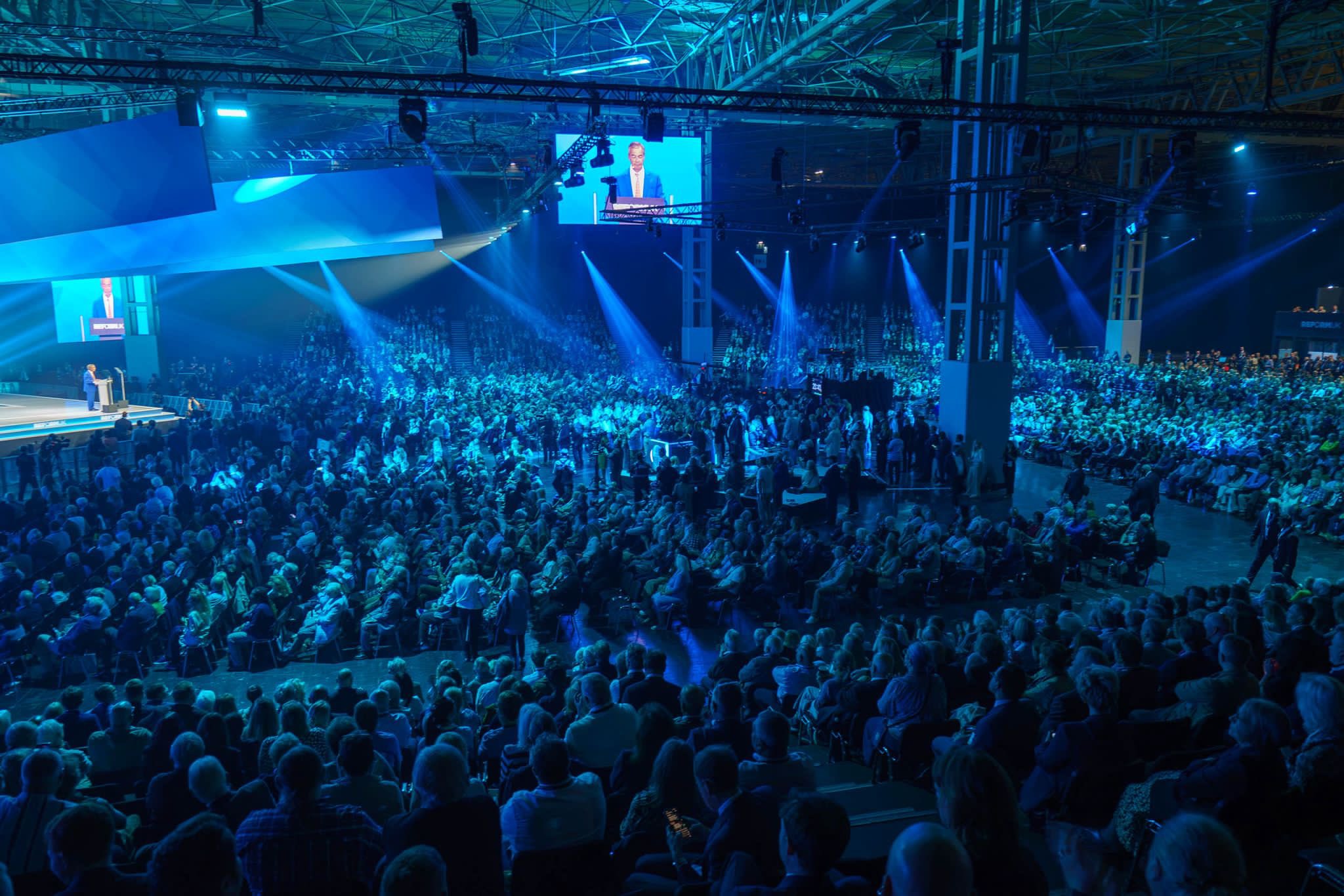
The main stage was only one part of what was happening. On Friday and Saturday, the vast NEC hall was busy from opening time with dozens of stands, campaign groups, policy organisations and businesses. Delegates could move from a keynote speech into a smaller fringe discussion, stop to question an exhibitor, then return to the hall for the next speaker. It gave the conference a breadth that is easily missed when coverage is reduced to clips from the platform.
The official fringe programme brought together an unusually varied list. The Institute for Government and Centre for Government Reform appeared alongside the TaxPayers’ Alliance and Centre for Policy Studies. Make UK and The Growth Commission reflected the interest in industry and growth; the NFU and Countryside Alliance brought in the rural economy; Big Brother Watch represented civil liberties; and Centre for Cities, Urban Transport Group and Campaign for Better Transport widened the discussion to the places and infrastructure on which daily life depends.
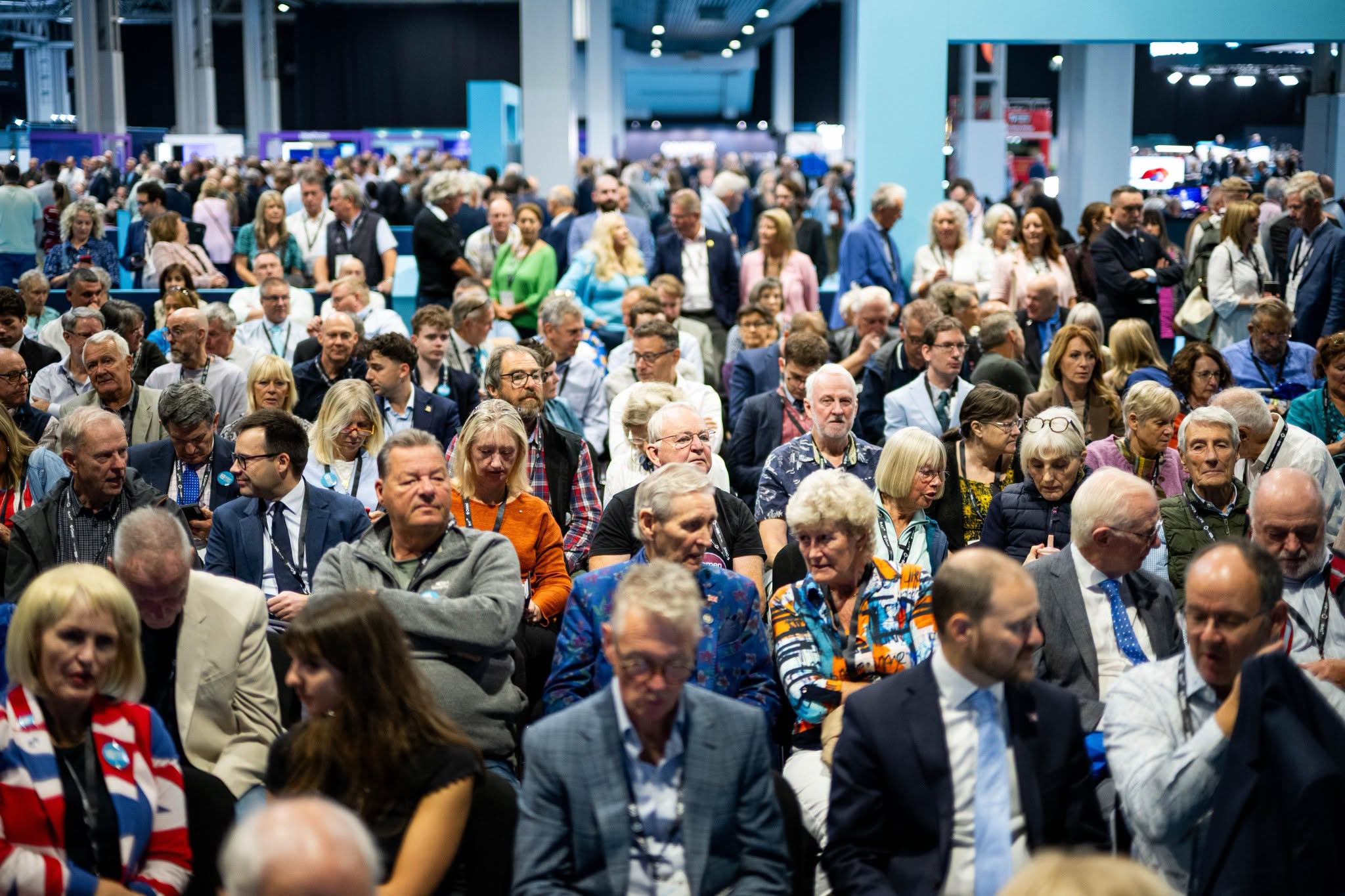
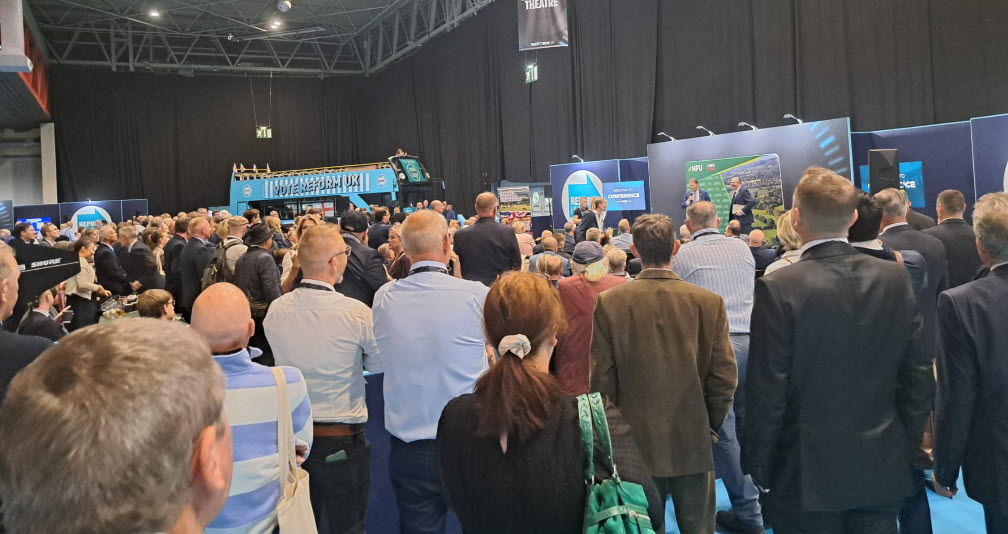
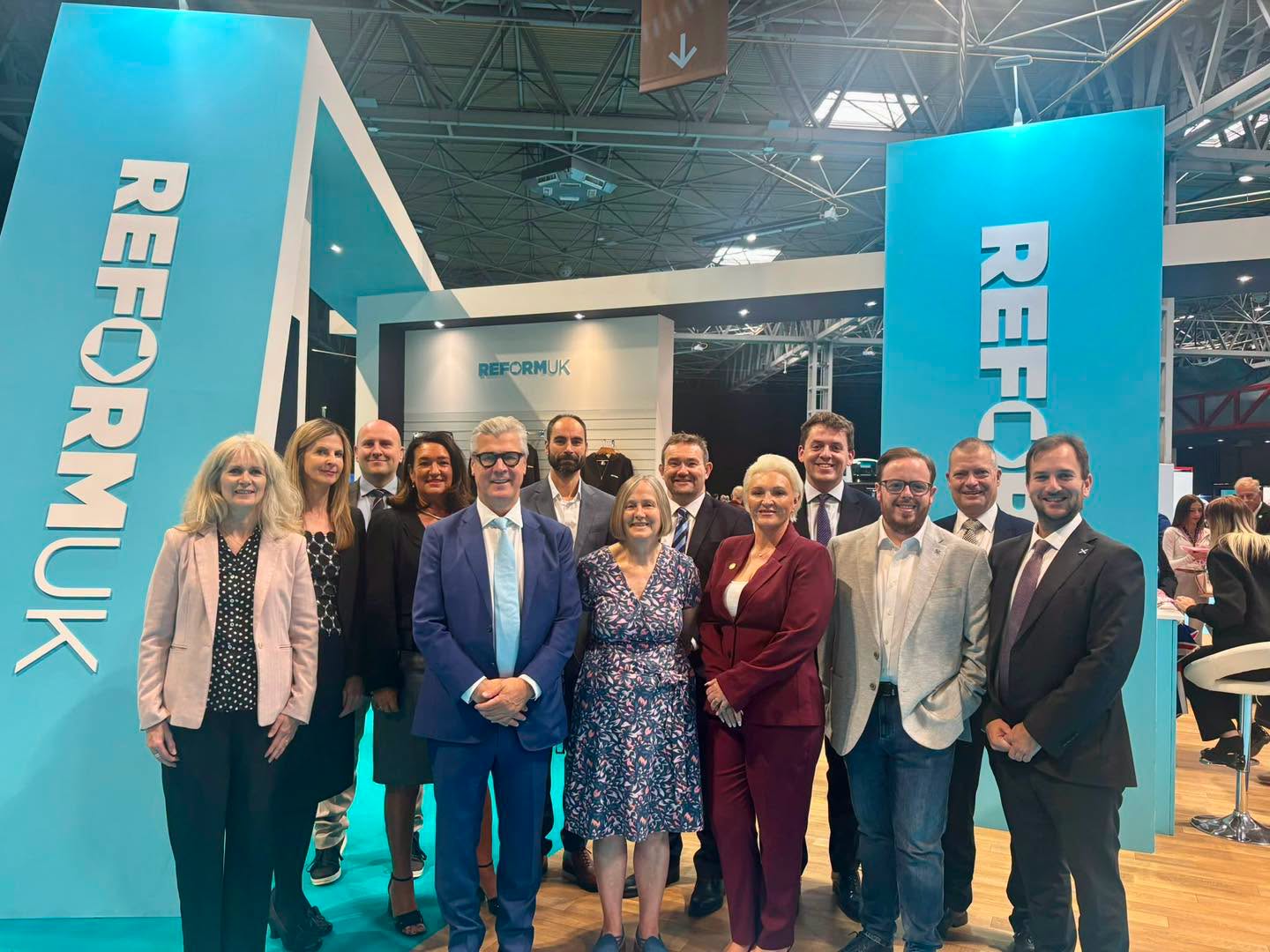
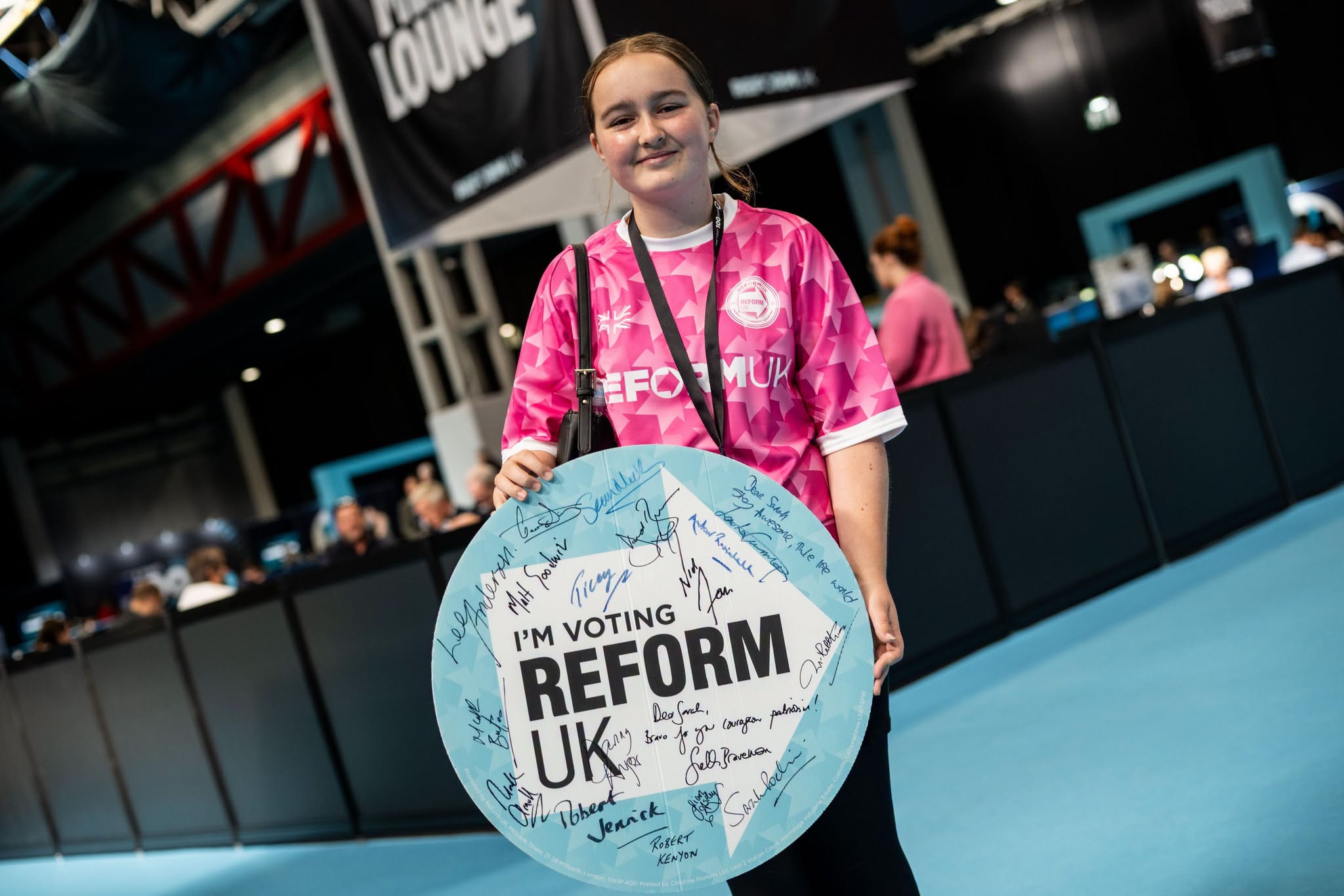

Taken together, the fringe programme shared the conference’s wider concern with practical government: how promises become policy, where the state works, what gets in the way of growth and how national decisions are felt by towns, businesses, farms and families. The keynotes supplied the headline moments and set the political direction. Around them, the stalls and smaller sessions provided the detail, the argument and many of the conversations delegates took home. The speeches mattered, but they were not the whole conference.
Reform’s speakers repeatedly returned to the same criticism of modern government: Britain is full of politicians who can describe problems, announce reviews and commission reports but appear unable to change the underlying system. The first-100-days programme is designed to be the opposite — legislate quickly, establish responsibility and impose consequences when commitments are missed.
Ann Widdecombe: A Conference Opens with Someone Missing
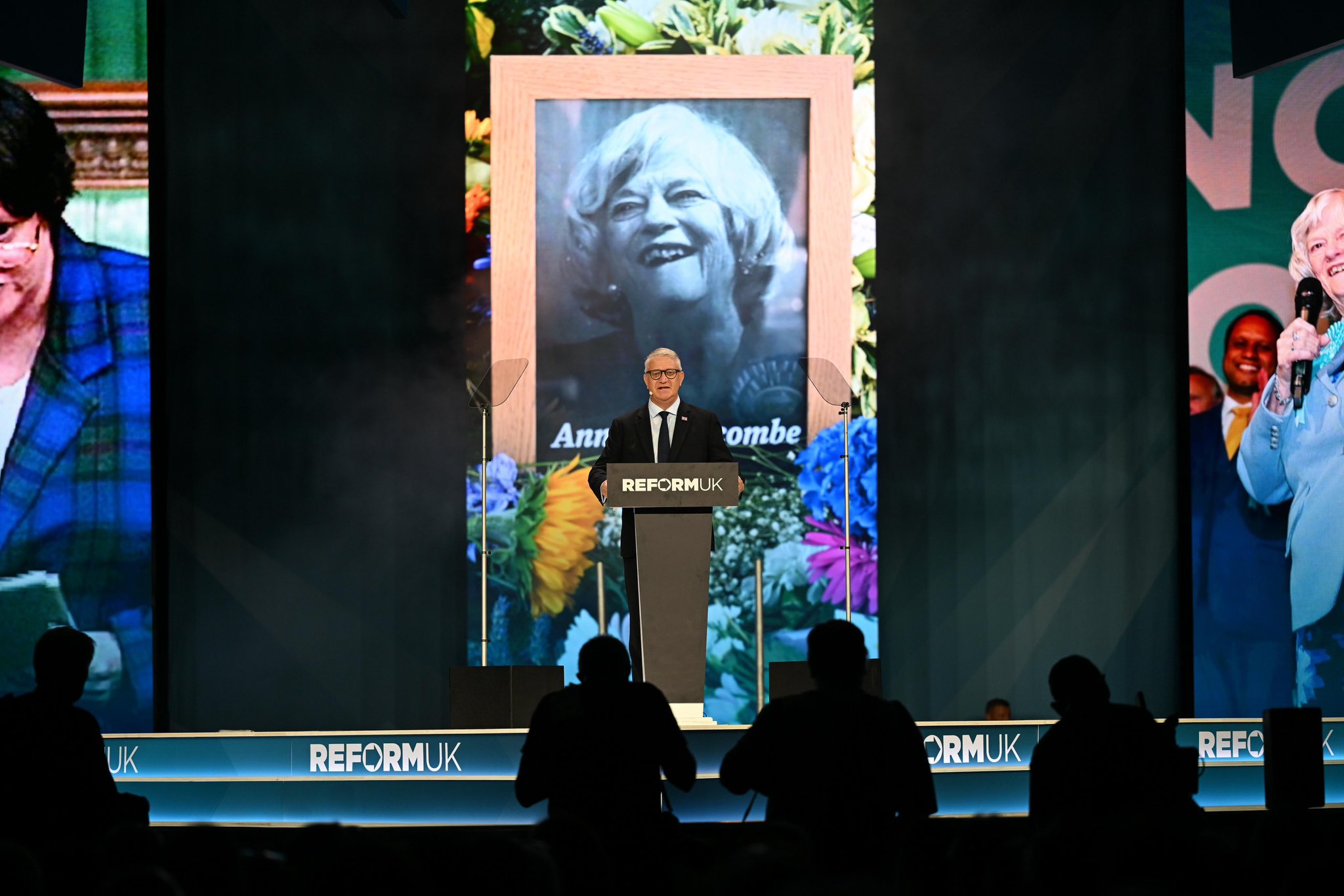
Before Friday’s political programme began in earnest, the hall paused for its most sombre moment. Nigel Farage stood beneath a giant portrait of Ann Widdecombe and opened with four plain words: “Someone is missing.” He remembered the “irrepressible, unique, totally extraordinary” woman who had been expected to share the conference with them. The applause was warm, but the mood was unmistakably one of grief.
Widdecombe had been a government minister, an MP for more than two decades, a Brexit Party MEP and, in her final years, Reform UK’s justice spokeswoman. Her sharp wit, independence and refusal to soften an argument made her one of the most recognisable figures in British public life. Farage recalled not only the politician, but the novelist, theatre performer and unexpected star of Strictly Come Dancing. It was a tribute to a colleague whose personality reached far beyond Westminster.
She was found dead at her home near Haytor in Devon on 9 July 2026, following a fatal attack the previous day. A man has been charged with her murder and remanded in custody pending trial. With criminal proceedings under way, responsibility is a matter for the court. What was beyond dispute in Birmingham was the shock of such a violent death and the depth of affection for the woman the conference had lost. As her portrait filled the stage, Farage ended simply: “May God bless her soul.”
Lee Anderson: Opening Conference with a Call for Common Sense
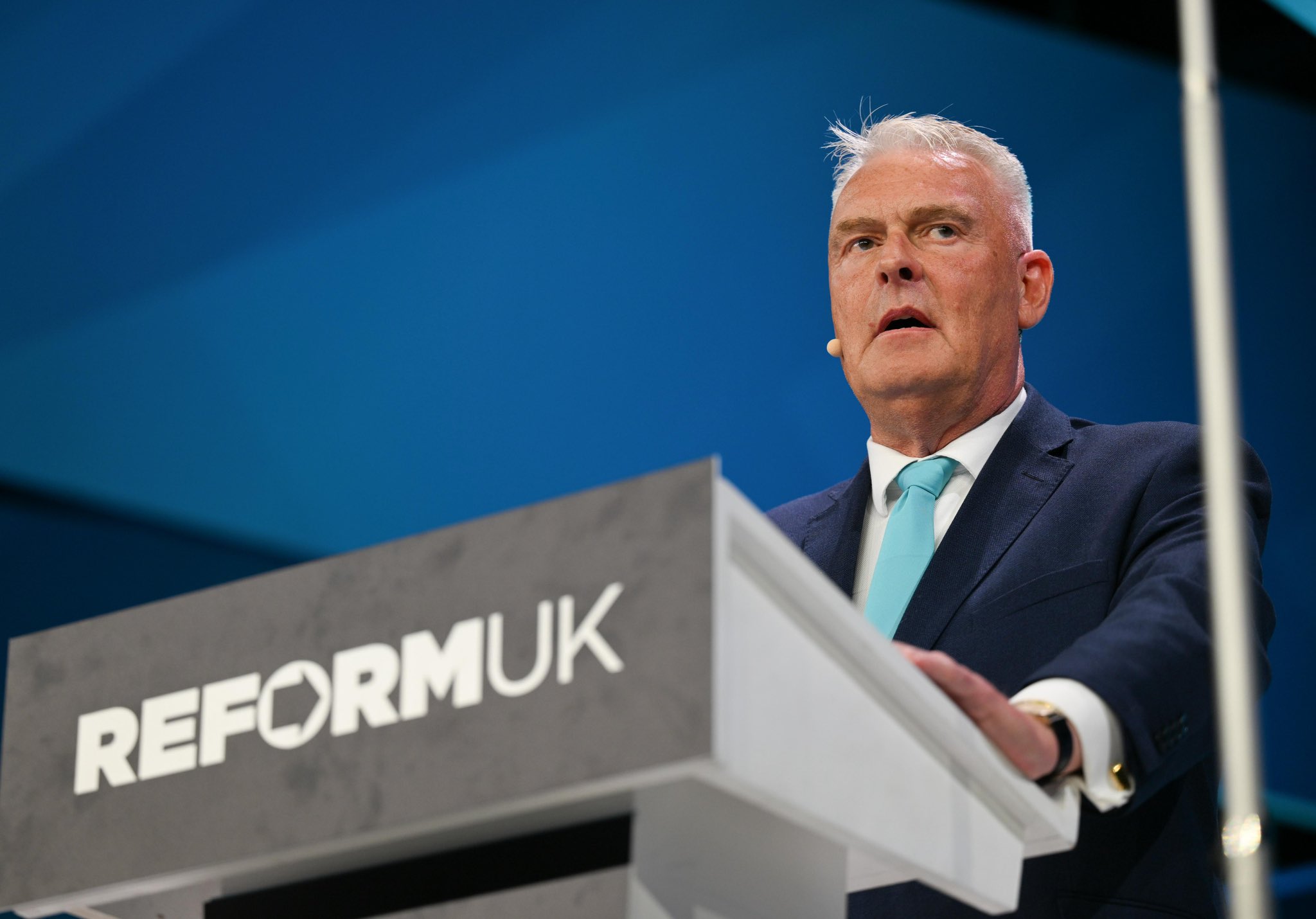
Party Chairman Lee Anderson formally opened Friday’s keynote programme and set its plain-spoken tone. His opening question — “Are you ready for some common sense?” — framed the conference as a challenge to a political culture that Reform believes has become detached from everyday experience.
Anderson’s role was also organisational. He presented the party as focused on the conference programme and on preparing for government, before handing the stage to Reform’s national and policy spokespeople.
Zia Yusuf: Make Britain’s Borders Mean Something Again
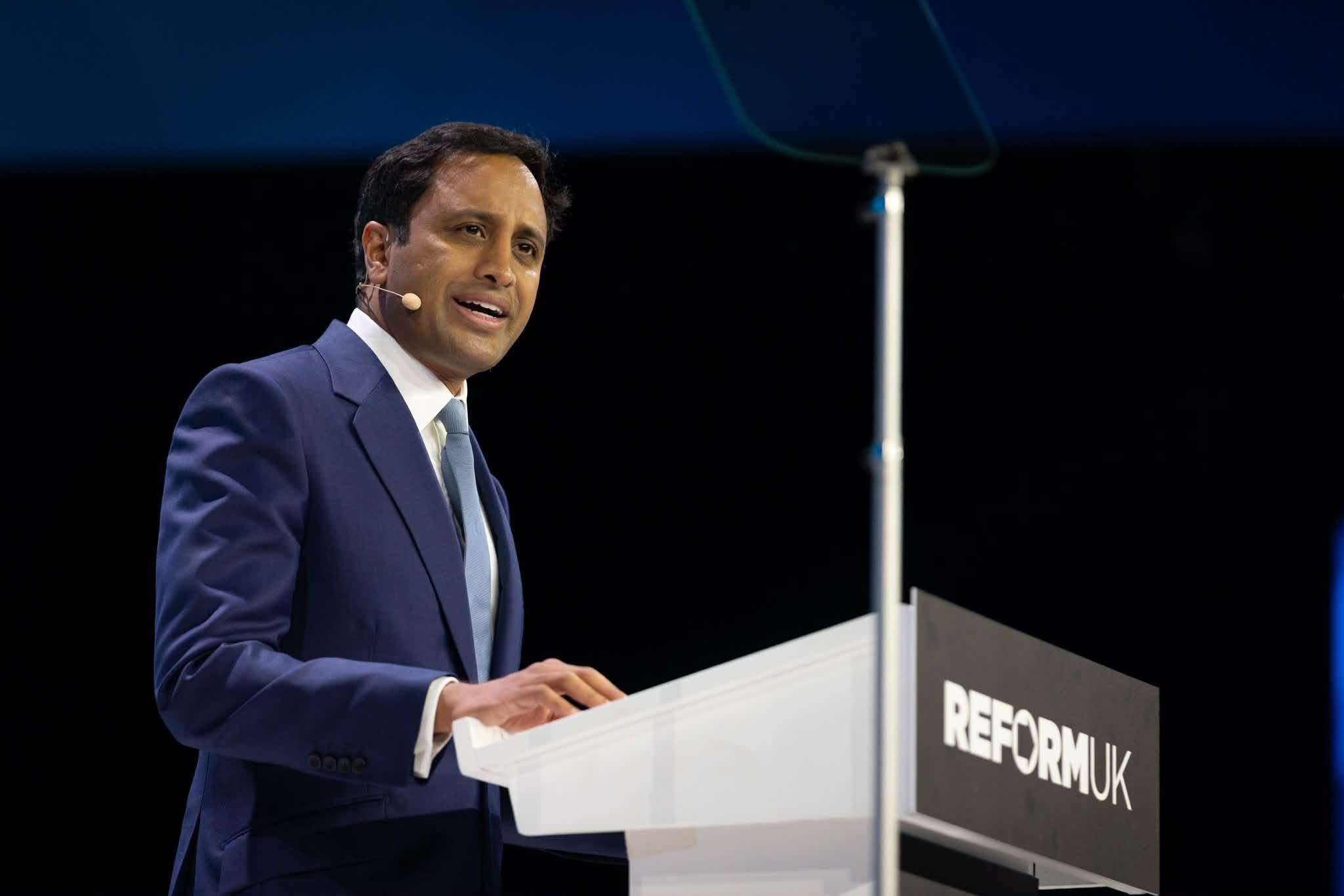
Immigration was never going to be a side-issue on Friday, and Yusuf did not treat it as one. Shadow Home Secretary Zia Yusuf used his conference speech to describe what he said would happen immediately after a Reform general-election victory — not as a hope, but as an instruction.
“He will pick up the phone to the First Sea Lord and deliver an order. He will order His Majesty’s Royal Navy to see to it that not a single unauthorised vessel makes it to the shores of the United Kingdom.”— Zia Yusuf
Yusuf’s argument cut through because it was simple, and the hall felt it. Illegal entry has been treated as an administrative problem when it is fundamentally a question of sovereignty. A national border only means something if the government is willing and able to enforce it. That is not a briefing-paper distinction. It is the difference between a country that still decides who comes in, and one that has learned to manage the consequences instead.
When he set out what that would mean in the first 100 days, the room answered him. Under the programme outlined at conference, Reform would deploy the Royal Navy, return attempted Channel crossings to France, expand detention capacity, remove people with no legal right to remain and deport foreign criminals. It was the Navy line that stayed in the air — the image of a government picking up the phone, giving an order, and meaning it.
- Deploy the Royal Navy to stop small-boat crossings.
- Return those intercepted after attempting illegal Channel crossings.
- Begin a large-scale removal programme for foreign nationals with no right to remain.
- End the early release of violent criminals.
- Expand prison and detention capacity.
- Deport foreign criminals held in British prisons.
Watch: Zia Yusuf’s Friday keynote
“Once elected, a Reform government will deliver more transformative change in our first 100 days than any administration in British history.”— Zia Yusuf
Farage and Bardella: A New Entente Cordiale on the Channel
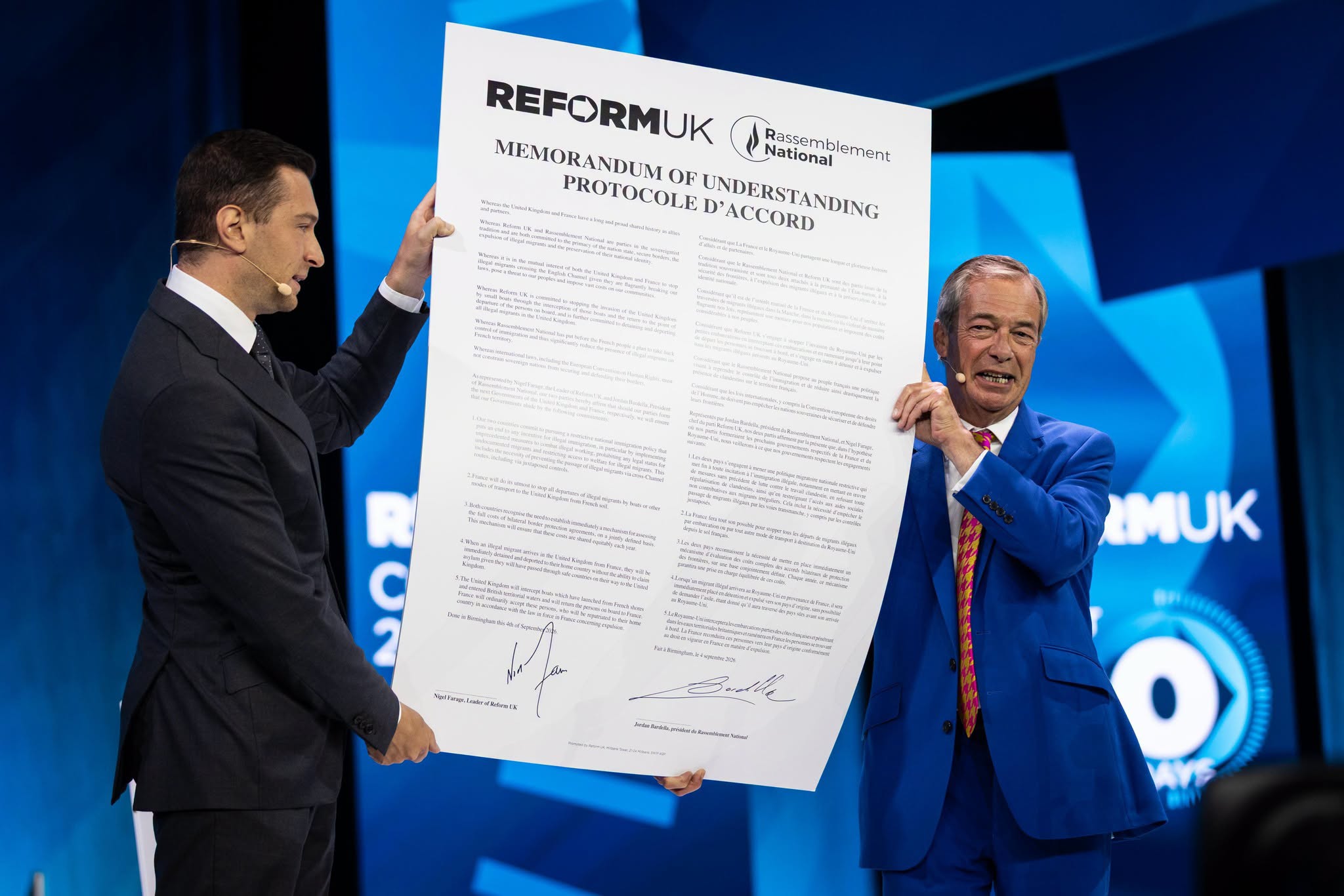
One of the conference’s most theatrical moments was also one of its most strategically interesting — and the hall knew it. When Nigel Farage and Jordan Bardella, President of France’s National Rally, came onto the main stage to sign a Memorandum of Understanding on Channel crossings, the crowd went up as if a home player had just walked out. Delegates were on their feet. The noise rolled around the NEC.
Bardella is not a bit-part visitor. Still only 30, he is one of the most popular politicians in France and president of the National Rally. With Marine Le Pen he now forms the ticket at the front of the 2027 presidential race: Le Pen for the Élysée, Bardella as her intended prime minister. Current polling puts that pairing ahead of the field. For Reform members in Birmingham, the signing felt less like a photo-opportunity and more like a glimpse of a possible new Channel settlement.
The agreement commits a future National Rally-led French government to accept the return of illegal migrants who launch from French territory, enter British waters and are then returned by a future Reform government.
“France is no longer the gateway for illegal immigration into the United Kingdom.”— Jordan Bardella
Bardella’s language went beyond simply accepting returns, and the hall stayed with him. He argued that people entering France illegally should ultimately be returned to their countries of origin rather than allowed to continue moving north towards the Channel.
“We must put an end to this deadly route. We must break the smugglers’ business model. And together, we must take back control of our borders.”— Jordan Bardella
Farage described the document as “a genuine new entente cordiale between our parties and our countries.”
The political significance lies in the attempt to answer one of the immediate objections to Reform’s Channel policy: what happens if France refuses to take people back? Farage’s response was to build a relationship with a political movement that may itself be in a position to govern France.
Watch: Jordan Bardella and Nigel Farage
Why Immigration Policy Still Matters to Scotland
Scotland is geographically distant from the Channel, but the consequences of national immigration policy are not confined to Kent. Immigration and asylum are reserved matters, while the resulting pressures on housing, local services, schools, health provision and infrastructure are felt across the UK.
For Reform Scotland, the argument is therefore two-stage. Westminster should control who enters and remains in the country; devolved and local government should then make sure scarce services and social housing are allocated fairly, with strong recognition of local contribution and connection.
This is one reason immigration, housing and public-service capacity cannot be treated as completely separate subjects. Population growth creates real demand. Refusing to discuss that connection does not create another GP surgery, another council house or another classroom.
Matt Goodwin: Reform’s Support Is More Than a Protest Vote
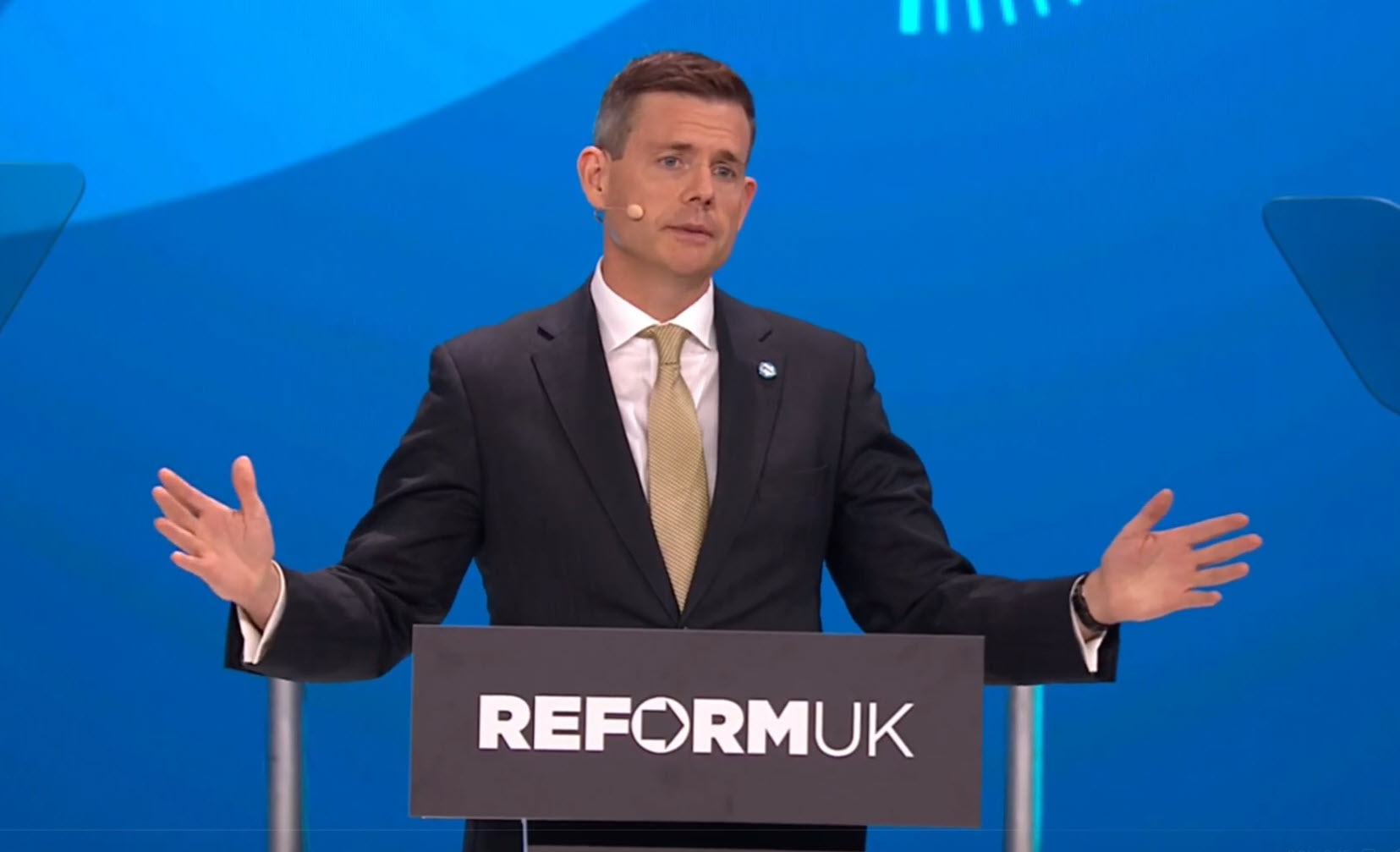
Writer, pollster and former Reform parliamentary candidate Matt Goodwin used his Friday main-stage slot to place the party’s rise in a wider electoral context. His central argument is that Reform’s voters are not held together simply by temporary anger, but by a durable concern about borders, national identity, law and order, social cohesion and the distance between political institutions and the public.
That analysis matters to a party preparing for government. A protest vote can register dissatisfaction; a governing coalition has to remain broad enough to win constituencies, withstand pressure and turn shared priorities into a deliverable programme.
Watch: Matt Goodwin’s Friday keynote
Sarah Pochin: A Parliamentary Voice for Reform’s Growing Coalition
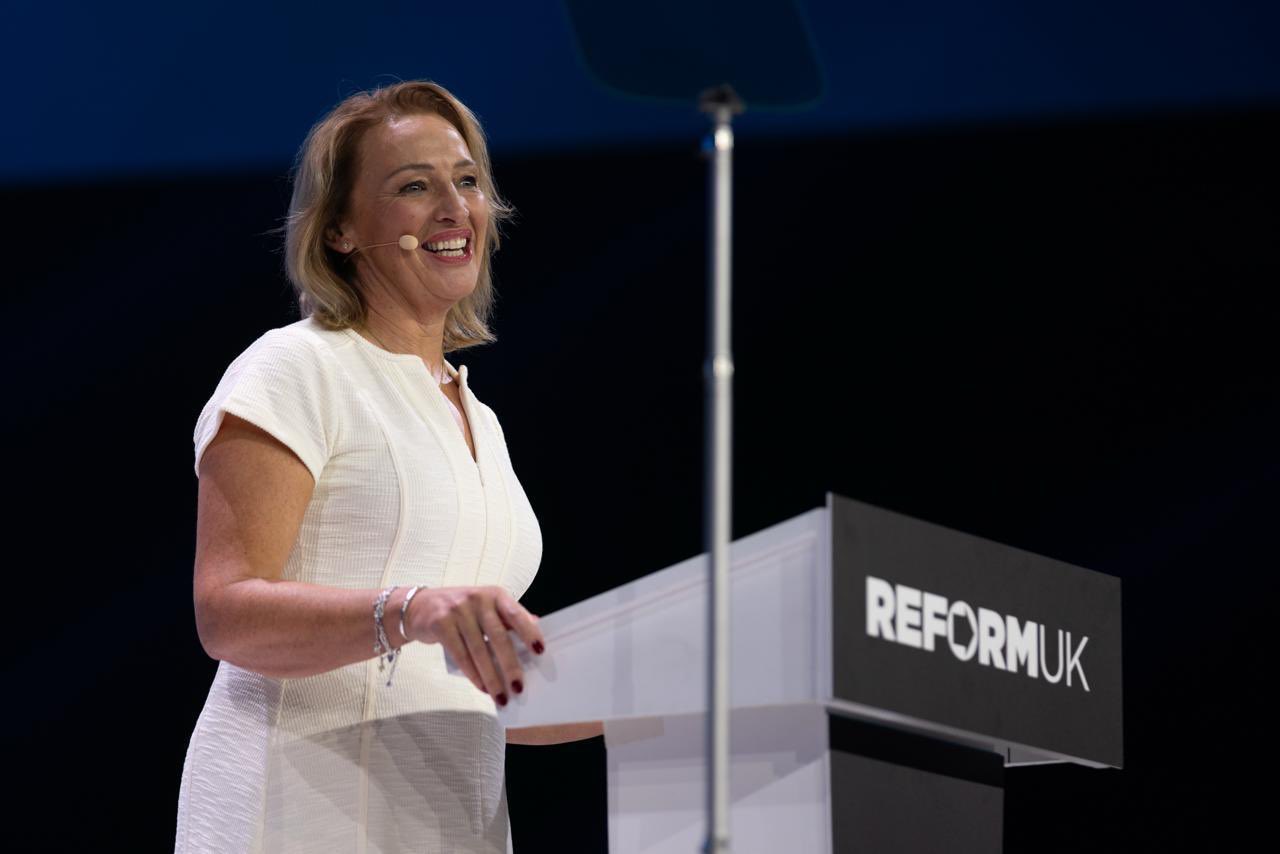
Sarah Pochin MP followed Goodwin on Friday’s main stage. As Reform’s first woman elected to the House of Commons, her contribution brought the discussion back from polling and political realignment to the practical task of representing voters in Parliament.
Across her conference appearances, Pochin argued that voters seeking change should not be let down by factional disputes or political “bickering”. Her contribution added an electoral warning to the policy programme: a movement can only deliver change if it remains focused enough to win.
Watch: Sarah Pochin’s Friday keynote
Richard Tice: Cut Household Energy Bills by £250 — or Resign
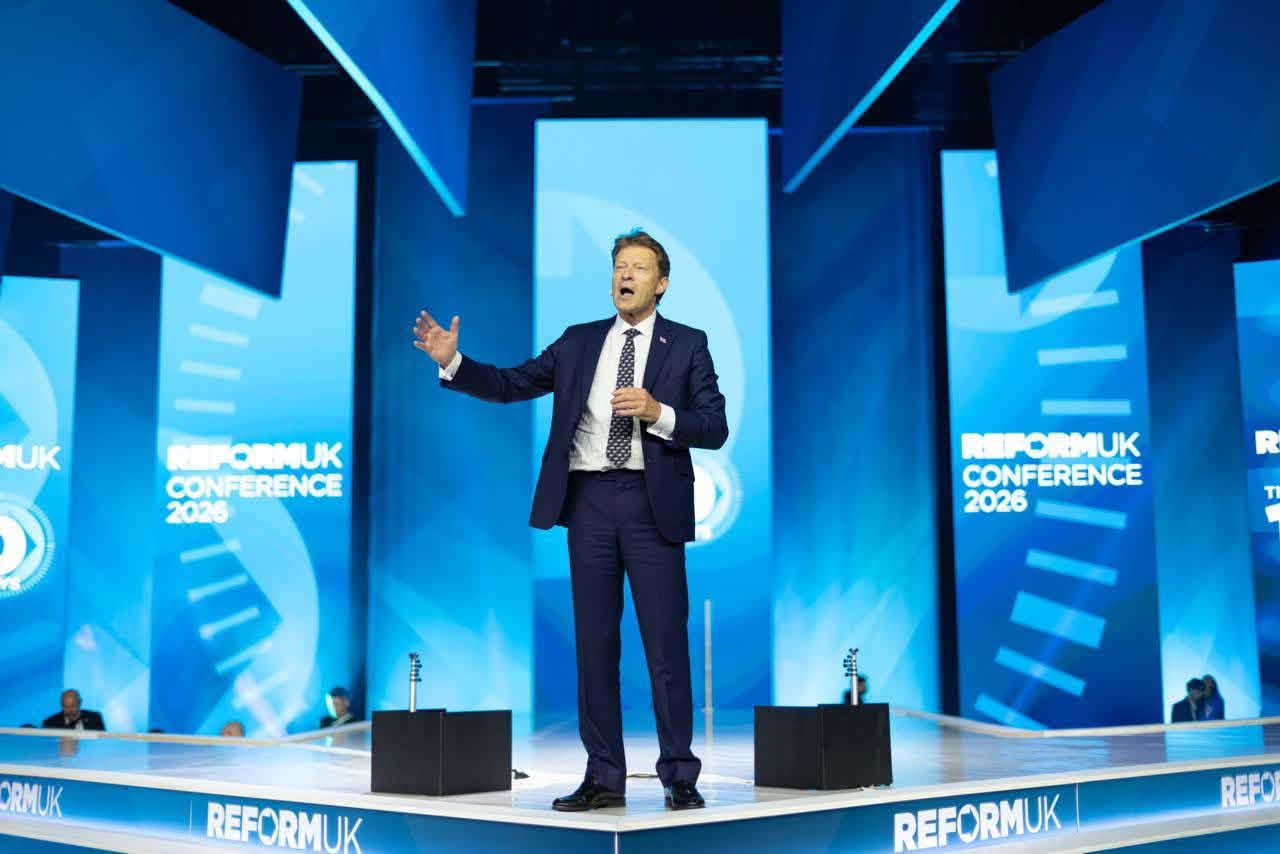
Energy produced one of the conference’s clearest examples of the accountability principle. Tice pledged that a Reform government would reduce the average annual household energy bill by £250 within its first 100 days.
“I’m going to repeat my pledge to you that in the first 100 days of a Reform government, I will bring the average annual household energy bill down by £250.”— Richard Tice
The proposed mechanism is to strip a series of policy costs from energy bills, remove VAT permanently and reduce carbon-related costs imposed on generators.
Watch: Richard Tice’s Friday keynote
What This Means for Scotland
For Scotland, the energy argument is especially powerful. Scotland is an energy producer with a major North Sea oil and gas basin, substantial renewable generation and the engineering base required for nuclear and new energy technologies. Yet Scottish households and businesses still operate inside a high-cost energy system.
That is not an accident of geology but the result of a political choice. The SNP has treated North Sea oil and gas as an industry to be talked down and wound down, wrapped in Net Zero targets, subsidies and quangos, while maintaining an ideological ban on new nuclear. Reform UK Scotland’s published answer is the opposite: scrap that SNP Net Zero machinery, end the nuclear ban, prepare to rehabilitate North Sea gas and require an Energy Price Impact Statement on related decisions. The Scottish manifesto also identifies about £1 billion of ideological Net Zero projects as money that can be reallocated. Holyrood cannot itself license North Sea fields because that power is reserved and the manifesto assigns it to a Reform government in Westminster, but it can stop treating the basin as an embarrassment.
Westminster would then do the reserved work: enable further North Sea drilling, scrap the Net Zero cost drivers, Renewables Obligations and green levies that have made industrial power so expensive, and expand domestic production. Reform’s website platform says household bills could fall by £500 a year if those cost drivers are removed; Tice’s conference pledge was the nearer, measurable cut of £250 in the first 100 days. Neither figure is a Holyrood guarantee, but both point the same way: use the resource under the North Sea rather than, as the Scottish manifesto notes, import 70 per cent of our gas from Norway, from the same geological basin, while telling Scottish workers the industry has no future.
Reform’s position is that this should be an economic absurdity: a nation rich in energy should treat that abundance as a competitive advantage. Cheap, reliable power is not merely a household issue. It affects factories, data centres, transport, food processing, hospitality and almost every other part of the economy. For the oil and gas workforce, the repair is political as much as technical. What is needed is a government that wants the industry to invest, train and stay, instead of one that talks the sector down while the bills stay up.
Nigel Farage: Treat Britain’s Problems as a National Emergency

A brief security concern delayed Farage’s arrival on stage, but it did nothing to dampen the party atmosphere or the anticipation inside the NEC. If anything, the wait allowed the noise and expectation to build. Delegates stayed animated, the music kept the hall moving and the sense that a major conference moment was coming only grew stronger.
Farage’s Friday keynote attempted to pull the individual pledges together into a governing method. It was less a fresh list of policies than an argument about what a Reform government would do with power. His test was simple: departments should know what must be drafted, ministers should know what they are responsible for and the first 100 days should be a period of action, not a year-long discovery of how difficult Whitehall can make political change.
His official conference extract was explicit: stop the boats, cut energy bills by £250, increase domestic NHS training and deliver tax and welfare changes within the first 100 days. These were Westminster-facing commitments, each tied to a named minister and a visible deadline rather than left as ambitions for the end of a Parliament.
“These aren’t vague, empty promises. These are pledges that we must deliver in the first 100 days of government, or those individual ministers will have failed.”— Nigel Farage
That deadline gave the speech its sharper edge. Farage said ministers who failed to deliver their allotted pledges would be removed and replaced by somebody with the courage to do the job. The point of the 100-day test was not that every national problem could be solved within 100 days. It was that the decisive legislation should be moving, responsibility should be unmistakable and failure should carry a political consequence.
He went further, saying a Reform government would declare a national emergency, cancel every parliamentary recess and keep Parliament sitting for as long as required to pass the necessary legislation. If needed, he said, Parliament would sit for 24 hours a day, six days a week. It was a deliberately confrontational answer to the familiar warning that radical change would take too long.
“We believe in jeopardy. We believe in accountability.”— Nigel Farage
Farage then turned to the institutions that might resist. He said he expected the House of Lords to honour a clear electoral mandate, but threatened to appoint enough peers to secure a majority if it blocked Reform’s programme. If that route proved impossible, he proposed putting the future composition of the Lords to a referendum. On the judiciary, he restated the principle that Parliament makes the law and judges interpret it, while warning that Reform could reconsider how judicial appointments work.
The same challenge was directed at Whitehall. Civil servants who offered honest advice would remain essential, but Farage said officials who actively tried to obstruct the elected government’s programme would be removed and replaced, including with people drawn from business. His refrain was that voters had heard “it cannot be done” too often. Reform’s answer, he said, would be a government organised around “can do, and will do”.
The drama in the room reinforced that message. A security alert delayed Farage’s arrival, and protesters interrupted the speech several times after it began. He laughed off the disruption and the hall answered with noise of its own. For supporters, the interruptions became part of the argument: Reform expected resistance and wanted to show that it would not be knocked off course by it.
Watch: Nigel Farage’s Friday keynote
That was perhaps the most important institutional argument of the entire conference. Modern British government is surrounded by regulators, quangos, arm’s-length bodies, consultation requirements and complex administrative procedures. Some of those checks exist for good reason, but together they can make responsibility easy to disperse and difficult for the public to locate.
That system is extremely convenient when a policy fails. The minister can blame the regulator; the regulator can point to legislation; officials can point to process; and the public is left with no obvious person to remove. Farage’s constitutional language was the most contentious part of the speech, but it followed directly from his central question: what is an electoral mandate worth if nobody can be held responsible for carrying it out?
Reform’s proposed answer is political ownership. If ministers make the pledge, they own the result. Friday’s speech was intended to show that the first 100 days would come with named priorities, named ministers and, if those priorities were missed, named consequences.
Friday Night: Boney M and the Afterparty

Friday did not end when the main-stage microphones were switched off. The official afterparty carried the conference into the evening, with Boney M featuring Maizie Williams bringing a burst of disco to the NEC. After a day of packed speeches, loud reactions and constant movement around the hall, the change of pace was welcome.
Delegates were still on a high from the day’s events, and the room had the release of a crowd that felt it had been part of something significant. There was dancing, more than a little singing, and it is fair to say that a few drinks and some late nights were had. Saturday’s programme would begin soon enough. For a few hours, people simply enjoyed the moment.
Watch: Friday’s full conference stream
Conference Day 1 live from Birmingham.
The Final Day: Tax, Wales, Scotland, Education and Accountability
If Friday established the scale of Reform’s first-100-days ambition, Saturday supplied more of the detail. The final day heard from Reform’s London mayoral candidate Laila Cunningham and Welsh leader Dan Thomas before the biggest new tax announcement of the conference, a direct intervention from Reform UK Scotland leader Malcolm Offord, a major education and NHS workforce package from Suella Braverman and a closing address from Farage.
Lee Anderson: Welcoming Conference Back for the Final Day
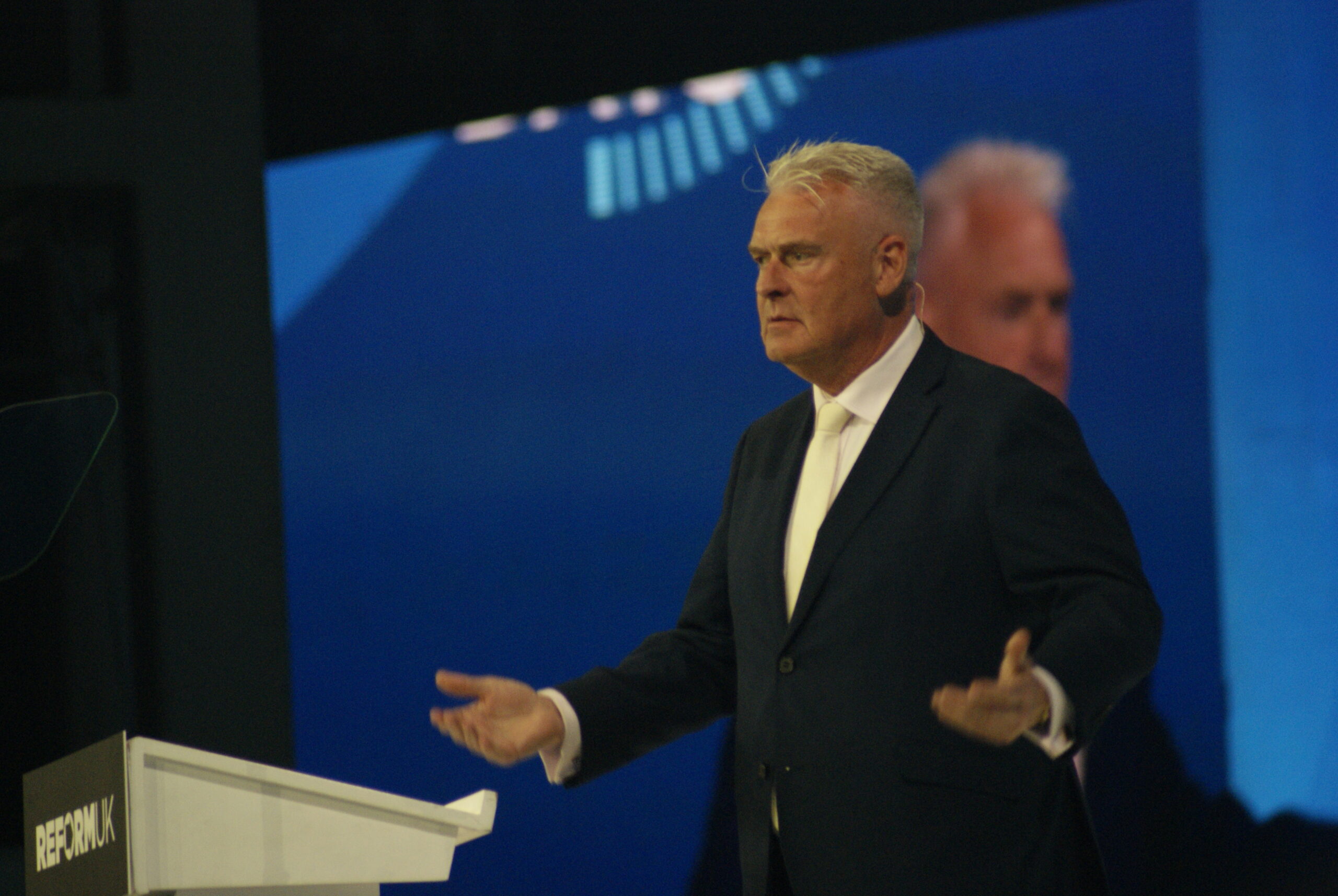
Lee Anderson returned to welcome members for Saturday’s final programme before the policy keynotes began. His familiar dry wit showed through in a run of well-timed asides, puncturing the formalities and drawing easy laughter from a hall that already knew his style. The chairman’s second appearance linked the two days together and cleared the stage for the final sequence of London, Welsh, Treasury, Scottish and education speeches.
Watch: Lee Anderson’s Saturday address
Laila Cunningham: Politics Should End Decline, Not Commentate on It
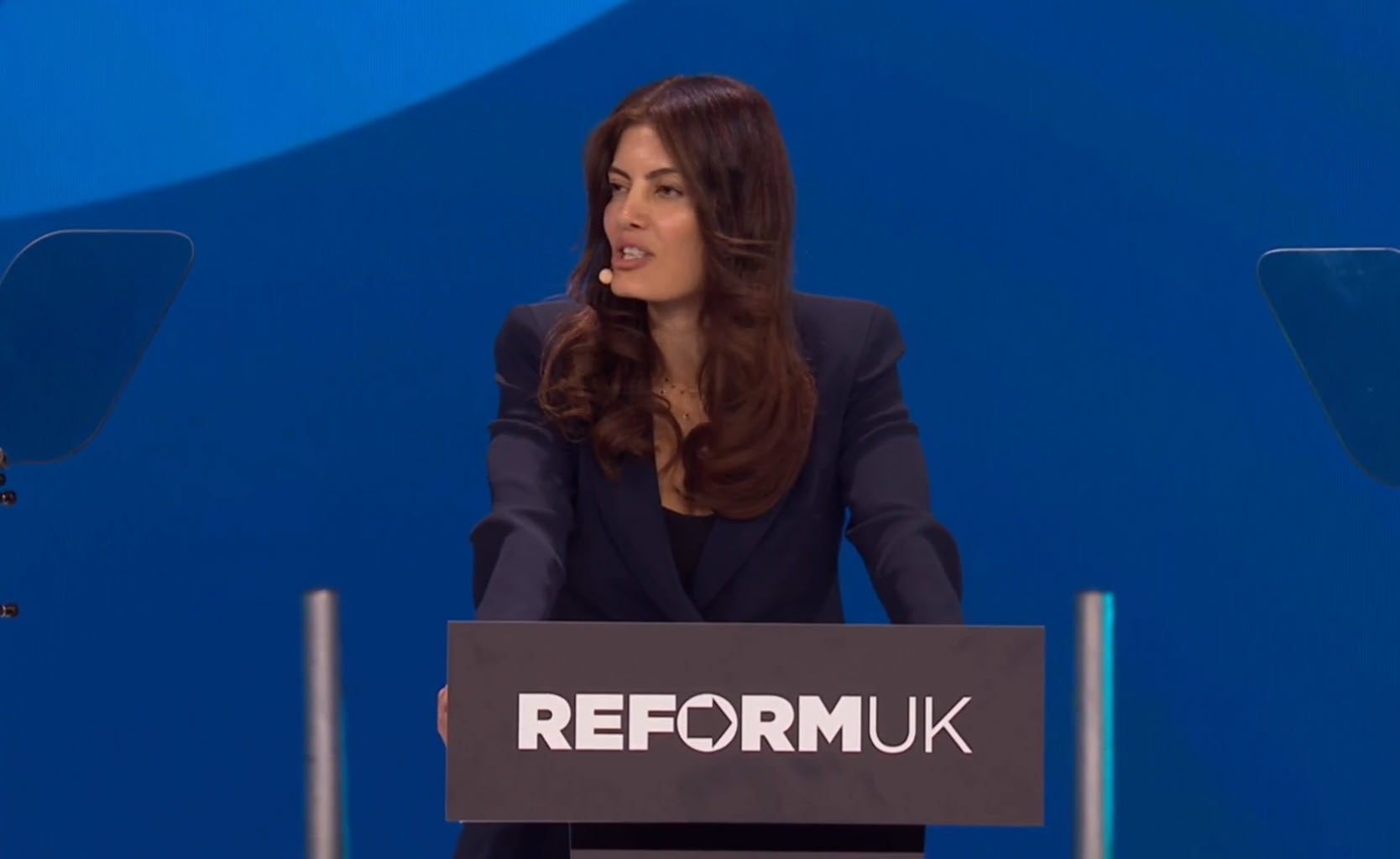
London mayoral candidate Laila Cunningham delivered one of Saturday’s most energetic speeches. Her message was highly transferable beyond London: the people who preside over decline should not be allowed to define managed decline as the only realistic option.
“I’m not standing for mayor merely to tell you what has gone wrong in London. I don’t want to be another commentator commenting on decline. I want to be the person who ends it.”— Laila Cunningham
That formulation captured the mood of Birmingham better than many technical policy announcements. Reform’s appeal depends heavily on voters who already know what is wrong. They are not looking for another diagnosis. They want evidence that a political movement can reverse the direction of travel.
Watch: Laila Cunningham’s Saturday keynote
Dan Thomas: Reform Says It Is Ready to Govern in Wales
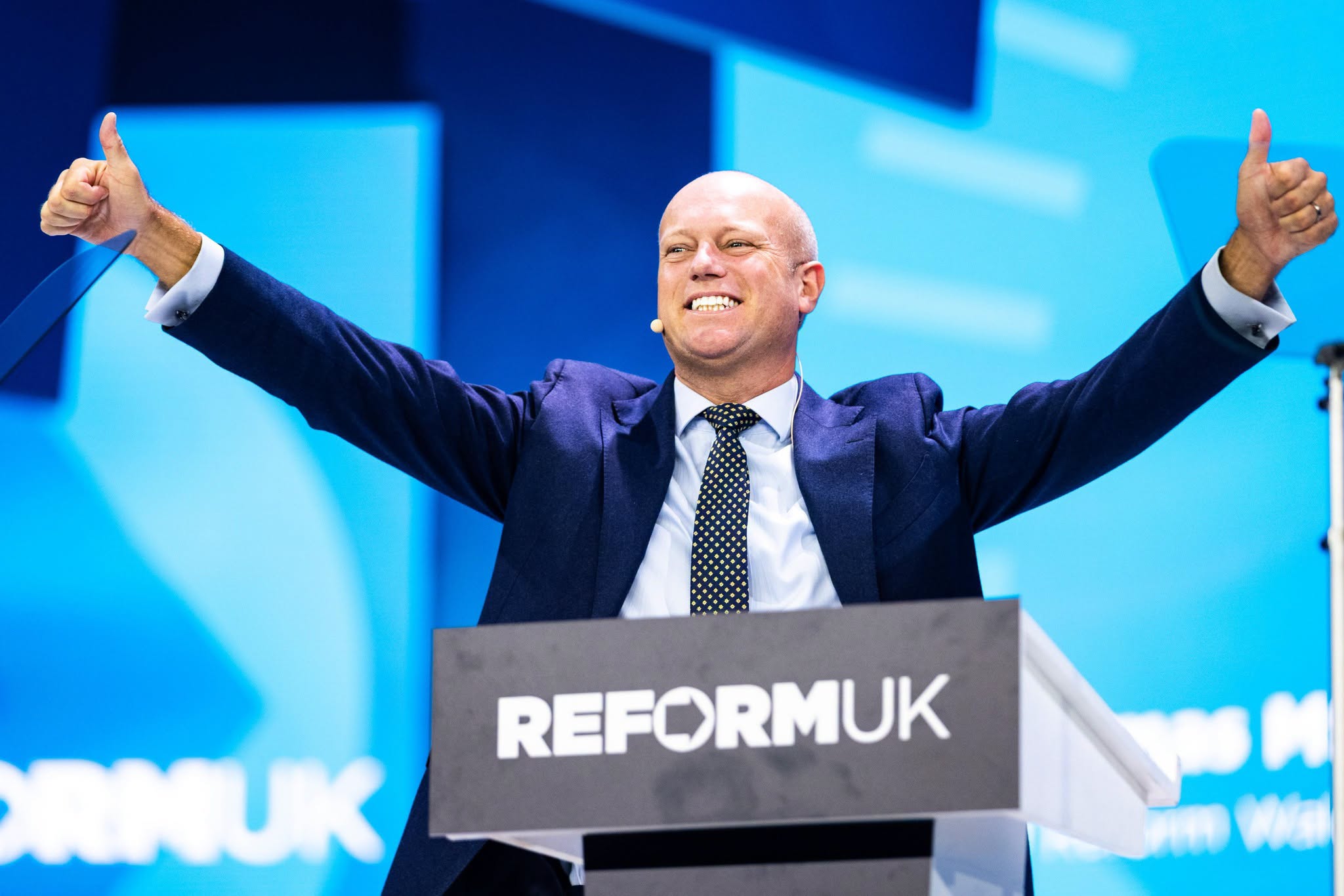
Dan Thomas MS, Leader of Reform UK Wales and Leader of the Opposition in the Senedd, used his Saturday address to report on Reform’s first months as the principal opposition in Cardiff Bay. He pointed to cross-party support secured for motions on bovine TB, legal protection for care leavers and a Welsh lobbyists’ register.
His message belonged specifically to the Welsh political context: Reform’s Senedd group intends to demonstrate that it can build support in opposition and is prepared to govern Wales if required. Those Senedd responsibilities are distinct from the Westminster programme discussed by the UK spokespeople and from Reform Scotland’s work at Holyrood.
Watch: Dan Thomas’s Saturday keynote
Robert Jenrick: Put More of Your Own Money Back in Your Pocket
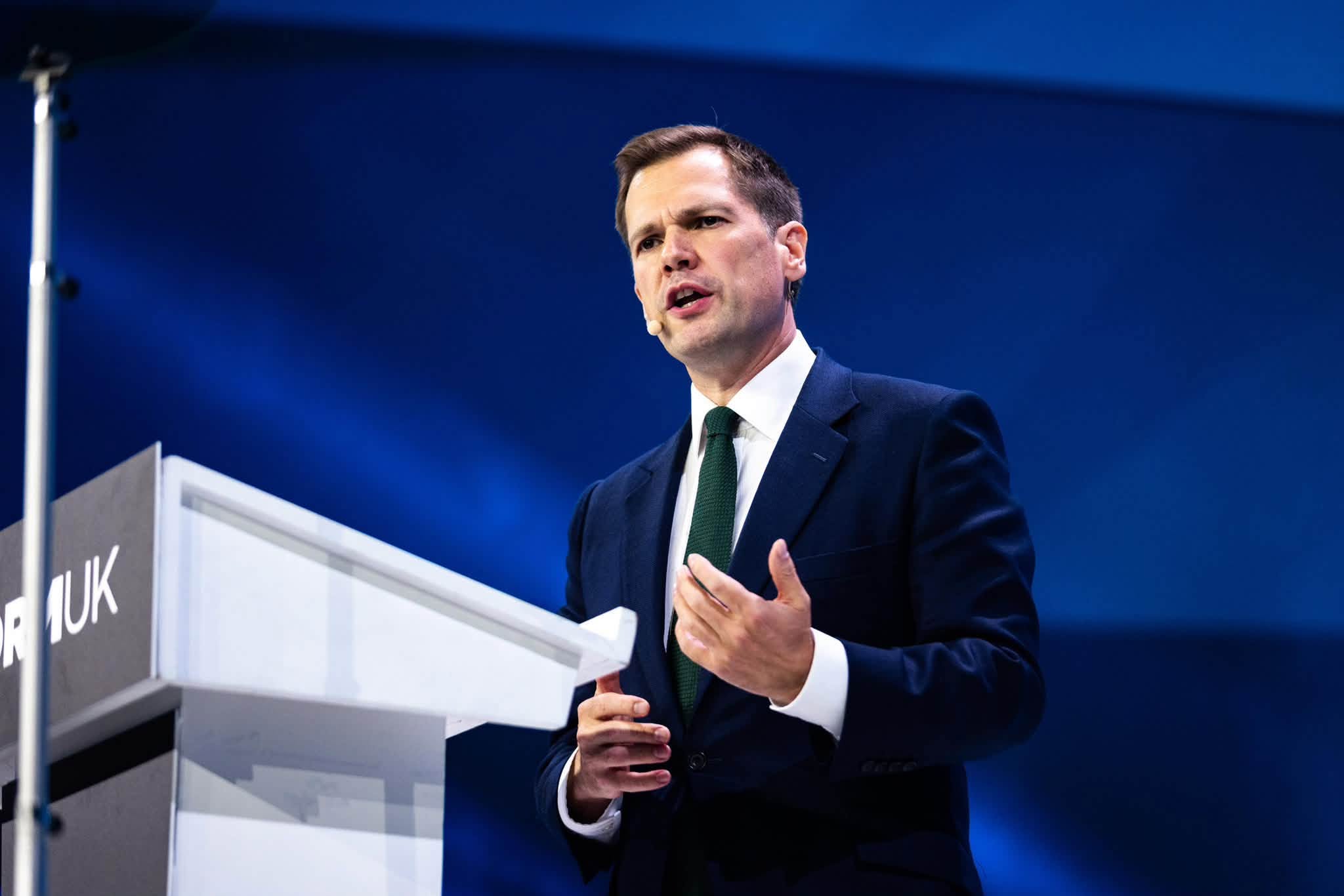
Saturday’s flagship economic announcement came from Jenrick. Reform would raise the UK personal income-tax allowance from £12,570 to £15,000 in its first Budget and within its first 100 days.
That means another £2,430 of earnings would fall outside income tax. For someone paying the 20% basic rate, the direct arithmetic is roughly £486 a year — close to £500 left in the taxpayer’s pocket rather than transferred to the Treasury.
Reform says the change would benefit around 40 million taxpayers and remove roughly 2.9 million people from income tax altogether. It also matters for pensioners because freezing the personal allowance while the state pension rises creates the prospect of more pension income being pulled into tax.
“In the first 100 days of a Reform government, in our first Reform budget, we will raise the tax-free personal allowance … to £15,000.”— Robert Jenrick
There is a broader political principle behind the proposal. Fiscal drag allows government to collect more tax without formally increasing headline rates. As wages rise, frozen thresholds pull more people into tax or higher bands. A worker may receive a nominal pay rise yet find that the state takes a larger share of the increase.
Reform is explicitly trying to reverse that direction. The longer-term ambition remains a £20,000 personal allowance when the finances permit it, but the £15,000 figure transforms that aspiration into an immediate first step.
“If I don’t deliver this exactly when I have said that I will, I will resign.”— Robert Jenrick
Watch: Robert Jenrick’s Saturday keynote
That sentence may prove as politically important as the number. Reform is deliberately trying to turn manifesto commitments into personal contracts between ministers and voters.
Malcolm Offord: Scotland Cannot Tax Its Way to Prosperity
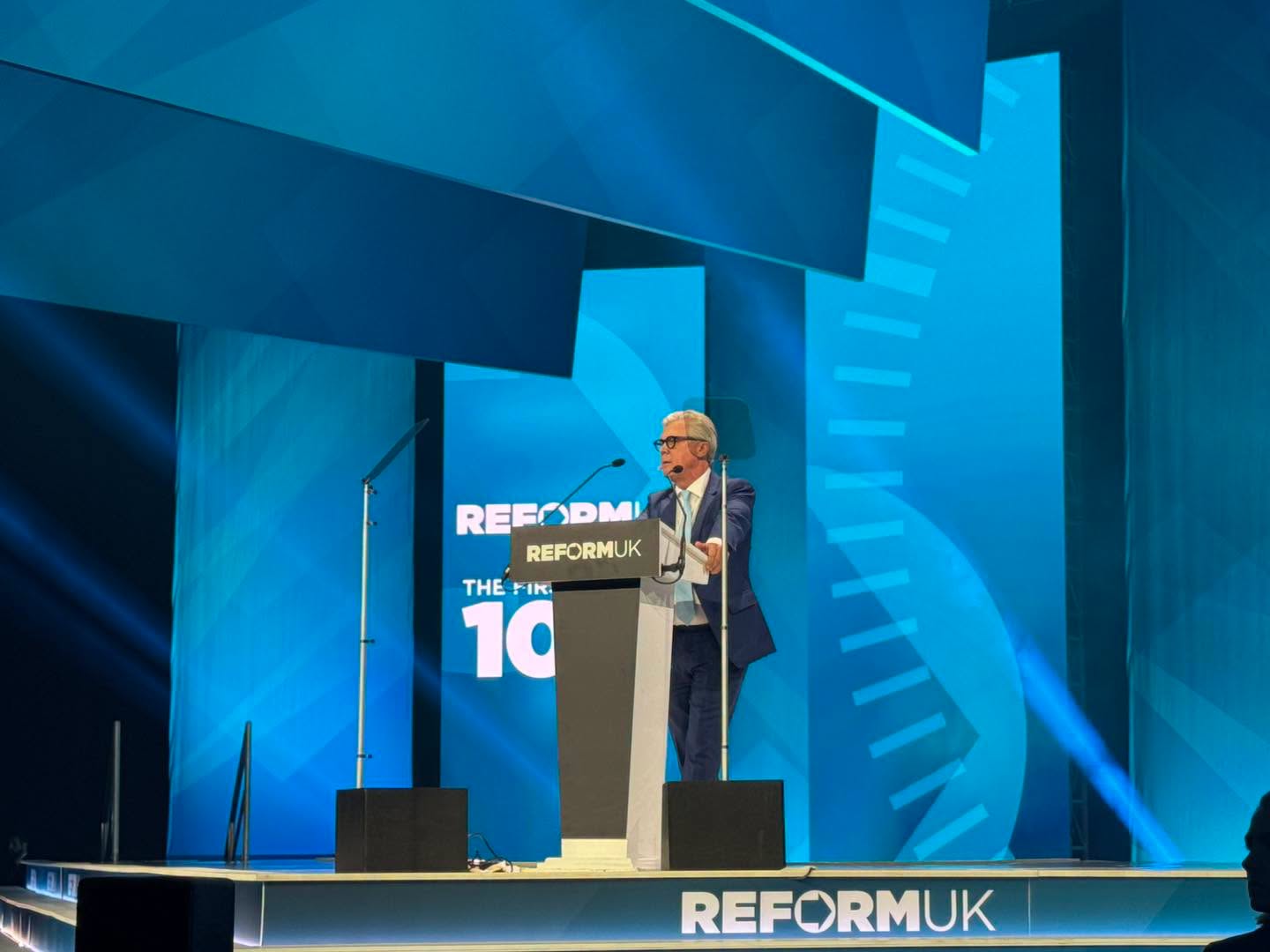
For Scottish readers, Malcolm Offord’s contribution brought the national conference directly back home.
Scotland operates a substantially different income-tax system from the rest of the UK. Rather than the three main rates applying elsewhere, Scottish taxpayers face six bands. Reform Scotland argues that this has moved far beyond a narrow tax on very high earners and increasingly affects experienced nurses, teachers, police officers, engineers, managers and skilled tradespeople.
“We are now in the most heavily taxed part of the UK. We have six bands — income tax bands — in Scotland, versus three in the UK.”— Malcolm Offord
“We’re dragging a lot of people who would normally be in medium wages, like nurses etc, into higher tax bands, which is nuts.”— Malcolm Offord
That criticism should not be dismissed as merely ideological. Scotland competes inside a single UK labour market. A skilled worker considering jobs in Newcastle and Edinburgh can compare take-home pay. A company deciding where to place high-paid jobs can do the same. Over time, tax differentials affect behaviour, recruitment and investment decisions.
Reform Scotland has already gone further in its own published economic argument: scrap the current six-band structure, match the rest of the UK’s three bands and then seek to make Scottish rates lower. The intention is to turn Scotland from the highest-tax part of Britain into one that competes aggressively for workers and investment.
The Scottish tax argument in plain English
Economic success should not be treated as a convenient target for another tax rise. Scotland needs more high earners, more entrepreneurs, more businesses and more investment — not policies that encourage them to locate elsewhere.
Watch: Malcolm Offord’s Saturday keynote
Reform UK Scotland leader Malcolm Offord addresses the national conference.
This is where Jenrick and Offord fit together particularly well. Westminster can raise the UK-wide personal allowance. Holyrood can reform Scotland’s devolved rates and bands. Together, those changes would represent a substantial shift towards rewarding work rather than taxing it ever more heavily.
What Jenrick and Offord’s Tax Plans Mean for Scotland
For working Scots, the two parts of the plan would work together. A higher UK personal allowance means less income is exposed to tax before Scotland’s rates are applied. Holyrood can then simplify those rates and bring them down. The aim is straightforward: a promotion, an extra shift or a pay rise should leave a worker noticeably better off.
The same principle matters to Scotland’s small and medium-sized businesses. Westminster controls employment taxes, while Holyrood controls business rates and other devolved burdens. Reducing those costs together would give an owner more room to invest and make the next hire less daunting. For a small firm operating on tight margins, that breathing space can be the difference between standing still and taking on another member of staff.
Growth cannot be ordered into existence, and tax cuts do not guarantee it. They can, however, leave families with more spending power and businesses with more money for wages, equipment and expansion. That is the intended cycle: reward work, let enterprise breathe, create more jobs and build a stronger Scottish tax base through prosperity rather than ever-higher rates.
Suella Braverman: Why Import Skills We Could Be Training at Home?

Shadow Education Secretary Suella Braverman used Saturday to connect two policy areas usually discussed separately: education and immigration.
Britain repeatedly says it has shortages of doctors, nurses and other skilled professionals. Governments then use those shortages to justify large-scale international recruitment. Reform’s challenge is more fundamental: why is Britain not training enough of its own people for strategically important jobs?
Medicine provides the clearest example. Highly capable British applicants compete for a limited number of medical-school places while the NHS remains dependent on overseas doctors. Braverman promised to remove that constraint.
“Within the first 100 days of becoming Secretary of State for Education I will scrap the cap on homegrown British doctors.”— Suella Braverman
Like Jenrick and Tice, Braverman attached her own position to delivery, saying she would resign if she failed to implement the commitment.
She also announced a major change for nurses:
“I will scrap all interest payments on student loans for British nurses, so that those young Brits who want to work in our NHS will be able to do it.”— Suella Braverman
The logic is straightforward. If the country genuinely needs nurses, public policy should make nursing an attractive career for British students rather than burdening them with decades of compounding loan interest while simultaneously recruiting abroad.
Braverman’s university package was broader still. Reform would cut taxpayer backing for student loans and tuition fees by 20%, reduce the number of loans and introduce a stronger value-for-money test for universities and courses.
- Expand places for British medical students.
- Remove interest from student loans for British nurses.
- Reduce taxpayer-backed student loans by 20%.
- Apply a tougher value-for-money test to universities and degrees.
- Reduce support for courses offering weak employment or economic outcomes.
- Take a tougher line on institutions that fail to protect free speech.
This does not mean arguing that university is unnecessary. It means rejecting the assumption that pushing ever more young people towards three-year degrees is automatically successful policy. Britain needs doctors and engineers, but it also needs electricians, technicians, welders, mechanics, construction workers and advanced manufacturing skills.
For Scotland, with its engineering heritage, energy sector and world-class universities, a more balanced skills system could be especially important. The objective should be to match education to genuine economic opportunity rather than treat one route as socially superior to another.
Patriotism Back in the Classroom
Braverman also argued for a more confident expression of national identity in schools, including the national anthem and traditional hymns.
Reform’s wider education argument is that children should leave school with knowledge, discipline, skills and some understanding of the country they inherit. Teaching British history should of course include its failures and controversies, but Reform rejects the notion that national history should be presented primarily as an exercise in collective guilt.
That debate will inevitably look somewhat different in Scotland, where Scottish and British identities overlap in distinctive ways. But the underlying principle remains relevant: schools should educate rather than politically condition children, and they should be capable of teaching national history with balance and confidence.
Watch: Suella Braverman’s Saturday keynote
Reform UK’s Shadow Education and Skills Secretary addresses the national conference.
Farage Closes the Conference with a Fiery, Inspiring Speech

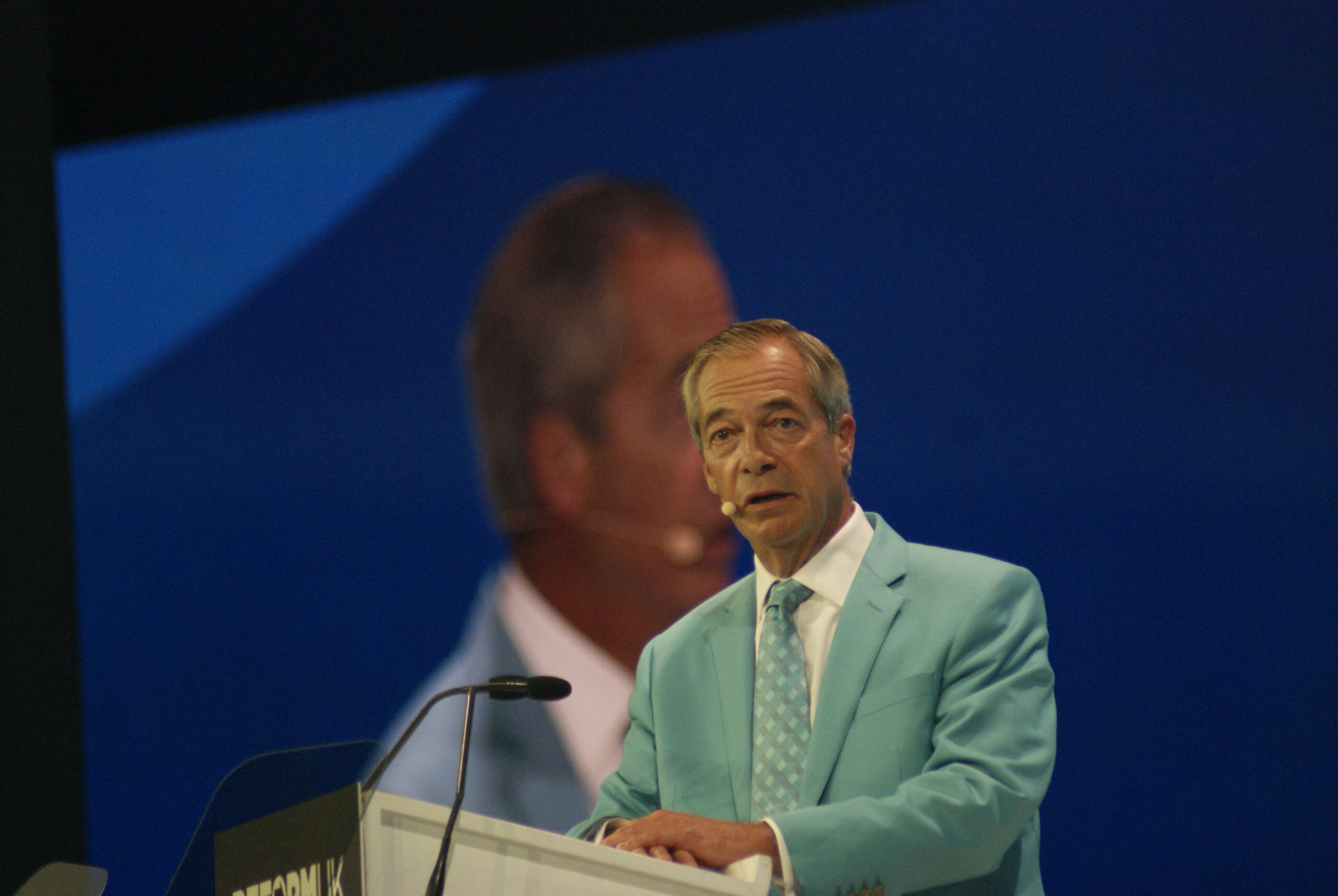
By late Saturday the NEC had the feel of a hall that knew it was approaching the final act. Delegates filled the aisles, the lighting lifted and the applause reached Farage before he had said a word. He returned not simply to review the announcements of the previous three days, but to rally a movement after a bruising weekend. There would be good days and difficult days, he said. Reform would sometimes make mistakes and take a kicking. What mattered was whether it had the strength to get back up.
“What this conference has shown is that whatever you throw at the leadership, whatever they throw at you, the people’s army, we immediately pick ourselves up, dust ourselves down and start all over again.”— Nigel Farage
That was the heart of the closing speech. Farage portrayed the criticism, protests and controversies surrounding the party as part of the pressure Reform should expect from an establishment that does not want it to succeed. His answer was not to pretend that the pressure was harmless or that the party would never get things wrong. It was to insist that neither hostile attacks nor its own mistakes would be allowed to stop the campaign.
“We will not let any obstacle get in our way to achieve the goals that we have promised to the British public.”— Nigel Farage
That promise tied the finale back to the governing argument heard throughout the conference. Ministers would be expected to deliver, institutions would be challenged when they frustrated a democratic mandate, and the leadership would be judged by results. But the closing minutes were less about machinery than resolve. Farage’s voice rose, the audience rose with him and the speech shifted from political instruction into a direct expression of loyalty between leader and movement.
“From the bottom of my heart, once again I thank you, my people’s army. I’m proud to lead you. I love you all. Thank you.”— Nigel Farage
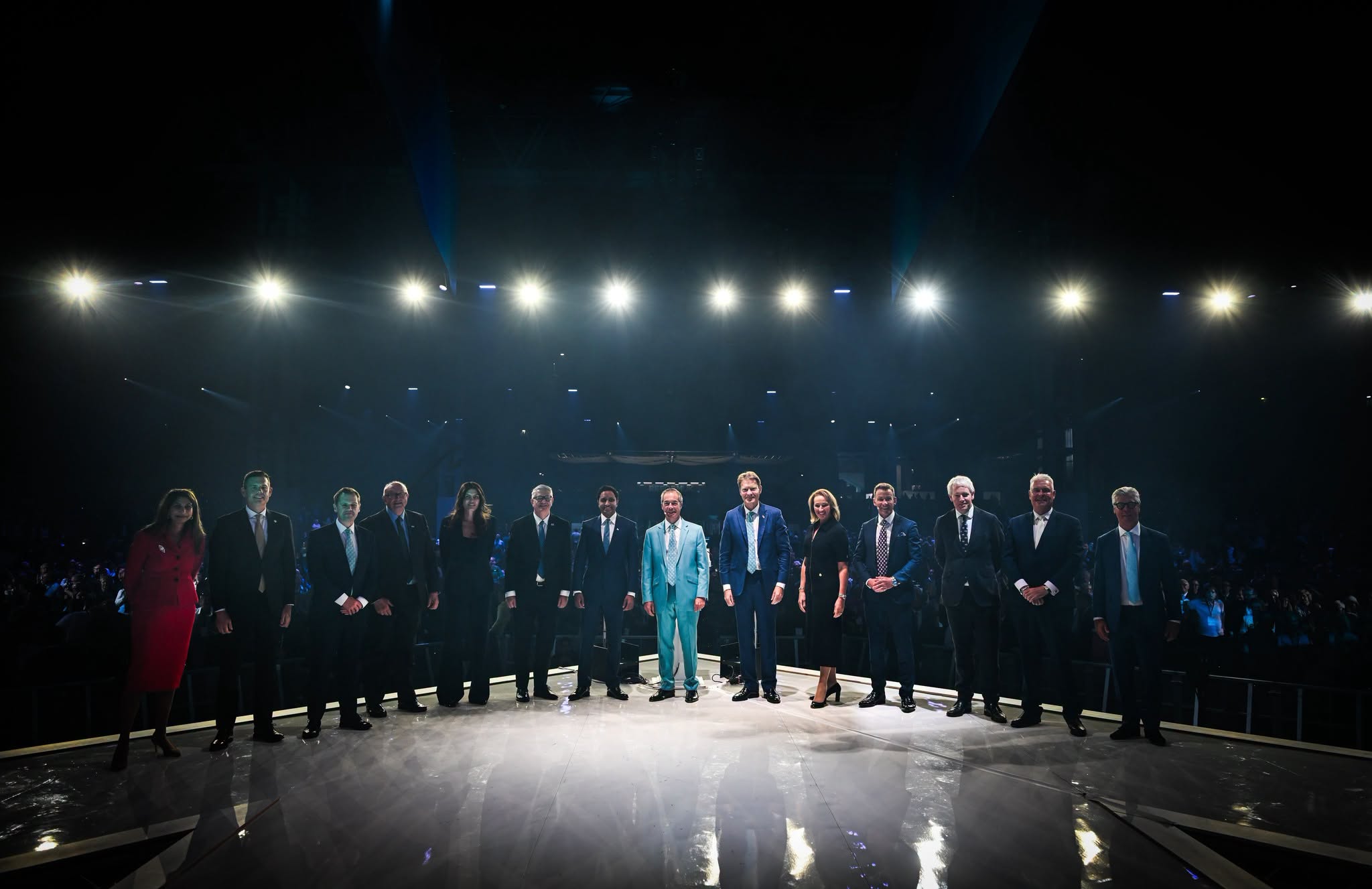
It was a warmer and more personal ending than the hard policy language that had dominated much of Birmingham. With the senior team gathering on stage and the hall still standing, the conference closed on defiance, affection and confidence. Whatever the political establishment threw next, Farage’s message was that Reform intended to pick itself up, press forward and keep its promises to the public.
Watch: Nigel Farage’s closing speech
Watch: Saturday’s full conference stream
Conference Day 2 live from Birmingham.
What the Three Days Add Up To
Looked at individually, Birmingham contained a long list of policies. Looked at together, they form a more coherent governing philosophy than the individual headlines suggest.
Cut welfare dependency, bureaucracy, quangos and low-value government expenditure.
Raise the personal allowance and reward employment, enterprise and progression.
Move from managing illegal migration to physically preventing illegal entry.
Strip policy costs from bills and treat domestic energy as an economic advantage.
Expand domestic medical training and rebalance education towards useful skills.
Prepare legislation early and hold ministers personally responsible for outcomes.
A Smaller State — But a State That Can Actually Act
There is a useful distinction at the heart of Reform’s programme. A smaller state does not necessarily mean a weaker state.
A government can spend less on bureaucracy while being stronger at the border. It can employ fewer administrators while putting more police officers on the street. It can close quangos while making elected ministers more accountable. It can reduce taxes while expecting people capable of work to take responsibility for themselves.
That is a very different conception of government from simply measuring success through the size of departmental budgets.
It also explains Reform’s hostility towards the accountability black hole created by arm’s-length government. Quangos can have legitimate technical functions, but they also make it easier for ministers to say a decision was “independent” and therefore beyond their control. Reform’s preference is for clearer lines of democratic responsibility: if a minister has the power, voters should know it; if the minister fails, voters should know who to blame.

For Scotland, this governing philosophy has obvious applications.
Scotland possesses enormous natural and human advantages: North Sea energy, major renewable generation, universities with global reputations, engineering expertise, financial services, agriculture, fisheries, tourism and a highly skilled workforce.
Yet those advantages coexist with weak productivity growth, high taxes, expensive energy and a devolved political culture that too often treats another programme, another commissioner or another public body as a substitute for measurable improvement.
Offord’s ambition went further than making Scotland merely competitive. He argued that Scotland has immense potential to become a powerhouse of growth, employment and innovation, drawing on its people, natural resources and established strengths in industries from energy and engineering to financial services, food and drink, life sciences and tourism. Reform Scotland’s task, as he set it out, is to stop punishing aspiration, restore the rewards for work and enterprise, and turn those advantages into better jobs, higher productivity and the revenues needed to rebuild public services.
Reward work.
Reduce the tax penalty on Scottish workers and stop treating career progression as an excuse for another higher rate.
Exploit our energy advantage.
Use North Sea resources, nuclear and reliable generation to support lower bills and reindustrialisation.
Train our own people.
Expand medical, technical and vocational routes so shortages do not automatically become arguments for more immigration.
Put government back in charge.
Reduce the quango state and restore responsibility to ministers who can be held accountable at elections.
Judge public services by outcomes.
More spending is not a success if waiting lists grow, roads deteriorate and taxpayers see no improvement.
From the 2024 Contract to a 2026 Programme for Government
There is clear continuity between the Birmingham conference and Reform’s earlier Our Contract with You. The Contract emphasised controlled immigration, lower taxation, government spending reform, cheaper energy, stronger policing, economic growth and national sovereignty.
What changed at Birmingham was the emphasis on sequence and delivery. The question was no longer simply what does Reform believe? It became: what is signed on Day One, what is in the first Budget, what legislation reaches Parliament immediately and which minister is responsible for delivering it?
That is the transition every insurgent political movement eventually has to make. Protest can identify what is broken. Government has to fix it.
A Party Preparing for Power
Thursday was about economic credibility and business confidence.
Friday was about sovereignty, energy, borders and the urgency of government.
Saturday was about putting numbers, deadlines and personal accountability against major promises.
Taken together, the three days represented Reform’s clearest attempt yet to answer the question critics have repeatedly asked: what would you actually do if you won?
The answers will be debated. The spending reductions will be challenged. The immigration programme will face fierce political and legal opposition. The tax cuts will be scrutinised for affordability. Energy policy will be contested. That is exactly what should happen to a party seeking government.
But there is value in moving the debate onto measurable territory. £250 off an energy bill can be measured. A £15,000 personal allowance can be measured. Small-boat crossings can be counted. Medical-school places can be counted. Public spending can be audited.
For years, too much British politics has been conducted through aspirations sufficiently vague that almost any outcome can later be described as success. Reform’s Birmingham conference deliberately raised the stakes by making many of its promises testable.
For Scottish supporters, that shift matters. Reform now has to prove that the same principles can be turned into a distinct programme for Holyrood and Scotland’s councils — one that rewards work, protects taxpayers, prioritises economic growth and makes public institutions answerable for results.
That is ultimately why “The First 100 Days” was more than a conference slogan. It was an attempt to answer the question Reform will increasingly face as it moves from insurgent party to contender for government:
the morning after?